Fjord Saunas Around Stavanger: The Sauna-and-Cold-Plunge Ritual
What is a fjord sauna in Stavanger, and does it include a cold plunge?
A fjord sauna is a wood-fired or electric sauna built on a floating platform or directly on the shoreline around Stavanger's fjords, used in short cycles of heat followed by cold water. The plunge into the fjord between rounds is not an optional add-on — it is the point of the ritual, and a typical session repeats the cycle several times.
A Different Kind of Fjord Experience
Most of what draws people to the Stavanger area is active: the long climb to Preikestolen, the chained sections of Kjerag, a RIB boat throwing spray across the Lysefjord. A fjord sauna session is the deliberate opposite of that. It is slow, it is short, and it does not require a full day or a head for heights. But it is not passive either — the format asks something of you, and understanding what before you book is the difference between a good session and an unpleasant surprise.
Floating and shoreline saunas have become a regular feature of the waterfront around Stavanger and along stretches of the wider fjord system, including quieter shoreline near Lysefjord and around Sandnes. The idea is simple in outline: sit in intense heat for ten to twenty minutes, then step directly into cold fjord water, then repeat. What makes it work — and what makes it worth doing deliberately rather than as an afterthought — is that the cold half of the cycle is not incidental. It is the entire mechanism.
This guide covers the general shape of the fjord sauna experience around Stavanger: how sessions are usually structured, why the cold plunge is built in rather than optional, what to bring, who should think twice, and how a sauna session pairs with the region’s more active water excursions. It stays general on purpose — venues, opening hours and exact locations change, and a walk along Vågen harbour or a search for current operators will turn up what is running this month.
The Ritual: Heat, Then the Fjord, Repeat
A typical fjord sauna booking runs somewhere between sixty and ninety minutes, structured as a private slot for a small group or a shared session for individual bookings. Inside that window, the pattern repeats three or four times: a stretch in the heat, a walk (or a run) to the water’s edge or the platform ladder, full immersion in the fjord, then back to the heat to recover. Some venues add a rest period between cycles wrapped in a towel on a bench outside the sauna, watching the water rather than sitting in it.
The heat itself is usually a wood-fired or electric stove bringing the room to somewhere between 70°C and 90°C, sometimes with steam added by throwing water on hot stones. That part will feel familiar to anyone who has used a sauna anywhere in the world. What is specific to the fjord version is what happens next.
| Phase | Typical duration | What happens |
|---|---|---|
| Sauna round | 10-15 minutes | Full heat exposure, seated |
| Transition | 30-60 seconds | Walk to the ladder or platform edge |
| Fjord immersion | 10-30 seconds, sometimes longer for experienced bathers | Full or near-full submersion in cold water |
| Recovery | 5-10 minutes | Wrapped in a towel, often outdoors, before the next round |
| Full session | 60-90 minutes | 3-4 complete cycles |
Why the Cold Plunge Is Not Optional
It is worth being blunt about this, because it is the single most common misunderstanding first-timers bring to a fjord sauna: the cold plunge is not a garnish on the sauna, and it is not something you can politely skip while everyone else does it. The entire format — the timing, the repeated cycles, the way sessions are guided when a host is present — is built around the contrast between the two temperatures. Skipping the water does not make the experience gentler; it just means you have booked a fairly ordinary hot room and missed the reason people come back for this specific ritual.
The cold water is also where most of the sensation lives. The heat is intense but familiar. The plunge is the part that produces the gasp, the fast heartbeat, the sudden total-body awareness that most people describe afterward — and it is the part that, for many, becomes the reason to return. Presenting it as optional would be misleading about what you are actually booking.
That said, “not optional” does not mean reckless. Nobody is forcing anyone to stay under for a set count, and shorter immersions are entirely normal, especially on a first visit or in the coldest months. The point is that some amount of cold-water contact is the activity, not an add-on to it.
Where Fjord Saunas Turn Up Around Stavanger
Floating saunas cluster naturally around sheltered water with easy platform access — the inner harbour areas near central Stavanger, quieter bays around Sola, and stretches of shoreline further into the fjord system. Shoreline (non-floating) saunas tend to sit on jetties or purpose-built platforms at the water’s edge, which makes the walk from heat to water shorter but the water itself no less cold.
Because operators and exact locations shift from season to season, this guide deliberately does not point to one specific address or company. What is consistent is the broader geography: expect to find sauna operators concentrated around the city’s harbour areas and in a handful of spots further out toward the fjord, rather than scattered evenly across the whole region. If you are staying centrally, a session close to Vågen harbour is usually the least logistically complicated option.
What to Wear and Bring
Packing for a sauna session is simpler than packing for a hike, but a few things matter more than they might seem to:
- Swimsuit, worn under your clothes to save time changing.
- A large towel — one to sit on inside the sauna, and ideally a second, dry one for after the final plunge. Some venues supply towels; many do not, so confirm ahead.
- Flip-flops or water shoes. Platforms and jetties are often wet, sometimes with barnacles or rough wood underfoot.
- A warm layer for immediately afterward — a fleece or down jacket, even in summer. Stavanger’s climate runs cool and damp for much of the year, and standing around in a wet swimsuit after the last cold plunge gets cold fast.
- A dry bag or plastic bag for your phone and any electronics, since platforms and changing areas are rarely fully weatherproof.
- Water to drink. Alternating heat and cold is more dehydrating than either extreme alone.
Alcohol before or during a session is a genuinely bad idea. It impairs the body’s ability to judge cold-water risk accurately, and combined with intense heat it raises the chance of dizziness or fainting — precisely the wrong moment for either.
Pairing a Sauna Session With an Active Day on the Water
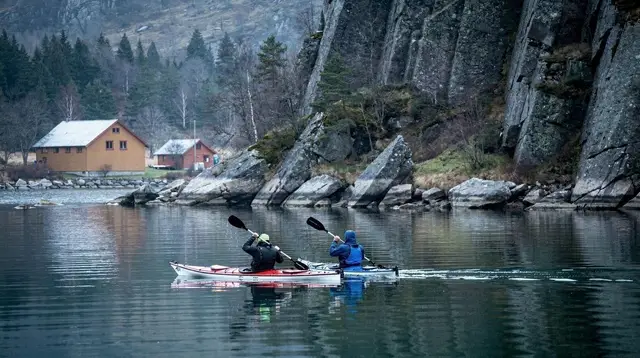
Because a sauna session is short and low-impact on the body in terms of exertion (even if it is demanding in other ways), it pairs naturally with an active morning or afternoon rather than replacing one. A common structure is to spend the first part of the day on the water — paddling, kayaking, or riding a RIB boat into the fjord — and treat the sauna as the way the day ends, using the heat-and-cold cycle to recover rather than starting cold.
Some operators fold both halves into a single booking. A guided stand-up paddle outing across two fjord stretches that finishes with a sauna session on the water is a straightforward way to get both without arranging two separate bookings.
For a more traditional paddling day with the sauna added afterward on your own, a guided kayaking trip into the Lysefjord covers the active half well, and pairs naturally with a sauna booked for later the same day. Anyone who prefers speed and spray to paddling might look instead at a RIB boat tour out from Sandnes into the Lysefjord, which covers a lot of the fjord’s scale in a short window and leaves the afternoon free.
If your day is already built around hiking rather than water — say, a morning on Dalsnuten or one of the region’s other short trails — a sauna session in the evening still works as a way to close the day, even without any water activity beforehand. The guide on easy hikes near Stavanger covers options that leave enough of the afternoon free for exactly that.
For readers weighing which water activity to build a sauna day around, the comparison in Lysefjord cruise versus RIB safari is a useful starting point, and the RIB safari guide on what to expect covers the practical side of the boat half in more detail than fits here.
Health, Safety and Who Should Think Twice
Cold-water immersion is a genuine cardiovascular stressor, not a wellness cliché. The initial shock of cold water triggers a rapid increase in heart rate and blood pressure — the “cold shock response” — and combining that with the vasodilation caused by prior heat exposure is exactly the combination that makes fjord saunas both effective and, for some people, risky.
People who should talk to a doctor before booking include anyone with a diagnosed heart condition, uncontrolled high blood pressure, a history of fainting, or who is pregnant. Children can usually take part with adult supervision and shorter immersions, but venues vary in their own age policies, so check ahead rather than assuming. Nobody should attempt a fjord sauna session after drinking, and nobody should push through dizziness, chest tightness or numbness that does not resolve quickly — those are reasons to stop, not signs to push harder.
None of this is meant to make the activity sound more dangerous than it is for a healthy adult treating it sensibly. Thousands of people use fjord and lake saunas across Norway every winter without incident. The point is that “sensibly” here means respecting the cold water as the real center of the activity, not a decorative detail you can wave off.
Season and Weather
Fjord saunas run through the whole year, and unlike much of what this region offers outdoors, winter does not close them down the way it closes the Lysebotn road and Kjerag access. If anything, winter is when the contrast between the sauna’s heat and the fjord’s cold is at its sharpest, since water temperatures drop to somewhere around 5-8°C in the coldest months. Stavanger’s own climate stays relatively mild for the latitude even in January, but the water is cold regardless of what the air is doing.
Summer sessions trade some of that intensity for daylight and easier logistics — long evenings mean sessions running well into what would be night further south, and warmer air makes the walk between sauna and water less of a shock in itself, even though the fjord water rarely warms past the mid-teens Celsius.
Readers planning a trip around this specific activity might find the month-by-month breakdown in best time to visit Stavanger useful for weighing a winter session against a summer one, and the note on why Stavanger has no midnight sun is worth a glance if you are picturing round-the-clock daylight in July — Stavanger sits south of the Arctic Circle, and summer nights here do get dark, just later than further south in Europe.
A fjord sauna session is also one of the more reliable rainy-day options in a region that gets a genuinely wet climate for much of the year — see the rain-proof Stavanger itinerary for how it fits alongside other indoor and covered options, and the honest take on why the rain here is climate, not bad luck for context on what to expect regardless of season.
Booking Practicalities and Cost
Norway is not in the eurozone, and prices for fjord sauna sessions are quoted in Norwegian kroner (NOK), not euros — worth flagging since it is an easy assumption to carry over from elsewhere in Europe. Norway is also a genuinely expensive country for organised activities generally, and sauna sessions are no exception; a private slot for a small group typically costs more per person than a shared public session, but guarantees you are not sharing the heat with strangers.
Most venues operate on a slot-booking system rather than open drop-in hours, particularly for private group bookings, and popular time slots — evenings and weekends, especially in winter when demand for the sauna’s warmth rises — fill up in advance. Booking a few days ahead is a reasonable default; booking on the day works occasionally outside peak periods but should not be relied on for a specific date.
If you are building a longer stay around Stavanger and the Lysefjord and want to slot a sauna session into a broader plan, the two-day Stavanger and Lysefjord itinerary and the one-day Stavanger without a car guide both leave room for exactly this kind of low-key addition at the end of an otherwise active day.
Fjord Sauna FAQ: What to Know Before You Book
Do I have to get into the cold water, or can I just use the sauna?
The format is built around alternating heat and cold, so the plunge is part of what you are paying for, not a side option. Staying in the sauna without ever entering the water is possible in theory, but it misses the physiological point of the ritual and is not how sessions are structured or guided.
How cold is the fjord water around Stavanger?
Water temperature swings with the season, from around 5-8°C in winter to somewhere in the mid-teens Celsius at the height of summer. Even the warmer months rarely feel warm against skin heated by a sauna, which is exactly the contrast the ritual relies on.
What should I wear and bring to a fjord sauna session?
A swimsuit under normal clothes, a towel, flip-flops or water shoes for a wet platform, and something warm to put on immediately after the last plunge. Many venues rent or lend towels, but confirm this in advance rather than assuming.
Is a fjord sauna safe for beginners or people with heart conditions?
Cold-water immersion places a real strain on the cardiovascular system, and anyone with heart or circulation issues, high blood pressure, or who is pregnant should talk to a doctor before booking. First-timers without medical concerns are welcome, but should expect the cold shock to be genuinely uncomfortable, not a minor tingle.
Can I combine a fjord sauna with a Lysefjord activity like kayaking or a RIB tour?
Yes — pairing an active morning on the water with a sauna afterward is a common way to structure a day around Stavanger, since the sauna works well as a way to warm up after time spent in or near cold water. Guided paddling, kayaking and RIB options all leave enough of the day free to add a sauna session at the end.
What time of year can you use a fjord sauna near Stavanger?
Fjord saunas run year-round, and winter is arguably when the heat-and-cold contrast feels most dramatic. Availability and exact hours shift with the season and daylight, so check ahead rather than assuming a summer schedule applies in January.
Do fjord saunas take walk-ins or do they need to be booked ahead?
Booking ahead is the safer assumption, since floating and shoreline saunas around Stavanger tend to run in fixed time slots with limited capacity per session. Walk-ins do sometimes get accommodated outside peak hours, but planning is the more reliable route, especially in summer.
tours.sauna-wellness
Verified deep-linked GetYourGuide tours. Book through these links and we earn a small commission at no cost to you.
GetYourGuide does not provide a product photo for this activity — the image shows the meeting point, photographed by us.