One Day in Stavanger Without a Car
Can you see Stavanger in a day without renting a car?
Yes. Stavanger's centre is small enough to cover on foot in a single day, and Kolumbus buses reach anything just outside walking range. A car adds nothing inside the city itself and mostly means paying for parking you will not use.
A city built at walking scale
Stavanger has a reputation problem it doesn’t deserve. Because the region around it is famous for a cliff-edge plateau and a boulder wedged 984 metres above a fjord, visitors sometimes assume the city itself demands the same kind of effort — boots, planning, a rental car parked somewhere expensive. It doesn’t. The old harbour, the colourful street and the wooden old town that make up the heart of a Stavanger visit sit within a few hundred metres of each other, on flat or gently sloping ground, all of it reachable on foot from a hotel near the centre. Add a Kolumbus bus if you want to stretch the day slightly further, and you’ve covered what most people come to Stavanger for without ever needing keys, a parking app or a fuel receipt.
This guide lays out one specific day: a route through Gamle Stavanger, Øvre Holmegate and Vågen harbour, done entirely on foot with public transport as a backup rather than a requirement. It deliberately doesn’t try to re-explain each stop in depth — Gamle Stavanger and Øvre Holmegate each have their own dedicated walk-throughs linked below — and it doesn’t relitigate the broader question of whether you need a car for a longer Rogaland trip, which belongs in a separate practical guide on driving in Stavanger. This is narrower: how to spend one good day in the city itself, on foot.
Why the “walking is hard here” idea is wrong
Stavanger’s built-up core — the part most visitors actually want to see — is small. You could walk from one edge of the old town to the far side of Vågen harbour in about 20 minutes without hurrying. Compare that to a city like Bergen, where the harbour, the funicular and the surrounding hills add real vertical distance, and Stavanger looks almost compact by design. The city dates its founding to 1125, the year usually given for the consecration of Stavanger Cathedral, and its centre grew up tightly around the harbour long before cars were part of the picture — the street pattern still shows it.
The one genuine caveat is weather, not distance. Stavanger sees a lot of rain over the course of a year, and wind off the water can make an otherwise short walk feel longer than it is. Neither of those is a reason to add a car; they’re a reason to bring a proper waterproof layer and treat this as a normal Norwegian coastal city rather than a fair-weather stroll.
The route, stop by stop
Morning: Gamle Stavanger
Start in Gamle Stavanger while the lanes are quiet. It’s a genuine residential neighbourhood — around 170 white wooden houses, mostly from the 18th and 19th centuries, described as the largest concentration of preserved wooden houses in Northern Europe — and people live behind those doors, so early morning is when it feels least like a tourist stop and most like what it actually is. There’s no ticket and no gate; you simply walk the cobbled streets. A slow pass takes 45 minutes to an hour if you stop to look rather than just walk through, and the full self-guided version of this walk, with a suggested lane-by-lane order, is covered in a dedicated Gamle Stavanger walking guide.
From Gamle Stavanger, it’s a short walk down to the water at Vågen harbour, which naturally becomes the next stop.
Late morning: Vågen harbour
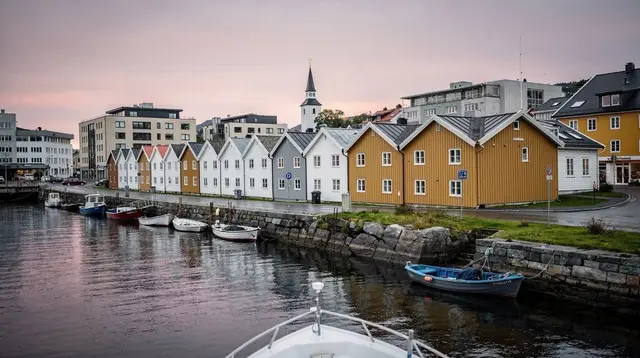
Vågen is the working harbour at the centre of the city — boats, cafés, and the Norwegian Petroleum Museum sitting right on the water’s edge in a building designed to echo offshore platform architecture. You don’t need to commit to the museum to enjoy the harbour itself; a walk along the quay, with the old town rising on one side and the newer city on the other, is worth 20-30 minutes on its own. If the industry that turned Stavanger into Norway’s oil capital after the 1969 Ekofisk discovery interests you, the museum easily fills an hour or two — there’s a full Norwegian Petroleum Museum guide if you want to plan that in.
This is also a sensible point in the day to eat, since Vågen has the highest concentration of cafés and restaurants on the route — see the guide to eating around Vågen harbour or the broader what to eat in Stavanger guide for specifics.
Midday: Valbergtårnet and Øvre Holmegate
From the harbour, a short uphill walk brings you to Valbergtårnet, an old watchtower that gives one of the better overview points onto the harbour and rooftops below — a few minutes, not a detour worth building an hour around. From there, it’s a five-minute walk down to Øvre Holmegate, the street painted in a run of saturated colours that has become one of the most photographed stretches in the city.
It works well at midday, when its cafés, boutiques and bars are properly open rather than shuttered. A slow walk with a coffee stop is 30-45 minutes; a full write-up of the street and its shops is in the Øvre Holmegate colourful street guide.
Afternoon: loop back through the centre
By mid-afternoon you’ll have covered the three anchor stops. What you do next depends on energy and weather. Reasonable options, all still on foot or a short bus ride:
- Loop back toward Sverd i Fjell at Hafrsfjord if you want the three bronze swords planted in 1983 to mark the Battle of Hafrsfjord — it’s further out, so check the Sverd i Fjell guide for the bus option before deciding it fits your afternoon.
- Wander the wider city centre for Stavanger’s street art, tied to the Nuart festival that’s run since 2001 — much of it is spread through ordinary streets rather than concentrated in one place, so the street art and Nuart guide is worth a look before you set off.
- Sit down for a proper meal back near Vågen and call the day there. Given everything already covered on foot, this is not a lazy choice — it’s usually the right one.
Evening: an easy add-on that still needs no car
If it’s still light and you’d rather do something structured than keep wandering, an indoor city activity fits well without pulling a car back into the day. An escape-room-style puzzle game set in Stavanger runs entirely within the city centre and slots neatly into a late afternoon or early evening slot after a day of walking.
Getting around: when to use a bus instead of your feet
Everything above works on foot alone. The point of bringing Kolumbus buses into this guide at all is for the edges of the day — getting from your accommodation to the start of the route if it’s not central, or reaching something like Sola a little further out. Kolumbus runs the local bus network across greater Stavanger, and a single ride between points inside the city rarely takes more than 10-15 minutes.
There’s no need to plan bus timings in detail for the core loop in this guide; it becomes relevant only if you’re staying outside the immediate centre or want to extend the day past what’s covered here. The comparison between doing the city on foot versus by hop-on-hop-off bus is covered separately in the bus tour versus walking tour guide, and the specifics of the sightseeing bus itself are in the Stavanger hop-on-hop-off bus guide — useful mainly for anyone with limited mobility or very little time.
A suggested timeline
| Time | Stop | On foot from previous stop |
|---|---|---|
| 9:00 | Gamle Stavanger | — (starting point) |
| 10:00 | Walk down to Vågen harbour | ~10 minutes |
| 10:15-12:00 | Vågen harbour + optional museum | — |
| 12:00 | Lunch near the harbour | — |
| 13:00 | Valbergtårnet viewpoint | ~10 minutes |
| 13:15 | Øvre Holmegate | ~5 minutes |
| 14:00-16:00 | Free block: street art, Sverd i Fjell by bus, or a longer lunch | varies |
| 16:00 onward | Dinner, or an evening activity | — |
Treat the times as a shape, not a schedule. The whole point of doing Stavanger this way is that nothing here is far enough away to force a fixed itinerary — if Gamle Stavanger holds your attention for two hours instead of one, nothing downstream is at risk of falling apart.
If you want to extend the day beyond the city centre
None of this changes the “no car” premise, but it’s worth flagging two ways to add scale to the day without renting anything. A guided option with its own driver removes the car question entirely while still reaching places outside walking range: a small-group city and coast tour with a driver-guide covers ground you wouldn’t otherwise reach on foot in an afternoon, and a guided kayaking trip on the Lysefjord is a way to see the fjord itself from Stavanger without needing to arrange your own transport to a trailhead.
Both are additions to this day, not replacements for the walking route — the city centre itself never needed a car to begin with, and stacking either of these onto the same afternoon usually means picking one and starting earlier.
For travellers weighing a two-day version of this same city-first, no-car approach, the two-day Stavanger and Preikestolen itinerary and the dedicated Stavanger without a car itinerary both build outward from the same core loop described here.
Frequently asked: doing Stavanger on foot
Do I need Kolumbus buses at all, or can I walk everything?
You can walk the whole core loop — Gamle Stavanger, Øvre Holmegate and Vågen harbour sit within about 15-20 minutes of each other on foot. A bus only becomes useful if you add somewhere further out, like Sola or the airport, to the same day.
How many hours does the walking route in this guide take?
Budget a full day, roughly 6-8 hours including lunch, coffee stops and time to actually stand in Gamle Stavanger’s lanes rather than just pass through them. It compresses to about 4 hours if you keep moving.
Is Stavanger’s centre flat, or is this a hilly walk?
It’s gentle. There are a few short slopes near Valbergtårnet and around the old town, but nothing like the elevation you’d meet on a Lysefjord hike. Ordinary shoes are fine.
Is Gamle Stavanger a paid attraction?
No. It’s a residential neighbourhood of privately owned houses that people still live in, and walking its lanes costs nothing. There is no ticket, gate or opening hour.
What’s the best order: Gamle Stavanger first, or Øvre Holmegate first?
Gamle Stavanger first works better logistically, since it sits closest to the harbour and the cruise terminal area, and its lanes are quietest in the morning. Øvre Holmegate suits midday, when its cafés and shopfronts are open.
Can this day be done in the rain?
Yes, and it often will be — Stavanger sees rain on a large share of the year. The route stays mostly on paved streets, and Vågen harbour has enough cafés and indoor stops to shelter under if a shower passes through.
Should I add the Norwegian Petroleum Museum to this day?
If you have any interest in why Stavanger looks the way it does, yes — it sits right on Vågen harbour, so it fits into the loop without a detour, though it does add an hour or two indoors.
Whichever version of the day you end up with, the underlying point holds: Stavanger’s centre was never the part of this trip that needed a car. Save that question for the Lysefjord side of your itinerary, and let the city be exactly as walkable as it actually is.
Day trips on GetYourGuide
Verified deep-linked GetYourGuide tours. Book through these links and we earn a small commission at no cost to you.
GetYourGuide does not provide a product photo for this activity — the image shows the meeting point, photographed by us.