A Two-Day Stavanger and Lysefjord Itinerary
What does a two-day Stavanger and Lysefjord itinerary actually cover?
Day one stays inside Stavanger itself: Gamle Stavanger, Øvre Holmegate and the cathedral, at a walking pace. Day two is dedicated to the Lysefjord, with one activity only — a cruise, a RIB safari, or the Preikestolen hike, not several. Kjeragbolten needs a full day of its own and is left out of this plan entirely.
Why Two Days Beats One for Stavanger and the Lysefjord
A lot of visitors try to do Stavanger and the Lysefjord in a single, very long day: an early start in the old town, a rushed lunch, then a race out to Preikestolen or a fjord boat before catching a flight home. It can technically be done, but it turns two genuinely different experiences — a small, walkable Norwegian city and a dramatic fjord landscape — into one exhausting blur where you remember neither properly.
Splitting the two over two days changes the pace completely. Day one stays inside Stavanger, on foot, with time to actually look at the wooden houses of Gamle Stavanger instead of photographing them mid-stride. Day two is handed over entirely to the Lysefjord, whether that means a hike, a cruise or a RIB safari, without a flight or a check-out time pressing on the schedule. It also means you’re not trying to do a demanding hike on legs that are already tired from a full day of city walking the day before.
This plan assumes two nights in or near Stavanger and no rental car requirement, though a car makes day two more flexible if you want to drive to Forsand yourself rather than taking a boat from the harbour.
Day One: Stavanger at Walking Pace
Start in Gamle Stavanger, on the west side of Vågen harbour. It’s a genuine, lived-in neighbourhood of around 170 white wooden houses, mostly from the 18th and 19th centuries, and is usually described as the largest concentration of preserved wooden houses in Northern Europe. There’s no entry fee and no fixed route — the appeal is wandering the cobbled lanes at your own pace, and a self-guided walk covers it well without needing a booked tour.
From there, cross back toward the centre for Stavanger Cathedral, consecrated around 1125 and generally considered the only medieval cathedral in Norway still standing and in use without a major post-medieval rebuild. It’s a short visit, but a striking one given its age. Nearby, Valbergtårnet gives a rooftop view over the harbour and rooftops for anyone who wants an overview before diving back into the streets.
Save some of the late morning or early afternoon for Øvre Holmegate, the short strip of brightly painted houses that has become one of the most photographed streets in the city, now lined with cafés and small shops. It pairs naturally with lunch, and a full loop of the colourful street rarely takes more than 20-30 minutes on its own, so it slots easily around a meal.
If there’s time and interest left in the afternoon, the Norwegian Petroleum Museum on the harbourfront covers the industry that built modern Stavanger, from the 1969 discovery of the Ekofisk field onward — worth it for anyone curious about why this particular Norwegian city became the country’s oil capital. Travellers with a car and an extra hour can also detour to Sverd i Fjell at Hafrsfjord, three ten-metre bronze swords planted in 1983 to mark the Battle of Hafrsfjord, traditionally dated to 872 and credited with unifying Norway — though this one is easier to skip if the day is already full.
| Time | Activity |
|---|---|
| Morning | Gamle Stavanger, self-guided walk |
| Midday | Stavanger Cathedral and Valbergtårnet |
| Early afternoon | Lunch around Øvre Holmegate |
| Late afternoon | Norwegian Petroleum Museum, or Sverd i Fjell with a car |
| Evening | Dinner near Vågen harbour |
None of this requires a car — everything on day one sits within comfortable walking distance in central Stavanger, which is one reason it works well as a low-stress first day after arriving.
Day Two: Choose One Lysefjord Activity, Not Three
This is the day the whole itinerary is built around, and the single most important rule is to pick one Lysefjord activity, not several. The fjord itself runs about 42 km, with walls exceeding 1,000 m in places, and there are several genuinely different ways to experience it — they don’t stack well into a single day.
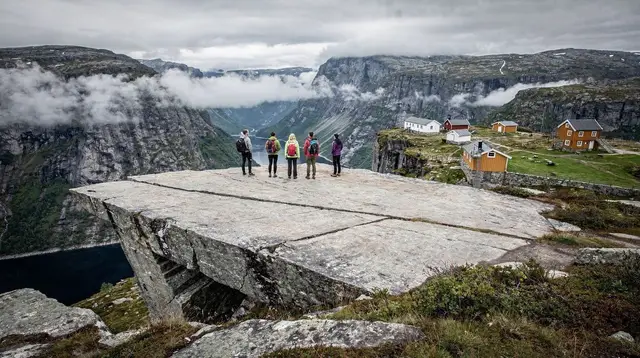
The Preikestolen hike is the classic choice for anyone reasonably fit: an 8 km round trip with roughly 350 m of elevation gain, taking 4-5 hours at a normal pace, ending on a 604 m plateau above the fjord with a drop on three sides and no railing. Parking at the trailhead is paid; the trail and plateau themselves are free. It draws around 300,000 visitors a year, so expect company on the path, especially in summer.
If hiking isn’t the plan, a Lysefjord cruise covers much of the same scenery from the water, including the view up at Preikestolen from below, without any walking beyond the boat itself. A RIB safari does something similar at higher speed, with more spray and more adrenaline, and is over faster. For a slower, self-powered option, guided kayaking on the Lysefjord puts you at water level for a few hours, which suits people who want to be active without committing to a full hike.
Some operators combine a cruise with the Preikestolen hike in a single package, which suits travellers who want both the water view and the summit view of the fjord on the same day — for example, the Stavanger Lysefjorden cruise and Preikestolen hike combo pairs a boat trip with time on the trail.
For a more straightforward boat crossing to the Preikestolen trailhead, the boat trip from Stavanger to Preikestolen via Forsand is a common way to reach the hike without driving. Travellers who’d rather stay on the water the whole time can look at the RIB safari past Pulpit Rock from Stavanger, and anyone wanting a quieter pace on the fjord might prefer guided kayaking on the Lysefjord instead.
| Activity | Typical duration | Physical effort | Best for |
|---|---|---|---|
| Preikestolen hike | 4-5 hours | Moderate to high | Hikers who want the plateau view |
| Fjord cruise | 2-3 hours | Low | Anyone, including limited mobility |
| RIB safari | 1.5-2 hours | Low, but bumpy | A faster, high-energy option |
| Guided kayaking | 3-4 hours | Moderate | Active travellers who prefer water |
Whichever you choose, plan the rest of day two around it rather than adding a second activity afterward. A midday Preikestolen descent followed by an evening cruise sounds efficient on paper, but it rarely works out once you factor in changing, transfers and simple fatigue.
What This Itinerary Deliberately Leaves Out
The most common mistake people make when planning around this two-day structure is trying to squeeze in Kjeragbolten as well, usually on the theory that “we’re already out at the fjord, so why not.” Don’t. Kjeragbolten is a 10-12 km round trip taking 6-8 hours, with three steep sections secured only by chains, reached via Øygardstølen at the end of the Lysebotn road — a road that closes entirely in winter. Fatal falls have happened there. It is not an add-on to a day that already includes a hike, a cruise or a city walk; it needs its own full day, ideally with nothing scheduled either side of it.
The same logic applies, a little less dramatically, to Ryfylke and the Jæren coast. Månafossen waterfall, the Ryfylketunnelen, and the long sandy beaches around Orre and Solastranden are all real and worth visiting, but they belong to a longer trip. Travellers with more time available might look at a five-day itinerary that folds in Kjerag and Jæren properly, rather than trying to bolt pieces of either onto this two-day core.
Where to Base Yourself and How to Get Around
Staying centrally in Stavanger makes both days easier, since day one is entirely on foot and most Lysefjord departures — boats, RIB safaris, and shuttle buses toward the Preikestolen trailhead — leave from or near the harbour. Sola airport sits about 14 km from the centre, with local Kolumbus buses connecting it to town, so a car isn’t necessary just to get in and out of the city.
A car becomes more useful on day two if you’d rather drive to the Forsand side yourself, or if you’re combining this trip with an extension elsewhere in Rogaland afterward. For a straightforward two-day version, though, most travellers manage comfortably without one.
If You Want to Extend This Trip
This plan is intentionally narrow: one day in the city, one day on the fjord. If it leaves you wanting more, the natural next step is a longer version that keeps the same city-then-fjord structure but adds a dedicated Kjeragbolten day, or spreads the Lysefjord across a full extra day of cruising and hiking rather than choosing between them. It’s a better next move than trying to retrofit those extras into the two days above.
FAQ: Planning a Two-Day Stavanger and Lysefjord Trip
Can I fit Kjeragbolten into this two-day itinerary too?
No — treat this as a hard no. Kjeragbolten is a 10-12 km round trip with three chained sections that takes 6-8 hours by itself, reached via a Lysebotn road that closes in winter. Stacking it onto a day that already includes Stavanger or a fjord cruise leaves no safety margin; give it its own dedicated day instead.
Should I do the Preikestolen hike or a Lysefjord cruise on day two?
Pick one based on fitness and weather rather than trying to combine both. The hike is a genuine 8 km round trip with about 350 m of elevation gain, while a cruise or RIB safari sees the same fjord from the water in a few hours, with no hiking required.
Do I need a car for this itinerary?
A car helps if you want to reach Forsand or Lysebotn independently, but it isn’t required. Buses and boat departures from Stavanger’s harbour cover both days without one.
How much walking is involved in day one around Stavanger?
Day one is a compact, mostly flat walk through Gamle Stavanger, Øvre Holmegate, Vågen harbour and the cathedral — a few easy kilometres, not a hiking day.
What’s the best time of year to do this two-day plan?
Roughly May to September, when the Preikestolen trail is clear of snow and fjord cruises and RIB safaris run their full schedules. Outside that window, confirm which activities are still operating before you book.
Is two days enough to see Stavanger and the Lysefjord properly?
It’s enough for one solid look at each — the old town on day one, one Lysefjord activity on day two — but not enough to also add Kjeragbolten, Ryfylke or the Jæren beaches. Those need extra days on top.
tours.multi-day-tours
Verified deep-linked GetYourGuide tours. Book through these links and we earn a small commission at no cost to you.
GetYourGuide does not provide a product photo for this activity — the image shows the meeting point, photographed by us.