Stavanger in Winter: What You Can Actually Do
What can you actually do in Stavanger in winter?
Kjerag is closed once the Lysebotn road takes snow, and Preikestolen turns into a real winter hike rather than a summer stroll, but Stavanger itself keeps going: museums, Gamle Stavanger, Øvre Holmegate, harbour-side restaurants and indoor activities all operate normally. The offer changes shape rather than disappearing.
Winter Doesn’t Close Stavanger, It Changes It
Ask what happens to Stavanger once the calendar turns to November, and the honest answer is not “everything shuts down.” It’s closer to “the outdoor postcard activities take a back seat, and the indoor and city-based ones step forward.” That distinction matters, because a lot of loose talk about Norwegian winters treats the whole country as if it goes dark and dormant from October to April. Stavanger, at 58.97°N on the country’s southwestern coast, doesn’t work that way. It gets real winter — cold rain, short days, a genuinely closed mountain road — but it also keeps a functioning city running underneath all of that, and that city is worth a trip on its own terms.
This page is a straightforward inventory: what stops working in winter, what keeps working, and what changes shape rather than disappearing. It deliberately leaves out the northern lights question, because that deserves its own page with the latitude nuance it needs — see why Stavanger rarely sees the northern lights if that’s what brought you here. This page is about daytime activities, not the night sky.
What Actually Shuts Down
Two of the region’s headline attractions are genuinely off the table, or close to it, for a chunk of the winter. It’s worth being upfront about both rather than burying the caveat in paragraph nine.
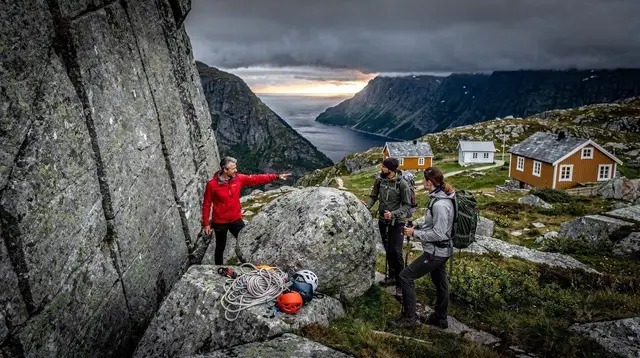
Kjeragbolten and the road to Lysebotn. The boulder wedged into the rock at Kjerag is reached via Øygardstølen, at the end of the road that winds down into Lysebotn. That road is a seasonal one: it closes once snow makes it unsafe, and when it’s closed, the trailhead is simply unreachable. No amount of hiking fitness gets you around a closed road. If Kjerag was the plan, check the Lysebotn road’s opening and closing dates before you build anything else around it — the closure isn’t a soft suggestion, it’s a gate across the only access route.
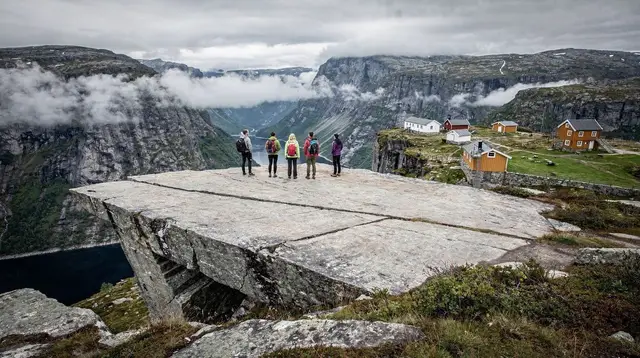
Preikestolen, sort of. The trail up to the 604 m plateau above the Lysefjord doesn’t officially close, but treating it as the same hike you’d do in July is a mistake. The standard route is roughly 8 km round trip with about 350 m of elevation gain — manageable terrain in summer conditions, considerably less so under snow and ice, on a trail that ends at an exposed edge with no railing. Winter ascents are real hikes for people with the right footwear, ice grips, and a realistic sense of daylight hours, not a spontaneous afternoon outing. For the specifics, see Preikestolen in winter and what’s actually closed between Preikestolen and Kjerag.
Kayaking on the open water of the Lysefjord and some of the more exposed hiking around Ryfylke fall into a similar bucket — not impossible, but weather-dependent enough that they stop being a reliable plan for a short trip.
| Attraction | Winter status |
|---|---|
| Kjeragbolten / Kjerag | Closed — Lysebotn road shut by snow |
| Preikestolen | Open but demanding — ice, no railing, shorter daylight |
| Lysefjord boat cruises | Reduced schedule, weather-dependent |
| Gamle Stavanger | Open, walkable year-round |
| Øvre Holmegate | Open year-round |
| Museums (petroleum, Viking House) | Open, indoor, unaffected by weather |
| Skogsprett zip-lines | Open on milder days, weather-dependent |
What Keeps Running: The City Itself
This is the part that gets underplayed. Stavanger is a functioning city of around 145,000 people, not a seasonal attraction that packs up when the tour buses thin out, and most of what makes the centre worth visiting has nothing to do with summer weather.
Gamle Stavanger is arguably better in winter than in the peak of summer. The roughly 170 white wooden houses on the cobbled streets west of Vågen harbour — the largest concentration of preserved wooden houses in Northern Europe — are lived-in, working residential streets, not a museum installation, and they’re just as photogenic wet and quiet as they are on a sunny July afternoon. A self-guided walk here costs nothing and takes an hour or two; see the self-guided walk through Gamle Stavanger for a route.
Øvre Holmegate, the colourful street a short walk from the harbour, doesn’t need good weather to work as a photo stop and a place to duck into a café. The guide to Øvre Holmegate covers what’s actually along it.
Stavanger Cathedral, consecrated around 1125 and the only medieval Norwegian cathedral still standing and in use without a major rebuild, is an indoor stop by definition — one of the few genuinely all-weather historic sites in the city centre.
Valbergtårnet, the old fire-watch tower above the harbour, and a walk down to Vågen itself round out a compact loop that covers most of central Stavanger’s outdoor sights in under half a day, none of which depend on summer conditions to be worth seeing.
Museums Do the Heavy Lifting
When the weather turns, museums stop being a fallback option and become the main event, and Stavanger has genuinely good ones for a city its size.
The Norwegian Petroleum Museum (Norsk Oljemuseum), opened in 1999 on the harbour in a building deliberately designed to evoke offshore platform architecture, covers the industry that transformed this city after the Ekofisk field was discovered in the North Sea in 1969. It’s a full, unhurried indoor visit regardless of what’s happening outside — see the full guide to the Norwegian Petroleum Museum.
Viking House, with its VR-based recreation of Viking-era life, is another entirely indoor option, and pairs naturally with a look at Sverd i Fjell — the three roughly 10 m bronze swords planted at Hafrsfjord in 1983 to mark the Battle of Hafrsfjord in 872 — even if you only view the swords themselves from outside for a few minutes. The Sverd i Fjell guide and the Viking House VR guide cover both.
For families or anyone who wants something more hands-on, Vitenfabrikken, the science centre, gives you an entire indoor afternoon that has nothing to do with the weather report.
Indoor Games and City Tours: Built for This Season
This is where winter stops being a compromise and starts being a genuine reason to visit. A handful of Stavanger’s activities are indoor by design, which means the season outside is irrelevant to whether they’re worth booking.
Escape-room-style puzzle experiences are a straightforward answer to a wet or freezing afternoon. Stavanger’s Cube puzzle game runs entirely indoors and works exactly the same in January as it does in July, which makes it one of the few activities on this page with zero weather dependency at all. In the same category, the Prison Island adventure game gives a couple of hours of indoor problem-solving that doubles as a way to warm up between outdoor stops. For a broader look at this niche, see the Stavanger escape games guide.
If you’d rather see the sights than solve puzzles, a private driving tour of Stavanger’s highlights covers ground on your schedule and largely from inside a heated vehicle — a genuinely practical option on a short, cold, or rainy day when walking everything isn’t appealing. Compare it against walking options in the bus tour versus walking tour comparison before deciding.
Not everything indoors-adjacent needs four walls, either. Skogsprett’s forest zip-line and climbing course keeps running through milder winter days, though it is genuinely weather-dependent — check conditions before booking on a day with heavy ice or snow, and treat it as a shoulder-season or mild-winter-day option rather than a guaranteed January activity. The Skogsprett adventure park guide has the specifics on when it operates.
Food and Harbour Life
One of the most underrated winter activities in Stavanger is simply eating well. The restaurants around Vågen harbour don’t close for the season, and a wet, dark evening is arguably the best possible setting for a long dinner rather than a rushed lunch between hikes. The guide to eating around Vågen harbour and the broader what to eat in Stavanger page both work exactly as well in December as in July — if anything, restaurants are easier to get into once the roughly 300,000 annual Preikestolen visitors have thinned out for the season.
If you want to extend the evening rather than end it early, a fjord sauna session in Stavanger is one of the few activities that specifically benefits from cold weather outside — the contrast is the point.
Street Art Doesn’t Need Sunshine
Stavanger has run Nuart, its street art festival, since 2001, and the murals it has left scattered around the city are permanent outdoor installations, viewable on any walk regardless of season. A wander through central streets looking for street art costs nothing and works as a low-effort, weather-tolerant way to fill an hour between other stops — see the Stavanger street art and Nuart guide for a route that covers the main pieces.
Day Trips: More Limited, Not Eliminated
Beyond the city itself, winter narrows the day-trip list without erasing it. The Ryfylketunnelen, opened in 2019 at roughly 14.3 km with its lowest point about 292 m below sea level, keeps Ryfylke connected to Stavanger without a ferry crossing year-round, which means some drives that would otherwise depend on ferry schedules stay straightforward in winter. Jæren’s long sandy beaches — Orre, Borestranden, Solastranden, Kvassheim and Obrestad — are, if anything, more dramatic under a grey winter sky and a rough North Sea than on a calm summer day, and a windswept beach walk needs nothing more than the right coat. See day trip: Jæren beaches for a route.
What genuinely narrows is anything depending on the Lysebotn road or on calm-water boat conditions. Månafossen, Rogaland’s tallest waterfall at around 92 m near Frafjord, remains reachable by trail in mild winter weather but is worth checking in advance if snow has settled on the approach.
Practical Notes for a Winter Trip
Stavanger’s climate is milder than its latitude suggests — January averages only around 1-2°C, well above what many visitors expect from Norway in winter — but the roughly 1,180-1,250 mm of rain that falls annually doesn’t take the season off, and wind off the North Sea adds a real chill factor that a thermometer reading doesn’t capture. Layered, waterproof clothing does more for comfort here than heavy down jackets alone.
Sola airport (SVG) sits about 14 km from the city centre and runs on its normal schedule through winter; Kolumbus buses connect the airport, the city and the wider region regardless of season, which means a car isn’t required for a city-focused winter trip. It becomes more useful only if Ryfylke or Jæren day trips are on the agenda and you want flexibility around road and weather conditions. See do you need a car in Stavanger for the fuller breakdown, and rain-proof Stavanger or Stavanger in winter for structured itineraries built around exactly this season.
Norway is not in the EU or the eurozone — prices run in Norwegian krone, and card payment is close to universal, so there’s little reason to carry cash even in winter’s quieter tourist season. Norway also remains a genuinely expensive country for food, drink and organised activities year-round, winter included; nothing about the season makes it a budget destination, though thinner crowds do sometimes mean easier restaurant bookings and shorter waits at museums.
The Honest Summary
Winter in Stavanger removes two specific things — Kjerag, closed by a snowed-in access road, and Preikestolen in its easy summer form — and leaves almost everything else standing. Gamle Stavanger, Øvre Holmegate, the cathedral, the harbour, two solid museums, indoor puzzle games, city driving tours, a genuinely good restaurant scene and a permanent outdoor street art collection all operate on their normal schedule. The mistake is expecting a winter visit to be a scaled-down version of a summer one; it’s a different visit, built around a different set of strengths, and for a lot of travellers — particularly anyone who’d rather skip Preikestolen’s roughly 300,000-visitor summer crowd — it’s a legitimately good trade.
Winter in Stavanger: Frequently Asked Questions
Is Stavanger worth visiting in winter?
Yes, though for a different reason than in summer. You trade fjord cruises and long hikes for museums, harbour restaurants and quiet streets in Gamle Stavanger without the crowds that fill Preikestolen’s trail from May to September.
Can you still hike to Preikestolen in winter?
The trail stays open, but it is a different undertaking: snow and ice cover the rock, the exposed final stretch has no railing, and the 350 m of elevation gain becomes far harder without crampons and proper winter footwear. It is not the same walk as the summer version, and it should not be attempted casually.
Why is Kjerag closed in winter?
Kjeragbolten is reached via Øygardstølen at the end of the road down to Lysebotn, and that road closes for the winter once snow makes it impassable. With the road shut, the trailhead itself becomes unreachable, which takes Kjerag off the table for a large part of the year regardless of hiking ability.
What is there to do in Stavanger when it’s raining or snowing?
The Norwegian Petroleum Museum and Viking House both work as full indoor afternoons, Gamle Stavanger’s cobbled streets are walkable in almost any weather, and the city has escape-room-style games and puzzle experiences built specifically as indoor activities.
Do you need a car for a winter trip to Stavanger?
Not for the city itself — Gamle Stavanger, Øvre Holmegate, the cathedral, Vågen harbour and the petroleum museum are all within walking distance of each other, and Kolumbus buses cover the wider area. A car matters more if you want to reach Ryfylke or Jæren, where winter daylight and road conditions are worth checking first.
Is Stavanger dark all day in winter?
No — Stavanger sits at 58.97°N, well south of the Arctic Circle, so it keeps several hours of daylight even in December, unlike Norway’s far north. Days are short and often grey, but the city is not in permanent darkness.
What should I pack for a winter trip to Stavanger?
Layered, waterproof clothing matters more than heavy insulation: January averages only around 1-2°C, but Stavanger’s roughly 1,180-1,250 mm of annual rain doesn’t stop falling just because it’s cold, and wind off the North Sea adds to the chill.
Are the fjord cruises still running in winter?
Some Lysefjord boat trips continue on a reduced winter schedule, weather permitting, but this is worth checking directly before you build a day around it, since sailings can be more limited and more weather-dependent than in the May-to-September season.
tours.winter-activities
Verified deep-linked GetYourGuide tours. Book through these links and we earn a small commission at no cost to you.
GetYourGuide does not provide a product photo for this activity — the image shows the meeting point, photographed by us.