Stavanger on a Budget: What's Actually Free to Do
Can you visit Stavanger for free?
Not entirely, but more than you'd expect. Walking Gamle Stavanger, hiking to Preikestolen (only the trailhead parking is paid), and exploring nature under Norway's right-to-roam law all cost nothing. Food, transport and organised tours are genuinely expensive, so budget for those separately.
Norway is expensive, but Stavanger has more free days than you’d think
Norway routinely tops the list of Europe’s most expensive countries to visit, and Stavanger is no exception. A simple restaurant meal, a taxi, or a guided boat trip will all cost more here than in most of continental Europe. That reputation is deserved, and this guide won’t pretend otherwise. But it would also be wrong to leave Stavanger off a budget itinerary altogether, because a surprising amount of what makes the city and the region worth visiting doesn’t cost anything at all: wandering historic streets, hiking to one of Norway’s most famous viewpoints, and exploring open countryside under a centuries-old legal right.
The honest version of a Stavanger budget trip mixes these free experiences with a small number of paid ones chosen deliberately, rather than avoided out of principle. Below is what actually costs nothing, what looks free but isn’t quite, and which paid experiences are worth the money anyway.
Gamle Stavanger costs nothing to walk through
Start with the easiest win. Gamle Stavanger, the old town on the west side of Vågen harbour, is a genuinely free attraction, not a marketing description of one. Its roughly 170 white wooden houses, mostly built in the 18th and 19th centuries, form the largest concentration of preserved wooden houses in Northern Europe. There is no ticket booth, no gate and no opening hours, because it isn’t a museum village: it’s a real, still-lived-in residential neighbourhood with cobbled lanes running between the houses.
You can walk the whole district in under an hour or spend half a day photographing doorways and gardens, and it costs exactly the same either way: nothing. For a structured route through the lanes rather than aimless wandering, the self-guided walk through Gamle Stavanger lays out a sensible order that avoids doubling back.
Øvre Holmegate and the harbour: more free wandering
A short walk from Gamle Stavanger, Øvre Holmegate is Stavanger’s colourful street, its wooden shopfronts painted in a run of saturated pinks, oranges and blues since a local hairdresser began the trend in the early 2000s. It’s one street, easily walked in ten minutes, but it photographs well and costs nothing to see beyond whatever you spend if a café or shop tempts you inside.
The harbour at Vågen itself is worth the same treatment: walk its length, watch the fishing boats and ferries come and go, and use it as a free orientation point for the rest of the old town. None of this requires a ticket, a booking, or even much planning — it’s simply a matter of showing up and walking.
Preikestolen: the hike and the plateau are free, only the parking isn’t
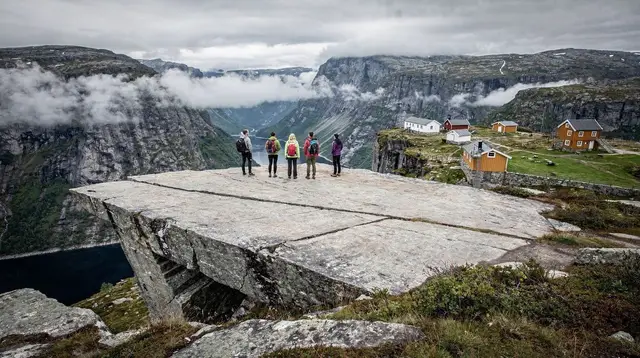
This is the detail that trips people up most often. Preikestolen, the 604-metre plateau above the Lysefjord and one of Norway’s most photographed natural attractions, is free to hike and free to stand on. The roughly 8 km round-trip trail, with about 350 m of elevation gain over 4-5 hours, has no entrance fee anywhere along its length. Around 300,000 people make the hike every year, and not one of them pays to walk the trail or stand on the plateau itself.
What costs money is the car park at the Preikestolen fjellstue trailhead. If you drive, you pay for parking. If you arrive by bus, on foot, or get dropped off, the entire experience — trailhead to plateau and back — costs nothing beyond whatever it took to get there. Worth being clear about, since the plateau has no safety railing at the cliff edge: free doesn’t mean risk-free, and the terrain is real, uneven hiking, not a paved path.
For the parking specifics and how to avoid it entirely, the guide on Preikestolen parking cost breaks down the numbers, and Stavanger without a car covers the bus and transit options that skip the car park altogether.
| Preikestolen cost breakdown | Free? |
|---|---|
| Hiking trail (both directions) | Free |
| Standing on the plateau | Free |
| Trailhead parking (car) | Paid |
| Arriving by bus or on foot | Free |
Allemannsretten: the right to roam that makes the mountains free
Underneath almost every free hike in this guide is a specific piece of Norwegian law: allemannsretten, the right to roam. It grants everyone the legal right to walk, hike, and even camp overnight on uncultivated land — forests, mountains, and open countryside — regardless of who technically owns it, as long as you keep a reasonable distance from private homes and leave the land as you found it. It doesn’t apply to cultivated farmland or private gardens, but it covers the vast majority of the terrain around Stavanger that visitors actually want to see.
This is why the hills, forests and coastline around the city are, functionally, one enormous free attraction. Dalsnuten, a popular short hike close to the city with panoramic views, costs nothing to climb. The wider network of easy hikes near Stavanger are all covered by the same right, meaning a week of hiking in Rogaland can be entirely free of entrance fees, even as accommodation and food add up elsewhere. The Lysefjord area itself, viewed from any of its many free viewpoints and pull-offs along the roads, costs nothing to look at — it’s only the boats, buses and guided hikes into it that carry a price tag.
It’s worth saying plainly: this right comes with responsibility. Pack out what you bring in, keep fires only where explicitly permitted, and respect any signage near farmland. The right to roam works because people don’t abuse it.
Sverd i Fjell and other free monuments
A few kilometres from the centre, Sverd i Fjell — three bronze swords, each about 10 metres tall, planted point-down into the rock at Hafrsfjord in 1983 — commemorates the Battle of Hafrsfjord, traditionally dated to 872 CE and credited with unifying Norway under Harald Fairhair. It’s a public monument in open parkland, free to visit at any hour, and one of the more striking free photo stops in the Stavanger area precisely because it isn’t inside a museum or behind a fence.
Jæren’s beaches cost nothing but a bus ticket
South of Stavanger, the long sandy coastline of Jæren is an anomaly in a country built on fjords and rock — kilometres of open beach rather than cliffs. Orre, Borestranden, Solastranden, Kvassheim and Obrestad are all public beaches with free access; there is no entry fee anywhere along this coast. A local Kolumbus bus ticket is the only cost involved in reaching them, making a Jæren beach day one of the cheapest full days out in the region, even if the water itself is bracingly cold most of the year.
The museums that are worth paying for
None of this is an argument that everything in Stavanger should be free, or that the paid attractions aren’t worth it. The Norwegian Petroleum Museum, opened in 1999 on the harbour in a building designed to evoke offshore platform architecture, charges an entrance fee — and it earns it. It’s the clearest way to understand how the 1969 discovery of the Ekofisk field turned a modest fishing and canning town into the wealthiest city in Norway, a transformation that shapes nearly everything else you’ll see here, from the harbour’s redevelopment to the price of a coffee. Treating every paid attraction as something to route around misses the handful that genuinely justify the ticket price.
The same logic applies to a few of the region’s paid activities. If your schedule or the weather rules out a full day of free hiking, a short paid experience can be a better use of a limited day than forcing a free option that doesn’t fit. A rainy afternoon in the city, for instance, suits an indoor activity better than another wet walk — Stavanger’s Cube puzzle game is a compact, weatherproof couple of hours that doesn’t depend on the forecast.
When the free version isn’t enough: paid ways to see more
Free hiking and walking cover an enormous amount of ground, but a few of the region’s best-known sights are genuinely easier, or only possible, with a paid option. If you want to see the Lysefjord from the water without arranging your own boat, a boat trip on the Lysefjord to Preikestolen from Forsand shows you the cliff from below rather than only from above, which the free hike alone can’t do.
And if you’d rather cover Stavanger’s compact highlights without walking between them yourself, particularly with limited mobility or limited time, a private driving tour of Stavanger’s city highlights trades a free walking route for a faster, guided one.
Neither of these replaces the free version — they add something the free version can’t. That’s the right way to think about any paid add-on to a budget trip: not as a failure to stay free, but as a deliberate choice where the paid experience genuinely offers something different.
A realistic budget day: mostly free, honestly priced
A sensible free-leaning day in Stavanger might run: morning coffee (paid, unavoidable) followed by a self-guided walk through Gamle Stavanger and Øvre Holmegate (free), a bus or walk out to the Preikestolen trailhead and the full hike to the plateau and back (free beyond transport and any parking), and an evening back in the centre along Vågen harbour (free).
Food and transport are the real costs in a day like this — the sights themselves add almost nothing to the bill. The budget-focused Stavanger itinerary lays out a similar structure across a longer stay, and it’s worth reading alongside a currency check on the Norwegian krone before you go, since Norway is not in the eurozone and prices here should never be assumed to track euro-area costs.
What this guide is not saying
To be direct about the trap this kind of guide can fall into: Stavanger cannot be visited entirely for free, and it would be misleading to imply otherwise. Accommodation, food, and local transport all cost real money, and Norway’s reputation for expense is earned rather than exaggerated. What is true is narrower and more useful: a meaningful share of the best things to do here — walking historic streets, hiking to a 604-metre plateau, exploring open countryside under the right to roam — genuinely cost nothing. Build a trip around those, budget honestly for the rest, and choose the handful of paid museums and tours that earn their price rather than treating every ticket as a compromise.
Free things to do in Stavanger: frequently asked questions
Is Stavanger an expensive city to visit?
Yes. Norway is consistently one of Europe’s most expensive countries for food, drink and organised activities. A restaurant meal or a guided tour will cost noticeably more than in most of continental Europe, so it helps to plan around the things that genuinely are free.
Is Preikestolen free to visit?
The trail and the plateau itself are free. The only cost is parking at the Preikestolen fjellstue trailhead, which is a paid car park. If you arrive by bus or on foot, the entire hike costs nothing beyond your own transport to the trailhead.
What is allemannsretten?
Allemannsretten, Norway’s right to roam, is a legal right to walk, hike and camp overnight on uncultivated land, including forests and mountains, regardless of who owns it. It is why so much of the Rogaland countryside around Stavanger is free to explore without a ticket or a guide.
Are the museums in Stavanger worth paying for?
Some are. The Norwegian Petroleum Museum in particular is well worth its entrance fee for understanding how oil reshaped Stavanger since 1969. Treat a handful of paid museums as a deliberate spend rather than something to avoid altogether.
Can you do a full Stavanger trip without spending money on activities?
No, and it is worth being honest about that. Free walking and hiking cover a lot of ground, but food, accommodation, local transport and at least some organised experiences will cost money. Budget for those rather than expecting an entirely free trip.
Is public transport in Stavanger expensive?
Local Kolumbus buses cost noticeably less than taxis or car rental and are the cheapest way to reach free attractions like Jæren’s beaches or the Preikestolen trailhead area if you don’t have your own car.
Trip-planning essentials on GetYourGuide
Verified deep-linked GetYourGuide tours. Book through these links and we earn a small commission at no cost to you.
GetYourGuide does not provide a product photo for this activity — the image shows the meeting point, photographed by us.