How Much Does Parking at Preikestolen Cost?
Is Preikestolen free, and how much does parking cost?
Access to the Preikestolen plateau and the hiking trail is completely free. The only fee anywhere in the experience is for parking a car at the Preikestolen fjellstue trailhead, charged per day. There is no ticket, gate, or entry fee to reach the viewpoint itself.
The One Sentence That Clears Up Most of the Confusion
Preikestolen is free. The trail is free, the plateau is free, and there is no gate, ticket booth, or entry fee anywhere on the route between the trailhead and the 604 m cliff edge above the Lysefjord. The only place money is collected is the car park at Preikestolen fjellstue, and only if you bring a car and leave it there.
That single distinction — free hike, paid parking — is small on paper but trips up a surprising number of visitors, some of whom arrive expecting a ticket window and others who skip the trip assuming the whole experience costs money. Neither is true, and understanding exactly where the fee applies makes it much easier to plan the day and decide whether paying for parking is actually your best option.
This guide is only about the parking fee itself: what it covers, how it compares to not driving at all, and how to decide whether it is worth paying. It does not re-explain the shuttle bus timetable or ticketing in detail — that lives in its own guide, linked below — so if the shuttle is your main question, go there directly.
Free Trail, Paid Parking: Where the Line Actually Falls
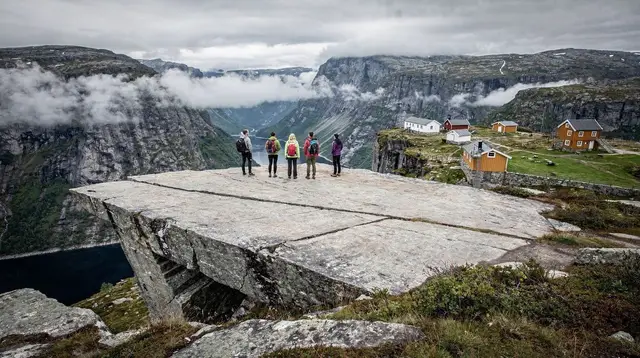
The Preikestolen hike is roughly 8 km round trip, takes most hikers 4-5 hours, and climbs about 350 m from the trailhead to the plateau. None of that costs anything. You can walk in from the trailhead, spend as long as you like on the rock, and walk back out without ever handing over a krone. The site is publicly accessible land, maintained in part by Stavanger’s outdoor recreation authorities and by the fjellstue itself, and there is no mechanism to charge hikers directly for using the trail.
The fee exists at one specific point: the car park at Preikestolen fjellstue, the building and lot that serve as the starting point for almost everyone doing the hike from the Stavanger side. If you drive your own car there and leave it in that lot while you hike, you pay a parking fee for the time your car occupies a space. If you do not drive — you take the shuttle, get dropped off, or arrive on a guided tour — you never encounter this fee at all, because it applies to parked vehicles, not to people.
It helps to think of it less as an entry fee with an unusual name, and more as ordinary paid parking, similar to what you would find at a trailhead, stadium, or airport anywhere else: you are paying for the space your car uses, not for permission to hike.
What the Parking Fee Actually Funds
With around 300,000 people hiking to Preikestolen in a typical year, the trailhead absorbs a lot of pressure: a large gravel and tarmac lot, toilet facilities, signage, and basic upkeep near where the trail begins. Parking revenue is what keeps that infrastructure running without charging hikers directly for the trail itself. It is a practical trade-off rather than a money-making scheme — someone has to pay for the lot that several hundred cars a day can fill in high season, and spreading that cost across parked vehicles rather than every visitor on foot keeps the hike itself open and free.
This is also why the fee is charged by time spent parked rather than as a flat entry cost: it reflects how long your car occupies a space that other hikers’ cars could otherwise use, especially relevant given how popular the route is in the Lysefjord area during summer.
Per Car, Not Per Person
One detail worth being clear on: the parking fee is charged per vehicle, not per hiker. A car with four people splitting one fee works out far cheaper per person than a car with a single driver. This is the main reason paid parking can be a genuinely good option for groups and families, even in an expensive country like Norway — the cost of the space is fixed regardless of how many people climb out of the car.
It also means the maths shift depending on who you are travelling with. A solo hiker paying the full parking fee alone is effectively paying more per person than a family of four splitting the same fee, which is worth weighing against the alternatives below before deciding how to get to the trailhead.
Paid Parking vs. the Alternatives
There is no single “cheapest” way to reach Preikestolen — it depends on group size, whether you already have a rental car, and how much you value flexibility over convenience. Here is roughly how the main options compare:
| Option | Who pays | Best for |
|---|---|---|
| Drive and park at the fjellstue | One parking fee per car | Groups and families splitting the cost, and anyone who wants to leave on their own schedule |
| Drop-off / pick-up (taxi, rental return, a friend driving) | No parking fee at all | Solo travellers or couples without a rental car who can arrange a lift |
| Shuttle bus from Stavanger or Sandnes | Per-person ticket | Visitors without a car, or anyone who would rather not deal with parking at all |
| Guided hike or tour | Included in the tour price | Hikers who want transport, a guide, and parking logistics all handled together |
If you already have a rental car and are travelling as a pair or a family, paying for parking is often the simplest and most cost-effective route to the trailhead. If you are travelling solo, or you do not want to worry about a return trip to collect a parked car, a drop-off, the shuttle, or a guided hike usually work out better — and remove the parking question entirely.
The Drop-Off Option: Free, But You Need a Plan for the Return
The simplest way to avoid the parking fee without touching the shuttle system is a straight drop-off: someone drives you to the fjellstue, you hike, and either the same driver returns to collect you or you arrange transport back from the trailhead afterwards. Because no car is left parked, there is no fee to pay.
The trade-off is logistical rather than financial. A round trip of 4-5 hours means your driver either waits nearby, comes back at a set time, or drops you and picks up again later in the day — none of which is difficult to arrange, but all of which need a plan, unlike parking your own car and simply walking back to it. For visitors who already have someone able to drive and return, this is the cleanest way to reach Preikestolen for free. For everyone else, the shuttle bus generally serves the same purpose more predictably, and that system — routes, timing, tickets — is covered in full in its own dedicated guide rather than here.
Is Paying for Parking Worth It?
For most car-based visitors, yes. A single parking fee split across a group is usually cheaper than several shuttle tickets, and driving yourself means you are not tied to a bus timetable — you can start early to beat the crowds, which matters given how busy the trail gets, or adjust your schedule around weather, since the plateau has no shelter and no barrier at the edge and is far more pleasant in clear conditions than in fog or rain.
The main downside is not cost but capacity: on peak summer days the lot can fill well before midday, and arriving late can mean circling for a space or parking further away than expected. Anyone planning to drive in July or August should aim to arrive early in the morning, both to find a space more easily and to get ahead of the crowds that build through the day.
Outside the busiest stretch of summer, the calculation tips further in favour of driving: fewer cars competing for the same spaces makes the parking fee feel like straightforward value rather than a gamble on finding a spot.
Skipping the Question Entirely: Guided Hikes
If working out parking, shuttle tickets, and return logistics sounds like more decision-making than you want on holiday, a guided hike removes the question altogether. Transport to the trailhead, the hike itself, and the return trip are bundled into one booking, with someone else handling the practicalities.
A local guided hike in the area around Preikestolen is a straightforward way to do this without touching a parking meter or a shuttle timetable at all. For hikers who want the challenge without the crowd logistics, a wild hike to Preikestolen along a quieter route is worth considering, since it also sidesteps the busiest trailhead parking hours.
And for a guide who handles the whole day, including transport from Stavanger, a Pulpit Rock hike led by a local guide folds parking, timing, and route knowledge into a single price.
Practical Tips for Parking Day
A few habits make paid parking at Preikestolen fjellstue smoother, regardless of season:
- Arrive early, especially from June to August, when the lot fills fastest and spaces are hardest to find later in the day.
- Check conditions before you drive. The trail is manageable in good weather but becomes noticeably harder in rain or after snow, and the road to the fjellstue itself can be affected by winter weather.
- Bring a card, since parking payment at Norwegian trailheads is almost always cashless.
- Split the cost within your group before arriving, since the fee is per car regardless of how many people are travelling together.
- Have a backup plan for a full lot on the busiest summer days — knowing the shuttle schedule or a nearby overflow option in advance saves time if the main lot is already full when you arrive.
Preikestolen Parking Cost: Frequently Asked Practical Questions
Is Preikestolen itself free to visit?
Yes. The trail and the plateau are open access with no entry fee, no ticket booth, and no gate. The only money changes hands at the trailhead car park, not at the hike or the rock.
What exactly does the parking fee pay for?
It pays for maintaining the large trailhead lot at Preikestolen fjellstue, which sees around 300,000 hikers a year, along with toilets, signage, and basic trail upkeep near the start of the route.
Can I avoid the parking fee entirely?
Yes, by arriving without your own car. A shuttle bus from Stavanger or Sandnes drops hikers directly at the trailhead, and a private drop-off (taxi, rental car pick-up, or a friend driving) also avoids the fee, since only parked cars are charged.
Is the parking fee charged per car or per person?
It is charged per vehicle for the time it stays in the lot, not per person, so a full car of four hikers pays the same single fee as a car with one person.
Does the parking fee change with the seasons?
The lot operates on the same paid basis through the main hiking season, and demand for spaces is highest from June to August. Outside that window, fewer cars compete for the same spaces, though the fee structure itself does not swing wildly by month.
Is paid parking worth it compared to the shuttle bus?
It depends on your group size and schedule: a car full of people splitting one parking fee can come out cheaper and more flexible than four shuttle tickets, while a solo hiker or someone without a car is usually better served by the shuttle or a guided tour.
What if the car park is full when I arrive?
On peak summer days the lot can fill before mid-morning, and overflow parking or a wait for a space becomes likely. Arriving early, or choosing the shuttle or a guided hike instead, removes that uncertainty.
Where to Go Next
For the shuttle bus itself — routes, timing, and tickets — see the dedicated shuttle bus guide rather than trying to piece it together here. If you are deciding whether to bring a car to Stavanger at all, the guide to visiting Preikestolen without a car and the broader do you need a car in Stavanger guide both cover that decision in full.
For timing the hike itself, see how long the hike actually takes and the best time to avoid the crowds. Winter changes the picture considerably, covered in the Preikestolen in winter guide, and families should also check the Preikestolen with kids guide before planning a day around the trailhead.
If you are arriving straight from the airport, the Stavanger airport to city guide covers that leg, and the two-day Stavanger and Preikestolen itinerary or the car-free Stavanger itinerary both build the hike into a fuller plan.
For a sense of how busy the trailhead and trail really get, the blog piece on why Preikestolen can feel more like a queue than a hike is worth a read before you go, and the Preikestolen category page lists every tour and activity option built around the hike, including the guided alternatives described above and options departing from Forsand by boat across the fjord.
tours.pulpit-rock-hikes
Verified deep-linked GetYourGuide tours. Book through these links and we earn a small commission at no cost to you.
GetYourGuide does not provide a product photo for this activity — the image shows the meeting point, photographed by us.