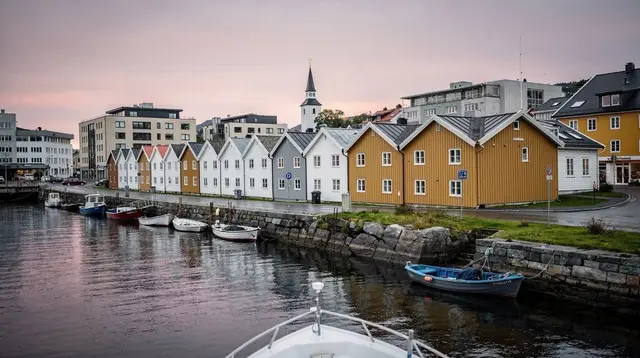
Walking Into a Neighbourhood, Not an Exhibit
The first thing to understand about Gamle Stavanger is what it is not. It is not a heritage park with a ticket window, not a reconstructed “old Norway” film set, and not a museum with opening hours you need to plan around. It is an ordinary residential neighbourhood on the west side of Vågen harbour that happens to contain around 170 white wooden houses from the 18th and 19th centuries, most of them still lived in today. Locals commute from these houses, hang laundry in their small gardens, and park bikes against the same white-painted clapboard walls that visitors come to photograph.
That distinction matters more than it might seem. Because nobody charges admission and nobody locks a gate at closing time, Gamle Stavanger has none of the friction that usually comes with a paid attraction — no queue, no time slot, no route you’re funnelled along. You can arrive at 7 a.m. before the town wakes up or at 9 p.m. in the long summer twilight, and the lanes will be exactly as open. The trade-off is that this is somebody’s home address, not an attraction built for visitors, and the way you behave here — quiet voices, no wandering into private courtyards, no touching doors and windows — is really the entry price.
Gamle Stavanger is usually described as the largest concentration of preserved wooden houses anywhere in Northern Europe, a claim tied directly to how the area survived: it wasn’t rebuilt, it was defended, block by block, against demolition in the mid-20th century when much of the rest of the city modernised around it.
Why These 170 Houses Survived
Most of Gamle Stavanger’s houses date from the late 1700s through the 1800s, when this side of Vågen was a working district of sea captains, merchants, coopers and cannery workers tied to the herring trade that once dominated the harbour below. Small wooden houses, often just one or two rooms deep, were built close together along narrow lanes that followed the contours of the hillside rather than any planned grid — which is a large part of why the area still feels organic rather than orderly.
By the mid-20th century, wooden housing stock like this was falling out of favour across Norway; it was considered a fire risk, hard to modernise, and standing in the way of new development. Whole quarters of similar houses were lost in other Norwegian towns during this period. Stavanger’s version survived largely because of a sustained local preservation effort from the 1950s onward that treated the houses as worth saving rather than clearing — a decision that, decades later, is a large part of why the city has a distinct identity beyond its oil-industry reputation.
The result today is not a frozen snapshot of the 1800s. Roofs, wiring, plumbing and insulation have all been modernised over the decades; window glass and paint are current, not original. What is preserved is the scale, the material and the street pattern — a genuinely old townscape that has been kept alive rather than kept static.
Where Gamle Stavanger Actually Is
Gamle Stavanger sits immediately west of Vågen, the harbour basin at the heart of Stavanger. If you’re standing at the harbourfront looking across the water, the old town rises on the slope directly opposite the modern shopping streets — close enough that most visitors reach it on foot in five to ten minutes from the centre, with no bus or taxi needed.
The neighbourhood is compact: a network of narrow lanes with names like Nedre Strandgate, Øvre Strandgate and Kongsgata, climbing gently from near the water up toward the hillside behind. It’s genuinely walkable in well under an hour, which is exactly why it works so easily as a stop between other central Stavanger sights — Stavanger Cathedral, the colourful shops of Øvre Holmegate, and the harbour itself are all within a similarly short walk in the opposite direction.
Because there’s no single “entrance,” there’s no wrong way to arrive. Most people wander in from the harbour side near the ferry terminal and let the lanes lead them uphill, doubling back through parallel streets on the way down.
A Self-Guided Route Through the Old Town
There’s no official trail and no numbered stops, which is part of the appeal, but a simple loop covers the neighbourhood’s character without retracing the same lane twice. Start near the harbour end of Øvre Strandgate, where the concentration of houses is densest and the lanes are narrowest. Work your way up the hillside on one street, then come back down a parallel one — the elevation change is gentle throughout, nothing that requires any real effort.
Along the way, look for small details rather than trying to “see everything”: the varied paint colours (white is dominant, but you’ll spot pale yellow, ochre and grey-blue houses too), the tiny front gardens packed with roses and hydrangeas in summer, the old ship’s-lantern-style lamps on some façades, and the way houses of clearly different ages sit shoulder to shoulder without any single one dominating the street.
For a version of this walk with a fixed sequence of streets and specific viewpoints, the dedicated route guide covers it stop by stop — see the self-guided walking route through Gamle Stavanger for a version you can follow lane by lane rather than freestyling it.
What You’ll See Along the Way
| Feature | What it is | Where to look |
|---|---|---|
| White wooden façades | 18th-19th century houses, most still private homes | Øvre and Nedre Strandgate |
| Cobbled lanes | Original narrow street pattern, no cars | Throughout the district |
| Small front gardens | Roses, hydrangeas, climbing vines in summer | South-facing lanes especially |
| Occasional galleries and studios | A handful of small craft shops and artists’ spaces | Scattered, not concentrated |
| Harbour views | Glimpses back down to Vågen and the modern centre | Higher lanes on the hillside |
Gardens, Roses and the Seasons
Gamle Stavanger changes noticeably with the seasons, which is worth knowing if you’re weighing when to fit it into a trip. In June and July, the small front gardens are at their fullest — roses climbing over fences and hydrangeas crowding the narrow strips of soil between house and lane are a large part of why this period produces the postcard version of the neighbourhood. Long daylight hours at this latitude also mean soft evening light lasts well into the night.
Outside that window, the area doesn’t close or dim in any meaningful sense — it’s still a functioning street, just a quieter, more monochrome one. Autumn brings damp cobblestones and turning leaves on the few trees tucked between houses; winter brings short days and a good chance of rain rather than snow, given Stavanger’s mild coastal climate. None of this rules out a visit; it just changes what you’re looking at. If timing your trip around weather and light matters to you generally, the month-by-month rundown for best time to visit Stavanger covers the wider picture.
Is It Really Free? Yes — And Here’s Why That Matters
It’s worth stating plainly, because visitors sometimes arrive expecting a paid heritage site and are surprised to find none: there is no admission fee for Gamle Stavanger, no ticket office, and no restricted hours. The lanes are public streets, and walking them costs nothing at any time of day or year.
That also means there’s no infrastructure built specifically for tourism inside the neighbourhood itself — no visitor centre, no gift shop attached to the district, no guided-tour desk on site. What you get instead is the real thing: a lived-in street where a handful of small independent galleries and craft studios occasionally open their doors, but where the main experience is simply walking and looking, not being managed through an attraction. If you’d rather have context and stories along the way than work it out yourself, both options exist side by side — see the comparison of self-guided versus guided walking tours in Stavanger for what each actually adds.
Combining Gamle Stavanger With the Rest of Central Stavanger
Because it takes so little time, Gamle Stavanger rarely needs to be the single focus of a day — it slots naturally alongside other central sights. A common half-day pairing is Stavanger Cathedral, a walk along Vågen harbour itself, and either the Norwegian Petroleum Museum or the Viking House experience, depending on whether industrial history or Viking-age Norway interests you more. The Valbergtårnet tower, a short climb above the centre, adds a rooftop view over the old town’s roofline that’s hard to get from ground level.
If street art is more your pace than 19th-century architecture, central Stavanger runs an active contemporary scene alongside its old one — see Stavanger’s street art and Nuart guide for the murals scattered through the street art district, a striking contrast to Gamle Stavanger’s whitewashed calm just a few minutes’ walk away.
For food, several small cafés and restaurants sit at the harbour edge of the old town, making it easy to combine a walk with a meal — the guide to eating around Vågen harbour and the broader what to eat in Stavanger rundown both cover options within a short stroll of these lanes.
None of this requires a car. If you’re building a longer stay around central Stavanger without renting one, the one-day-in-Stavanger-without-a-car guide and the matching one-day-in-Stavanger itinerary both use Gamle Stavanger as a walkable anchor point.
Beyond the Old Town: Using Stavanger as a Base
Most visitors treat central Stavanger, Gamle Stavanger included, as the base for the wider region rather than the whole trip. The city’s real draw for many travellers is what lies a short boat ride away — the Lysefjord and Pulpit Rock — and Stavanger’s harbour is the departure point for most of it.
A fjord cruise is the easiest way to see that scale without hiking, and departures run directly from the city: the Lysefjord and Pulpit Rock boat tour from Sandnes covers the fjord’s cliffs from the water in a few hours, while the boat trip to Preikestolen from Forsand is a similar option departing from a different point on the fjord.
For something more active than a cruise deck, the guided SUP and sauna paddle tour on the fjords near Stavanger pairs paddleboarding with a warm-up sauna session, a distinctly Norwegian way to spend an afternoon on the water. And for travellers set on reaching the plateau itself but wanting to skip the busiest section of trail, the off-the-beaten-path route to Pulpit Rock offers an alternative approach with fewer crowds.
None of these leave from inside Gamle Stavanger itself — they depart from the harbour a short walk away — but they’re a natural next step once the old town has taken up its 45 minutes to two hours of your day.
Practical Tips for Visiting
A few points make the visit smoother, mostly because there’s so little formal structure to lean on:
- Wear shoes with grip. The cobblestones are old and uneven in places, and can be genuinely slippery when wet — trainers or walking shoes work better than smooth-soled footwear.
- Photograph from the lane, not the doorstep. Front gardens and porches are private property; there’s no barrier stopping you from stepping onto one, which is exactly why it’s worth a conscious effort not to.
- Avoid peak cruise-ship hours if you want it quiet. Large ship arrivals can bring tour groups through the main lanes around midday; early morning or evening is calmer.
- There are no public restrooms inside the district itself — plan around the harbour or central Stavanger facilities nearby.
- It pairs well with rain. Since there’s no indoor component to miss, Gamle Stavanger is one of the more forgiving stops on a wet-weather day in Stavanger.
Gamle Stavanger at a Glance
| Question | Short answer |
|---|---|
| Cost to enter | Free, always |
| Opening hours | None — it’s a public street, open 24 hours |
| Typical visit length | 45 minutes to 2 hours |
| Best for | Photography, architecture, an easy walk |
| Accessibility | Mostly flat, some old cobblestones and side-alley steps |
| Nearest landmark | Vågen harbour, 5-10 minutes on foot |
Frequently Asked Questions About Visiting Gamle Stavanger
Is Gamle Stavanger a museum you have to pay to enter?
No. It is a privately owned, still-inhabited neighbourhood, not a museum village, and there is no ticket, no gate and no opening hours. You can walk its lanes at any time of day, for free.
How long does it take to walk around Gamle Stavanger?
Most visitors need 45 minutes to cover the main lanes at a normal pace, or 1-2 hours with time to stop for photos, read the small plaques on some houses, and wander the side streets slowly.
Do people really still live in these houses?
Yes. The roughly 170 wooden houses are privately owned homes, so please treat the area as someone’s street rather than a stage set — stay on the public lanes, keep noise down, and do not enter private gardens or knock on doors.
What’s the best time of day to visit Gamle Stavanger?
Early morning or early evening gives the softest light for photos and the fewest cruise-ship crowds. Midday in July and August can bring large tour groups through the narrower lanes near Vågen.
Is Gamle Stavanger the same as Øvre Holmegate?
No, they are different streets with different characters. Gamle Stavanger is the white wooden old town west of Vågen harbour, while Øvre Holmegate is the separate, brightly painted shopping street on the opposite side of the centre.
Can you visit Gamle Stavanger in the rain or winter?
Yes. It is an outdoor street walk with no indoor component, so it works in any season and any weather, though wet cobblestones can be slippery and winter days are short and often grey.
Is Gamle Stavanger stroller and wheelchair friendly?
Mostly, but not entirely. The main lanes are paved and reasonably flat, but the surface is old cobblestone in places and some side alleys have steps, so a stroller or wheelchair may need to backtrack rather than complete a full loop.