What Stavanger Is Not (And What It Actually Is)
What should you not expect from a trip to Stavanger?
Don't expect guaranteed northern lights, midnight sun, or the red fishing villages of the Lofoten — Stavanger sits too far south and at the wrong latitude profile for any of the three. What it does offer is a medieval cathedral still in daily use since 1125, the cliffs and waterfalls of the Lysefjord, and a compact, walkable oil city with real character.
Setting the record straight before you book
Search for “Norway trip” and you will land on photos that have nothing to do with Stavanger: green curtains of aurora over snow, a sun that never sets, red fishing cabins on stilts over a turquoise fjord. Those images are real, they are just from somewhere else in Norway, and it is worth being direct about that before you plan a single day of your itinerary around Stavanger. Getting the geography right up front saves you a disappointing trip and points you toward what this corner of Rogaland is actually good at.
None of this is a knock on Stavanger. It is a mid-latitude, southwestern Norwegian city with its own history, its own dramatic landscape, and its own reasons to visit. But those reasons are different from the ones that pull people toward Tromso or the Lofoten, and conflating the two leads to itineraries built around things that simply will not happen here.
No guaranteed northern lights at this latitude
Stavanger sits at 58.97°N. That is well south of the auroral oval that regularly produces visible aurora activity over Tromso, the Lofoten, or Norway’s far north, all of which lie above or close to the Arctic Circle at 66.5°N. On an unusually strong geomagnetic storm, aurora activity can occasionally be visible this far south, but it is the exception, not something you can plan a trip around.
If seeing the northern lights is the actual goal of your Norway trip, the honest answer is to base yourself further north. We go into the mechanics of why Stavanger’s latitude rules this out in a dedicated guide — see why Stavanger doesn’t get northern lights — rather than repeating the detail here.
No midnight sun either
The same latitude problem applies in the opposite season. A true midnight sun, where the sun never dips below the horizon, only happens above the Arctic Circle in summer. Stavanger’s summer nights get long and pale, especially through June, but the sun does set. If a photo of a sunlit landscape at 2am is on your must-have list, it belongs on a Lofoten or Nordkapp itinerary, not a Rogaland one. Again, the full explanation lives in its own piece: why there’s no midnight sun in Stavanger.
Not the red fishing villages of the postcards either
The third mismatch is architectural. Norway’s most photographed building tradition — rows of red-painted rorbu cabins on stilts over the water — belongs to the Lofoten and other fishing communities further north, built originally as seasonal housing for fishermen during the cod season. Stavanger’s own historic housing stock looks nothing like that.
What Stavanger has instead is Gamle Stavanger: around 170 white wooden houses, mostly built in the 18th and 19th centuries, packed onto cobbled streets on the west side of Vågen harbour. It is described as the largest concentration of preserved wooden houses in Northern Europe, and unlike a museum village, it is a working residential district — people live behind those white facades today. It is a genuinely rare urban landscape, just a different one from the red fishing hamlet you may be picturing. For a slower look at the district on foot, there’s a dedicated self-guided walk through Gamle Stavanger.
The table below lines up the three expectations against what Stavanger actually delivers, so there is no ambiguity going in.
| Expectation | Reality in Stavanger | Where it does happen |
|---|---|---|
| Northern lights | Rare, storm-dependent only | Tromso, Lofoten, far north Norway |
| Midnight sun | Does not occur | Above the Arctic Circle, 66.5°N+ |
| Red Lofoten-style fishing houses | Different tradition entirely | Lofoten and other northern fishing villages |
| White 18th-19th century townhouses | Yes — Gamle Stavanger, ~170 houses | Unique to Stavanger’s old town |
So what does Stavanger actually offer
Ruling three things out is only useful if it is followed by what replaces them, so here is the honest, positive case for the trip.
A medieval cathedral still doing its job
Stavanger Cathedral was consecrated around 1125, and the city dates its own founding to that year. What makes it unusual is not just its age but its continuity: it is the only medieval cathedral in Norway still standing and in active use without a major post-medieval rebuild. Nidaros Cathedral in Trondheim, by comparison, was extensively reconstructed after fires and centuries of decay. Stavanger’s cathedral has simply kept going, largely intact, for roughly nine centuries — a genuinely rare thing to stand inside. We cover what survived and what changed over those centuries in the cathedral that never got rebuilt.
The Lysefjord and its cliffs
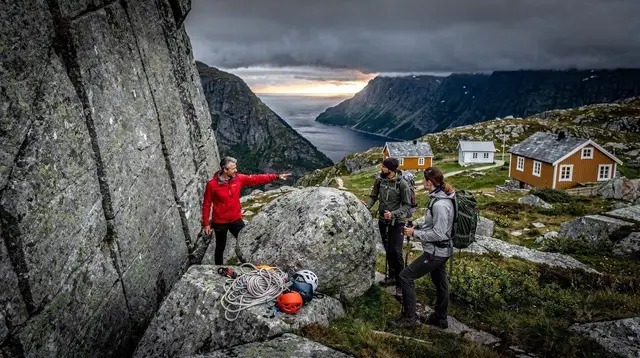
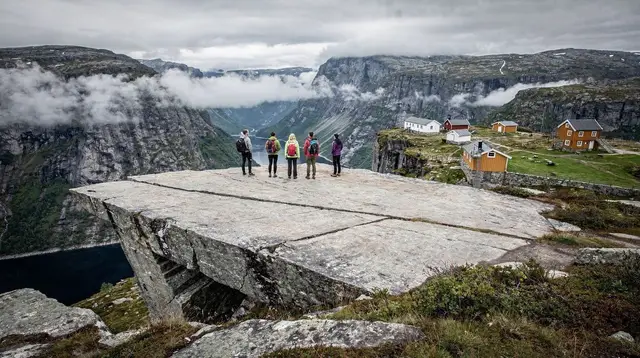
The Lysefjord is the single biggest reason most visitors come to this region at all. It runs about 42 km inland, reaches roughly 400 m deep, and is walled in places by rock faces over 1,000 m high. From its rim you get Preikestolen, a 604 m plateau reached by an 8 km round-trip trail that draws something like 300,000 visitors a year, and further down the fjord, Kjeragbolten, a boulder wedged at around 984 m above the water. Both are covered in full in their own destination guides, and a two-day plan that pairs the city with the fjord is laid out in two days in Stavanger and Preikestolen.
You don’t have to hike to experience the fjord’s scale. A boat trip along the water puts the cliffs in proportion in a way no photo from above quite manages — the Lysefjord boat trip to Preikestolen from Forsand is a low-effort way to see the fjord’s walls without a full day of hiking, and paddling closer to the water on a guided kayaking trip on the Lysefjord gives a slower, quieter version of the same view.
For those who do want the hike, the guided hike to Kjeragbolten from Stavanger handles the transport to Øygardstølen and the chained sections of the trail with a guide, which matters given how exposed that route is.
An oil city that is honest about being one
Stavanger became Norway’s oil capital after the Ekofisk field was discovered in the North Sea in 1969, and the city has not tried to hide that identity. The Norwegian Petroleum Museum, opened in 1999 on the harbourfront in a building designed to echo offshore platform architecture, tells that story directly — the wealth, the engineering, and the tradeoffs. We look at the broader civic transformation in what oil did to this city. It’s a more grounded, specific kind of interest than a generic “Norwegian fjord town” pitch, and it explains a lot about why Stavanger looks and functions the way it does today, from its restaurant scene to its cost of living.
There’s older history layered in too. At Hafrsfjord, just outside the centre, three roughly 10 m bronze swords were planted into the rock in 1983 at Sverd i Fjell, marking the Battle of Hafrsfjord in 872 — traditionally credited, with some legend mixed in, as the moment Norway was unified under Harald Fairhair.
A landscape wider than the fjord
Beyond the Lysefjord, the region has range. South and west of the city, Jæren’s long sandy beaches — Orre, Solastranden, Kvassheim — are an odd, welcome exception in a country defined by fjords and rock; see the day trip to Jæren’s beaches for a plan. Inland, Rogaland’s Ryfylke district holds Månafossen, a 92 m waterfall near Frafjord that is the tallest in the county, reachable on foot or paired with a via ferrata session on the Månafossen waterfall and via ferrata bouldering tour.
Who Stavanger actually suits
Given all of the above, Stavanger tends to reward a particular kind of traveller more than others:
- Hikers who want serious, well-marked trails (Preikestolen, Kjeragbolten, Månafossen) within a short drive of a proper city, not a remote outpost.
- History-minded travellers who want tangible, walkable medieval and industrial history rather than folklore alone.
- People who want a compact, walkable base — Stavanger’s centre, harbour and old town all sit within easy reach of each other — with day trips rather than a demanding multi-stop road trip.
- Anyone comfortable trading the far north’s aurora-and-midnight-sun spectacle for fjord cliffs, a working old town, and an oil-money city with its own distinct character.
It suits less well the traveller whose whole trip is built around a single bucket-list sky event. That is a legitimate trip to plan, it’s just not this one.
Planning around what Stavanger really offers
Once the northern lights and midnight sun are off the table, planning gets more straightforward: build the trip around the fjord, the old town, and the museums, and size the visit to how much hiking you actually want to do. Most first-time visitors land on somewhere between two and four days, covered in more detail in how many days you need in Stavanger, and the right season shifts what’s realistically open — the Lysebotn road to Kjerag closes for winter, for instance — which is broken down month by month in the best time to visit Stavanger.
If a first orientation day in the city itself is useful before heading out to the fjord, a private driving tour of Stavanger’s city highlights is a fast way to see the cathedral, Gamle Stavanger and the harbour without working out bus routes on day one. Budget matters too — Norway is a genuinely expensive country for food and organised activities, and it’s worth knowing what a realistic trip costs before you arrive; free things to do in Stavanger covers the no-cost side of that ledger.
None of this requires apologising for what Stavanger isn’t. It is a city with a nine-century-old working cathedral, one of Norway’s most dramatic fjords on its doorstep, and a very specific, very real modern history built on North Sea oil. That is a strong pitch on its own — it just isn’t the aurora-and-midnight-sun pitch that a lot of Norway marketing leans on, and it’s worth knowing that before you land at Sola.
Stavanger reality check: your questions answered
Can you see the northern lights in Stavanger?
Rarely, and never reliably. Stavanger sits at 58.97°N, well south of the auroral oval that regularly lights up Tromso or the Lofoten. A strong geomagnetic storm can occasionally push the lights this far south, but you should not plan a Stavanger trip around seeing them.
Does Stavanger have a midnight sun in summer?
No. Stavanger’s latitude is too low for a true midnight sun, unlike northern Norway above the Arctic Circle. Summer nights here get late and grey rather than fully dark, but the sun does set.
Are the wooden houses in Stavanger the same as the red houses in the Lofoten?
No. Gamle Stavanger’s roughly 170 preserved houses are white wooden townhouses from the 18th and 19th centuries, a dense urban district on the harbour. The red rorbu fishing cabins associated with the Lofoten are a different regional building tradition further north.
Is Stavanger worth visiting if it doesn’t have those things?
Yes. Stavanger’s value is a medieval cathedral still standing and in use since 1125, the Lysefjord with Preikestolen and Kjeragbolten within day-trip range, and a walkable city shaped by nearly six decades of North Sea oil wealth. It suits a different kind of trip than a northern-lights or midnight-sun holiday.
What is Stavanger actually known for?
Stavanger is Norway’s self-styled oil capital, home to the Norwegian Petroleum Museum, and the gateway to the Lysefjord, Preikestolen and Kjeragbolten. Its old town, Gamle Stavanger, and its 1125 cathedral are its main historic draws.
How far south is Stavanger compared to the rest of Norway?
Stavanger sits on Norway’s southwestern coast at 58.97°N, roughly on the same latitude band as the Shetland Islands or southern Alaska, and well south of the Arctic Circle at 66.5°N that separates it from the midnight sun and reliable aurora country further north.
Should I still book a Norway trip around Stavanger?
If your priority is northern lights or midnight sun, base your trip further north instead. If you want fjord hiking, a walkable historic centre, and an honest look at how oil shaped a modern Norwegian city, Stavanger delivers on its own terms.
Trip-planning essentials on GetYourGuide
Verified deep-linked GetYourGuide tours. Book through these links and we earn a small commission at no cost to you.
GetYourGuide does not provide a product photo for this activity — the image shows the meeting point, photographed by us.