A Building That Argues Its Own Point
Most museums explain their subject with objects behind glass. The Norwegian Petroleum Museum starts before you’re even through the door: the structure itself, sitting on the edge of the harbour in central Stavanger, is deliberately shaped to recall an offshore platform, all steel-grey drums and angular decks rising above the water. It opened in 1999, thirty years after the discovery that the whole building exists to explain, and it has spent the time since arguing a single point that’s easy to miss if you only skim the exhibits: the oil story didn’t end. It’s still running, funding the country you’re standing in, right now, while you look at a drill bit the size of a person.
That distinction matters more here than it does in most industry museums. It would be easy to walk through, admire some scale models of platforms, read a timeline, and leave with the impression that this is a museum about the past — about a boom that happened, peaked, and is now safely enclosed in a building for tourists to nod at. That’s not really what’s on offer.
Norway is still one of the world’s larger oil and gas exporters, Stavanger’s economy is still built substantially on the industry, and the museum’s newer sections make a visible effort to connect 1969 to now: energy transition displays, questions about what comes after oil, exhibits on the engineers and technicians who still fly out to platforms in the North Sea every week. If you come away thinking “interesting history,” you’ve only gotten half of what the place is trying to tell you.
What Changed in 1969
Everything here traces back to a single event: the discovery of the Ekofisk field in the North Sea in 1969. Before that, Stavanger was a fishing and canning town — a solid regional centre, but not a name anyone outside Scandinavia would have recognized. Ekofisk changed the calculation entirely. Phillips Petroleum, the American company behind the discovery, chose Stavanger as its onshore base, and the city has been rebuilding around that decision ever since. Within a couple of decades, Stavanger had gone from a place known for sardines to the de facto oil capital of Norway, a title it still carries.
The museum’s core galleries walk through that transition in reasonably concrete terms: the geology that put the oil there in the first place, the engineering problem of extracting it from beneath a genuinely hostile stretch of ocean, and the social and economic aftershocks in a country that had, until then, thought of itself as a modest fishing and farming nation. There’s a frankness to some of this that’s worth appreciating — the museum doesn’t just celebrate the boom, it also engages with the risks, the accidents, and the debates about how a small country should manage a sudden windfall of resource wealth. Norway’s sovereign wealth fund, built almost entirely on oil revenue, gets its origin story told here too.
Inside: What You’ll Actually See
The layout rewards a bit of patience rather than a speed-walk. Full-scale and model rigs dominate several of the larger halls, giving a genuine sense of the scale of offshore infrastructure that’s easy to underestimate from photographs. There are simulator-style stations where you can get a feel for drilling operations, examples of diving and safety equipment from different decades, and a section that traces the geological timeline of how North Sea oil formed in the first place, if you want the science behind the industry rather than just its results.
A few things are worth building into your expectations before you arrive:
- The museum is substantially about scale and engineering, so expect large physical exhibits — rig sections, pipes, valves — rather than only text panels and photographs.
- Signage and exhibit text are generally in both Norwegian and English, which makes it workable for visitors without any background in the subject.
- Some sections lean interactive, which tends to work well for families with kids old enough to engage with a hands-on display, though very young children may find the more text-heavy galleries slow going.
- The building includes a café with harbour views, a reasonable spot to sit down partway through rather than trying to absorb everything in one continuous pass.
If you’re the kind of traveler who likes to understand the mechanics behind a place rather than just its postcard version, budget on the fuller end of the 1.5-2 hour range. If you’re mainly filling an hour of rain-avoidance between other plans, the highlights are navigable more quickly.
Not a Relic: The Industry Is Still Working
It bears repeating, because it’s the single easiest thing to get wrong about this place: the Norwegian Petroleum Museum is not a memorial to something that stopped. Norway continues to produce oil and gas from the North Sea today, and Stavanger continues to be the operational base for a meaningful share of that activity. The city’s airport, Sola, still runs a steady stream of helicopter and charter traffic connecting onshore staff to offshore platforms. Local employment, restaurant prices, and even the international feel of a city this size all trace back, at least in part, to an industry that’s still active.
The museum’s exhibits on energy transition and the future of the North Sea fields are, in a sense, the most editorially honest part of the visit — they’re grappling with a live, unresolved question (what happens to a region this dependent on oil as the world shifts toward renewables) rather than presenting a tidy, closed narrative. That’s a more interesting museum experience than a simple boom-and-bust story, and it’s worth going in expecting that framing rather than a purely historical one.
Why It Works So Well on a Bad-Weather Day
Stavanger’s climate is not the postcard version of Norway. Latitude puts it at 58.97°N, but the coastal, oceanic pattern means winters are mild for the latitude (January averages around 1-2°C) while summers stay cool, generally around 16-17°C in July — and annual rainfall runs somewhere in the 1,180-1,250 mm range. Put plainly: it rains here, often, in every season, and outdoor plans get rearranged more frequently than visitors expect.
That’s exactly the situation this museum is built for. It’s fully indoors, well-heated, has a café, and takes long enough to fill a genuinely wet afternoon without feeling padded. If you’re building a rain-proof stretch of your itinerary, or you’ve had a hike like Preikestolen postponed by a forecast, this is one of the more natural places to redirect a day toward.
Getting There
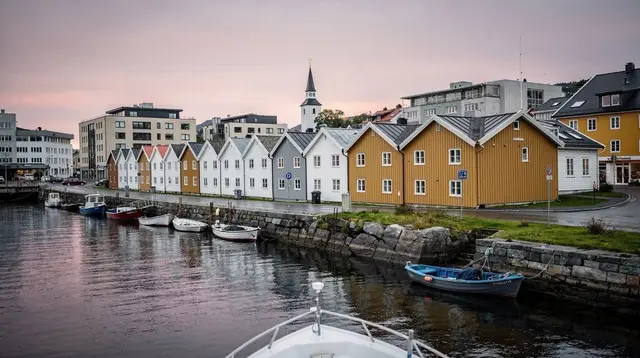
The museum sits directly on the harbour, close enough to Vågen and Gamle Stavanger that it fits naturally into a walking day around the old town. From most central hotels it’s a flat 10-15 minute walk. If you’re arriving by cruise ship, it’s one of the more straightforward stops to reach on foot without arranging transport, which is part of why it’s a common choice for one day in Stavanger without a car.
| Starting point | Approx. time on foot | Notes |
|---|---|---|
| Central Stavanger hotels | 10-15 min | Flat, along the harbour |
| Cruise terminal | 10-20 min | Depends on berth location |
| Sola Airport | Not walkable | Bus or taxi into the city first |
Note the currency before you plan a budget: Norway uses the Norwegian krone (NOK), not the euro — it isn’t in the EU or the eurozone, even though it’s inside the Schengen area for entry purposes. Card payment is close to universal, so there’s rarely a need to carry cash for the ticket or the café.
What to Pair It With
Because the visit itself only takes part of a day, it slots naturally alongside other central Stavanger stops. A common pattern is a morning in Gamle Stavanger among the roughly 170 preserved white wooden houses, lunch around the harbour, then the museum in the afternoon before the light fades.
If you’re weighing whether to add the Viking House or stavanger-cathedral to the same day, both are within easy walking range and the museum doesn’t overlap with either in subject matter — it’s the only stop in the city centre that’s specifically about the oil and gas story rather than the Viking Age or the medieval town.
For travelers building a longer stay, it’s also a useful counterweight to a Lysefjord-and-hiking-heavy itinerary. If most of your trip is Preikestolen, Kjeragbolten, and boat trips through the Lysefjord, an afternoon here adds context about the economic engine behind the region rather than just its scenery — and gives tired legs a break.
Several boat operators depart from the same general harbour area, so it’s easy to combine a museum morning with an afternoon on the water, for example a Lysefjord and Pulpit Rock boat trip from Sandnes or a faster RIB tour into the Lysefjord from Sandnes later the same day. Travelers short on time sometimes skip the boat entirely and book a helicopter flight over Pulpit Rock and the Lysefjord instead, which pairs oddly well with a museum morning: one gives you the industrial view of the region, the other gives you the aerial one.
If you’d rather understand how the day fits your budget before booking anything, it’s worth checking what a week in Stavanger really costs — Norway is a genuinely expensive country for food, drink, and organized activities, and it’s better to plan for that than be surprised by it.
FAQ: Visiting the Norwegian Petroleum Museum
How long should I plan for a visit?
Most visitors need 1.5 to 2 hours to see the main galleries at a comfortable pace, including a stop at the café. It’s possible to do a faster pass in under an hour if you’re mainly filling time between other plans.
Is the museum only about the history of oil, or does it cover today’s industry too?
Both. The core galleries trace the story from the 1969 Ekofisk discovery onward, but newer sections deal directly with the industry as it operates now, including energy transition questions and the future of North Sea production. It’s not a museum about something that stopped.
Is it a good option on a rainy day in Stavanger?
Yes. It’s fully indoors, has a café, and takes long enough to genuinely fill part of a wet afternoon, which makes it one of the more reliable rainy-day choices in the city alongside other central attractions.
Is it suitable for children?
It works reasonably well for families with older children, especially given the interactive and hands-on elements in some galleries. Very young children may find the more text-heavy sections slower going.
How do I get there without a car?
It’s an easy walk from most central Stavanger hotels and from the cruise terminal, generally 10 to 20 minutes along or near the harbour. No car or bus is needed if you’re already staying centrally.
Do exhibits have English information?
Yes, signage and exhibit text are generally presented in both Norwegian and English, so the museum is workable for visitors without prior background in Norwegian or in the subject.
What should I budget for a visit, including food nearby?
Plan on roughly 800 to 1,500 NOK per person for the museum ticket and a harbourside lunch. Norway is a comparatively expensive country for food and activities, so it’s worth budgeting on the higher end rather than the lower one.
Does it connect to anything else in central Stavanger?
Yes. It sits within easy walking distance of Gamle Stavanger, Vågen harbour, and Stavanger Cathedral, which makes it straightforward to combine with a half-day or full-day walk around the historic centre.