A different kind of Norwegian coastline
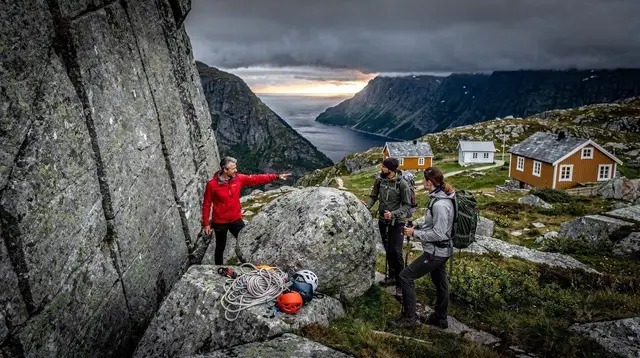
Most people arrive in Stavanger expecting fjords, and the region delivers them in force — the Lysefjord, Preikestolen, Kjeragbolten, walls of rock dropping straight into black water. Jæren is the region’s rebuttal to all of that.
Drive twenty to forty-five minutes southwest of the city and the landscape flattens out into open farmland, wide skies and a long, straight run of sand that has more in common with the coasts of Denmark or the Netherlands than with the postcard fjord country a short drive away. This is not a lesser or watered-down version of Rogaland’s scenery — it is a genuinely different landscape, and treating it as filler between fjord hikes misses the point of going at all.
The Jæren coast runs roughly from the area around Sola in the north down past Bryne and on toward Egersund in the south, a stretch of perhaps 30-40 km of beaches, dunes, low cliffs and grazing land facing directly into the North Sea. Along the way sit named beaches and landmarks — Orre and Borestranden, Solastranden, and the lighthouses at Kvassheim and Obrestad — each with its own character and its own detailed page on this site. This page is the overview: how the whole stretch fits together, why it looks the way it does, and how to spend time on it without a car if you’d rather not rent one.
Why Jæren looks nothing like the fjords
Norway’s coast is, geologically speaking, mostly a story of glaciers carving deep valleys into hard rock and the sea flooding in behind them — that is what produces a fjord. Jæren sits on a different kind of ground: a lowland plain of sedimentary and glacial deposits, flat enough that it has been farmed for millennia, ending at the sea in sand rather than cliff. It is the largest continuous lowland on Norway’s entire west coast, and locally it reads as an exception precisely because it breaks the pattern everyone expects.
That flatness is not incidental scenery — it is the reason the region is Norway’s agricultural heartland, with the kind of dense grazing land and grain fields you don’t associate with a country better known for mountains and midnight fishing villages. The result, at the coast, is a landscape of dune grass, wind-bent shrubs, drifting sand and open horizon, backed by pasture rather than pine forest. In poor light it can look bleak; in good light, especially early or late in the day, the flat sand and huge sky produce a kind of drama that has nothing to do with height and everything to do with scale.
What to expect along the coast
The beaches themselves vary in character but share the same basic ingredients: pale sand, dune systems held together by marram grass, and a North Sea that is cold, often rough, and taken seriously by the surfers who use this coast year-round. Orre and Borestranden are the best known and most visited stretches, with parking, seasonal facilities and, at Orre, a protected wetland behind the dunes that draws birdwatchers.
Solastranden, closer to Stavanger and the airport, tends to be busier on warm days. Further south, Kvassheim and Obrestad mark the coast with two lighthouses and quieter, more exposed sand. None of these gets the depth of coverage here that they get on their own pages — this is the place to understand how the pieces connect, not the detail of any single beach.
Inland, Bryne functions as Jæren’s market town: a working agricultural centre rather than a tourist stop, useful as an anchor point if you’re exploring the area by public transport or want a sense of the region beyond its coastline. It is not a beach destination in itself, and this page won’t pretend otherwise — it’s included in the region for completeness, and covered properly on its own page.
Cycling, walking and the wind
Because the land is flat, Jæren is one of the few parts of the Stavanger region genuinely well suited to cycling — long coastal roads and paths run for tens of kilometres with almost no elevation change, a striking contrast to the vertical hiking that dominates the Lysefjord side of the region. It’s a popular route for both day cyclists out from Stavanger and Sandnes, and for longer, multi-day coastal touring. The trade-off is wind: this coast faces the open North Sea with nothing to block it, and a headwind can turn an easy ride into a slow one in either direction. Check the forecast before committing to a specific route, and expect wind on most days regardless of season.
Walking is just as viable and requires no equipment beyond decent shoes and a windproof layer. Long stretches of firm, flat sand make for easy beach walking at low tide, while the dune paths and coastal trail connecting the lighthouses give a walk with more texture and history built in. Surfing is a serious pursuit here, not a novelty — several beaches along this coast, most notably around Borestranden, have real surf culture and board rental, with the water cold enough year-round that a wetsuit is not optional.
Getting there
| From Stavanger to | Approx. distance | Approx. drive time |
|---|---|---|
| Solastranden | ~15 km | 20 minutes |
| Orre / Borestranden | ~25 km | 30-35 minutes |
| Bryne | ~30 km | 35-40 minutes |
| Kvassheim / Obrestad | ~40 km | 45-50 minutes |
| Egersund (edge of Jæren) | ~65 km | 60-70 minutes |
A car gives the most flexibility for stringing several beaches together in one trip, and is the practical choice for cyclists bringing their own bikes. Kolumbus buses connect Stavanger with Sola, Bryne and other towns along the coast, though services to the beaches themselves are sparser than to the towns — if you’re relying on public transport, plan around bus timetables rather than assuming you can hop between beaches freely. Guides on doing this without a car and on cycling the coast go into the specifics of routes and timetables.
A day on the Jæren coast
A single day is enough to get a real feel for this landscape: a late-morning drive or bus out to Orre or Solastranden, a couple of hours of beach walking or a bike ride along the coastal path, lunch in Bryne or at one of the seasonal beach cafés, and an afternoon pushing further south to see one of the lighthouses before the light turns. It pairs naturally with a rest day from hiking — nothing here demands the fitness or nerve that Preikestolen or Kjeragbolten do, and that contrast is part of the appeal.
For a structured version of this, the Jæren beaches day trip guide and the Jæren beach coast itinerary both lay out route options in more detail, and the Orre and Borestranden guide focuses specifically on the two most-visited beaches.
If the weather turns, as it often does on this exposed stretch of coast, the fjord side of the region offers an easy alternative for the rest of the day. A short RIB run out onto sheltered water can work even when an onshore wind makes the open beach unpleasant — the Lysefjord RIB fjord tour from Sandnes departs close enough to Jæren to slot into the same day, and an electric boat tour with a guide out of Haugesund is a quieter option if you’re exploring the coast further north toward Haugesund and Karmøy.
Combining Jæren with the rest of Rogaland
Jæren works well as one leg of a longer stay rather than a destination on its own. Many visitors treat it as a counterpoint day: fjord and mountain scenery for two or three days around Sandnes and the Lysefjord, then a day on flat sand and open sky before heading back to the city or on toward Dalsnuten for an easier hike with a view over the whole region.
If you’re building a longer Rogaland itinerary, the Jæren beach coast route can be dropped in as a single day within a wider loop, and it’s worth reading what Stavanger is not if you arrived expecting only fjords — Jæren is exhibit one for why that expectation is incomplete.
For water lovers who want something between a fjord cruise and a beach walk, a guided paddle session is another way to see the coastline from a different angle — the two-fjord SUP and sauna paddle tour based in Stavanger is fjord-side rather than open-coast, but it’s a comparable slow-water alternative on a day when the North Sea itself is too rough to enjoy.
Those staying longer and exploring north toward Haugesund can also look at the RIB safari to the island communities around Haugesund, which shows a gentler, more sheltered stretch of the same North Sea that pounds the Jæren beaches further south.
Practical notes
Facilities along the coast are seasonal and modest — expect car parks, some toilets and seasonal cafés at the busier beaches like Orre and Solastranden, and very little at the quieter, more southern stretches near the lighthouses. Bring layers regardless of the season: this coast is windier and often several degrees cooler than central Stavanger, and there is little shelter once you’re out on open sand or dune paths. Swimming is possible in summer for those used to cold water, but there are no lifeguards at most beaches, and the surf and currents on this open coast should be taken seriously rather than treated like a sheltered fjord swim.
Norway’s currency is the krone (NOK), not the euro — Norway is outside the EU and does not use the euro, so budget and price comparisons here are all in NOK. Card payment is accepted almost everywhere, including small seasonal cafés, so carrying much cash is rarely necessary.
Jæren coast: frequently asked questions
Is Jæren worth visiting if I’m mainly here for the fjords?
Yes, and arguably more so if fjords and hiking are your main plan — Jæren is a genuinely different landscape within an hour’s drive, useful as a contrast and as a lower-effort day between more demanding hikes like Preikestolen or Kjeragbolten.
Which Jæren beach should I visit if I only have time for one?
Orre and Borestranden are the most complete introduction, with the widest sand, the most facilities and a protected wetland behind the dunes; see the dedicated Orre and Borestranden guide for specifics.
Can I swim at the Jæren beaches?
Yes in summer, though the North Sea here is cold year-round, currents can be strong, and there are no lifeguards at most beaches — treat it as open-water swimming, not a sheltered pool.
Do I need a car to see the Jæren coast?
A car is the most flexible option and the only practical way to string several beaches together in one day; Kolumbus buses reach the main towns along the coast but connections to individual beaches are limited, as covered in the car-free guide.
Is Jæren good for cycling?
Yes — it’s one of the few flat, long-distance cycling landscapes near Stavanger, in contrast to the steep terrain around the fjords, though wind off the North Sea is a factor on most days; see the cycling guide for routes.
What’s the best time of year to visit Jæren?
Late spring through early autumn (May-September) is best for swimming, cycling and beach time; the coast is also walkable and often striking in other seasons, particularly for photographers, as long as you’re dressed for wind and cold.
Are the Kvassheim and Obrestad lighthouses worth the extra drive?
Yes for anyone who wants a quieter, more exposed stretch of coast than Orre or Solastranden — the lighthouses walk guide covers the route and what to expect at each site.