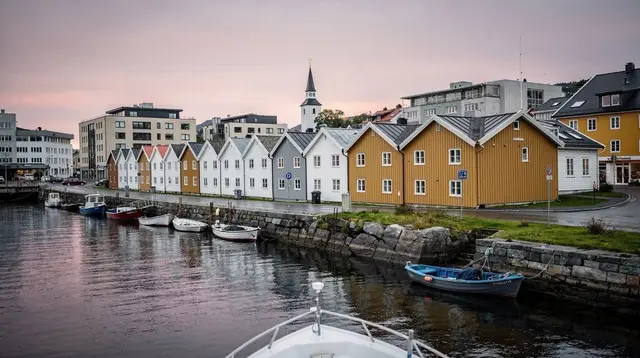
The Water Stavanger Was Built Around
Every visitor to Stavanger ends up at Vågen sooner or later, usually without planning to. It is the narrow, elongated harbour basin that cuts into the middle of the city, and it is close to impossible to spend a day in central Stavanger without walking along at least part of it. On its west bank sits Gamle Stavanger, the old town of white wooden houses; on its east side, the newer commercial centre climbs the hill toward Stavanger Cathedral and Valbergtårnet. Vågen is the seam between the two.
It is easy to treat a harbour like this as scenery — a nice backdrop for a photo before moving on to whatever the guidebook lists as the “real” attraction. That undersells Vågen. This is not simply the prettiest street to walk down between two better sights. It is Stavanger’s working waterfront, still used by fishing boats, and it is also the departure point for most boat trips heading out into the Lysefjord — the fjord cruises, RIB safaris and paddling tours that, for a large share of visitors, are the single most memorable thing they do in this part of Norway. Treat Vågen as a place in its own right, not a corridor, and it earns the time.
Reading the Harbour
Vågen is long and narrow rather than wide and open — closer to a canal in feel than to the big open fjord views you get further out toward Lysefjord or Preikestolen. Walk its length and you pass through several distinct moods in the space of fifteen minutes: fishing boats moored close to the old town side, tour boats and RIB craft loading passengers further along, outdoor café seating filling the quay in summer, and, toward the inner end, the striking angular form of the Norwegian Petroleum Museum standing directly on the water.
That museum deserves its own visit and its own time — its building alone, designed to echo an offshore platform, is worth seeing even from outside, and its collection on Norway’s oil history since the 1969 Ekofisk discovery is one of the more substantive museum experiences in the city. This page will not try to cover it in depth; treat Vågen and the museum as neighbours rather than the same stop, and budget separately for each. The same goes for Gamle Stavanger on the opposite bank: its roughly 170 preserved wooden houses are a destination in their own right, reachable by a short walk from anywhere along Vågen’s western quay, and covered on its own page rather than repeated here.
The Fish Market, in Proportion
Ask about Vågen online and “fish market” comes up quickly, sometimes with expectations shaped by much larger seafood markets elsewhere in Europe. It is worth being upfront: Stavanger’s fish market is modest. A small number of stalls and a dedicated fish market building near the harbour sell fresh catch, shrimp, smoked salmon and other seafood, mostly concentrated in the warmer months when both supply and foot traffic are higher. It is a genuine, functioning market rather than a tourist reconstruction, which is part of its appeal, but arriving expecting rows and rows of stalls will disappoint.
What it does well is give an honest sense of Stavanger as a working port rather than a purely ornamental old town. Boats still land catch here. Locals still buy from these stalls on the way home. If seafood is a reason you have come to Norway, pairing a walk past the market stalls with a proper meal is more rewarding than treating the market itself as the main event — see the notes on where to eat nearby further down this page.
Where the Fjord Actually Begins
The point most visitors miss is that Vågen is not a dead end that happens to look photogenic — it is a gateway. This harbour connects to the open water beyond it, and from there, out to the Lysefjord itself: some 42 kilometres of fjord with walls exceeding 1,000 metres in places, the fjord that carries Preikestolen on one side and, much further in, Kjeragbolten near its inner end.
Most sightseeing cruises, several RIB safaris and some paddling tours that head into that landscape begin, at least in part, from the quays around Vågen and the wider Stavanger harbour area, with a few operators instead departing from nearby Sandnes or Forsand.
This matters for planning. If a Lysefjord cruise or a Preikestolen boat trip is on your itinerary, the natural anchor for that day is not some separate marina — it is this same harbour you are already walking along. A boat trip that takes you out toward Preikestolen from the water, seeing the plateau’s 604-metre cliff face rise straight out of the fjord, gives a genuinely different perspective from climbing the trail itself, and for visitors short on time or unable to manage the roughly 8-kilometre round-trip hike, it can be the more realistic way to experience the landmark at all.
a Lysefjord and Pulpit Rock boat tour departing the Stavanger area combines that fjord scenery with a close pass beneath Preikestolen, entirely from the water. For those working from the Sandnes side of the harbour system, a Stavanger boat trip to Preikestolen from Forsand covers similar ground on a different route.
Visitors who want more speed and spray than a sightseeing cruise offers tend to book a Lysefjord RIB fjord tour from Sandnes instead — open, fast inflatable boats that get closer to the fjord walls and waterfalls than a larger cruise vessel can. And for a slower, more physical way onto the water close to the city itself, a guided SUP and sauna paddle tour on the fjords around Stavanger pairs paddleboarding with a harbourside sauna session, a distinctly Norwegian way to end a day near Vågen without leaving the city fjords at all.
None of this requires advance planning beyond picking a departure time. What it does require is not writing Vågen off as “just the harbour” before checking what leaves from it.
Eating and Drinking Along the Quay
Vågen’s edges, particularly on the side facing Gamle Stavanger, are lined with restaurants and cafés that make the most of harbour views — many with outdoor seating that fills up on any dry afternoon between May and September. Seafood is the obvious specialty given the setting, but the range extends well beyond fish: bakeries, coffee bars and casual lunch spots sit alongside the harbourside restaurants, so it is a reasonable base for a meal at almost any point in the day, not only around the fish market stalls themselves.
Norway’s general cost level applies here as everywhere: expect Vågen’s restaurants to sit at the pricier end of what you would pay for similar food at home, since the country is genuinely expensive for food and drink by most visitors’ standards, not merely by reputation. A coffee and a pastry is an easy, low-cost way to sit and watch the harbour for half an hour; a full seafood dinner on the quay is a legitimate splurge rather than a routine stop. If you want a fuller sense of what is worth ordering and where, treat this page as the geography and look elsewhere for the specifics of eating well around the water.
Vågen After Dark and Off-Season
Outside the peak summer months, Vågen changes character. Boat departures thin out, especially anything heading toward Lysebotn or the outer fjord, since some routes reduce frequency or pause for the winter. Outdoor seating along the quay empties in the rain and cold that define much of Stavanger’s year — this is a wet city by Norwegian standards, with annual precipitation typically in the range of 1,180 to 1,250 millimetres, so a dry, sunny walk along Vågen is a genuine stroke of luck at any time of year, not a given even in summer.
That does not make the harbour not worth visiting outside the warmer months. Lit up in the evening, with reflections off the water and Gamle Stavanger’s wooden façades on one side, Vågen photographs just as well — arguably better — outside the crowds of the peak cruise-ship season. If your trip includes a stretch of Stavanger’s mild but grey winter, when January averages sit around 1-2°C, a harbourside walk followed by something warm at one of the quay’s cafés is one of the more comfortable ways to spend an hour in the city regardless of the weather outside.
Getting to and Around Vågen
Because Vågen sits at the physical centre of Stavanger, reaching it rarely requires more than a short walk from wherever else you are in the city. It is within easy walking distance of the cathedral, Øvre Holmegate, and the streets of Gamle Stavanger, and most central accommodation in Stavanger is within ten to fifteen minutes on foot. Stavanger Airport, Sola lies roughly 14 kilometres outside the city; local Kolumbus buses and taxis connect it to the centre, from which the harbour is a short walk further.
Once you are at Vågen, there is little need for transport at all — this is a walking destination by design, and the whole quay can be covered on foot in well under an hour, market stalls, museum exterior and boat docks included. If a fjord tour is part of your plan, arrive at the stated departure point with some margin, since exact meeting quays can differ slightly between operators even when they all depart from broadly the same harbour area.
Planning a Day Around Vågen
A simple, workable structure for a first visit: start on the Gamle Stavanger side of the harbour in the morning, when the old town’s streets are quietest, walk the length of Vågen past the fish market stalls, cross toward the Norwegian Petroleum Museum side, and either stop for lunch on the quay or head straight to a booked boat departure if a Lysefjord cruise or RIB safari is on the schedule. Visitors building a longer day around the harbour often add a short walk up toward the cathedral and Valbergtårnet afterward, since both sit within a few minutes of the water.
The table below gives a rough sense of how a half-day at Vågen can be built, depending on how much time and budget you want to put toward the water itself.
| Approach | Time needed | Rough budget (NOK) | Good for |
|---|---|---|---|
| Harbour walk only | 30-45 minutes | 0-100 | First orientation, photos, a quick coffee |
| Walk plus a seafood meal on the quay | 1.5-2 hours | 400-700 per person | Seafood lovers, a relaxed midday break |
| Harbour walk plus a fjord cruise | Half a day | 600-1,200 per person | Anyone prioritising Lysefjord and Preikestolen views from the water |
| Harbour walk plus a RIB safari or SUP tour | Half a day | 900-1,500 per person | Visitors wanting a faster, more active time on the fjord |
None of these figures include the Norwegian Petroleum Museum’s own entry fee or a full sit-down dinner, both of which are worth budgeting separately.
Frequently Asked Questions About Vågen Harbour
What is Vågen harbour in Stavanger?
Vågen is the narrow, sheltered inlet that cuts into the centre of Stavanger, separating Gamle Stavanger on the west bank from the newer town on the east. It has functioned as the city’s harbour for centuries and today mixes working fishing boats, a small fish market, restaurants, and the quays used by fjord cruise and RIB operators.
Is there still a real fish market at Vågen?
Yes, though it is smaller than it once was. A handful of stalls and a fish market building near the harbour sell fresh and smoked fish, shrimp and other seafood, mostly in the warmer months. It is a working stop for locals as much as a tourist sight, so hours and the number of stalls vary through the year.
Can you catch a Lysefjord cruise or boat tour from Vågen?
Vågen and the adjoining quays are the main departure point for boat trips into the Lysefjord, including sightseeing cruises toward Preikestolen and faster RIB safaris. Some operators depart from nearby Sandnes or Forsand instead, so it is worth checking the exact meeting point when booking.
Is Vågen worth visiting if you are not taking a boat tour?
Yes. Even without a boat booked, Vågen is the natural starting point for walking into Gamle Stavanger, reaching Øvre Holmegate, or looking across the water at the Norwegian Petroleum Museum. It is also one of the more reliable spots in the city for a harbourside coffee or seafood meal.
How long should you spend at Vågen harbour?
Walking the full length of the quay and browsing the market stalls takes well under an hour. Most visitors treat it as a passing-through point on a longer day in central Stavanger, or as the start and end point of a half-day fjord cruise.
Is Vågen the same as Gamle Stavanger?
No. Vågen is the harbour itself, the water and the quays around it. Gamle Stavanger is the historic neighbourhood of around 170 white wooden houses on the harbour’s west bank, a short walk from the water. They sit side by side and are usually visited together, but they are two distinct places.
What is the building that looks like an oil platform next to Vågen?
That is the Norwegian Petroleum Museum (Norsk Oljemuseum), built directly on the harbour in a shape that references offshore platform architecture. It covers the history of Norway’s oil and gas industry since the Ekofisk discovery in 1969, and deserves its own visit rather than a quick look from outside.