Preikestolen in Winter: What Actually Changes on the Trail
Can you still hike to Preikestolen in winter?
Yes, but it is a different hike from the summer version: expect snow and ice on the trail roughly between October and April, sections where the summer waymarking is buried or missing, only around six to seven hours of daylight, and a real need for crampons, poles and prior winter hiking experience. Many visitors choose a guided winter hike rather than going alone.
The Hike Changes, Not Just the Temperature
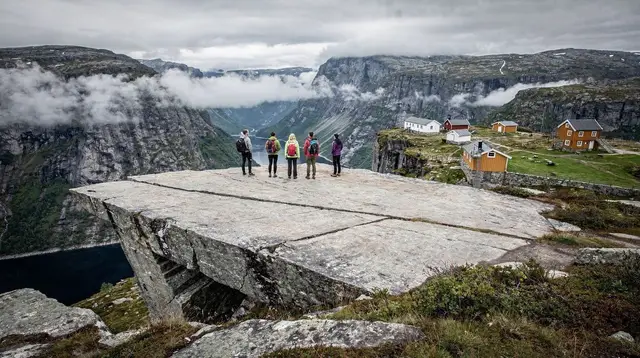
Most of what gets written about Preikestolen describes the summer version of the trail: an eight-kilometre round trip, four to five hours, roughly 350 metres of elevation gain, a well-trodden path used by around 300,000 people a year. That description is accurate from roughly May to September. It stops being accurate the moment snow settles on the plateau, and treating winter as simply a colder, quieter edition of the same walk is the single most common mistake visitors make. The distance and elevation gain on paper do not change. Almost everything else does.
This guide is specifically about what winter does to the Preikestolen trail itself — snow, ice, daylight, waymarking and the gear and experience you actually need. It does not cover the Lysebotn road closure that cuts off access to Kjerag for much of the year; that is a separate situation with its own logistics, covered in what closes in winter around Preikestolen and Kjerag.
When “Winter” Actually Starts and Ends
There is no fixed calendar date when the trail flips from summer to winter conditions, because it depends on snowfall in a given year, not the month on a clock. As a working guideline:
| Period | Typical conditions | How to treat it |
|---|---|---|
| Late April – mid May | Variable: some years mostly clear, others still snow-covered | Check recent trail reports before deciding |
| June – September | Bare rock and dirt path, official summer conditions | Standard day-hike planning applies |
| Late September – October | First snow possible at altitude, trail still mostly usable | Carry poles, watch the forecast |
| November – March | Full winter: snow, ice, short daylight | Treat as a winter mountain hike |
| Early-to-mid April | Often still icy underfoot even as lowland snow melts | Do not assume spring conditions from Stavanger’s weather |
The trail sits above sea level at Lysefjord, and snow at the plateau’s 604-metre elevation can linger well after Stavanger itself looks like spring. Checking conditions the week of your hike, not the season on a calendar, is the only reliable approach.
What Snow and Ice Do to the Route
The summer Preikestolen trail is a mix of gravel path, wooden boardwalk sections over boggy ground, and stretches of exposed rock slab. In winter, all three surfaces behave differently:
- Rock slabs turn to ice rinks. The smooth granite that is a minor scramble in dry summer conditions becomes genuinely dangerous once a thin layer of ice forms over it, particularly on the steeper early sections of the climb.
- Boardwalks disappear under snow and can hide uneven footing or gaps beneath the surface.
- The packed-snow path is not the same as the marked trail. Earlier hikers compress a route through the snow that often follows the general direction of the summer trail but can drift off it, especially around the exposed final approach to the plateau.
- The final stretch onto the plateau has no barrier at the cliff edge in any season. In winter, ice on the approach rock adds a fall risk that simply is not present in summer.
None of this means the hike is impossible. It means the terrain has to be read actively rather than followed passively, which is a different skill from summer hiking.
Daylight: The Constraint That Catches People Out
Stavanger sits at close to 59 degrees north, and winter daylight is genuinely short: around six to seven hours in December and January, compared with close to twenty hours around midsummer. A hike that takes four to five hours in summer can easily take six to eight hours in winter once you account for snow, ice, more cautious pace and route-finding around sections where the markers are buried. Do the arithmetic before setting off, not halfway up: a late start in December can mean finishing the descent in the dark, on ice, without the visibility to spot where the trail actually goes. Headlamps, spare batteries and a firm turnaround time are not optional extras in winter — they are the difference between an ordinary hike and an emergency.
Waymarking: Reliable in Summer, Not in Winter
From May to September, the Preikestolen trail is one of the best-marked hikes in Norway: red T symbols painted on rock, cairns, and a path worn so clearly by 300,000 annual visitors that getting lost takes real effort. Winter removes most of that reliability. Snow covers painted markers and low cairns. Fog and low cloud, common on the Lysefjord plateau, cut visibility to a few metres at exactly the point where you most need to see the next marker.
The safest approach is to check recent trail condition reports before you go — see our dedicated notes on trail conditions after rain and hiking Preikestolen in the rain for how quickly conditions shift here even outside the coldest months — and to turn back the moment you are unsure of the route rather than pushing on and hoping it reappears.
Gear: What Changes From the Summer Packing List
A summer Preikestolen hike needs sturdy shoes, layers and a rain jacket, covered in our general packing guide for hiking in Rogaland. Winter adds a shorter but non-negotiable list:
| Item | Why it matters in winter |
|---|---|
| Crampons or micro-spikes | Ice on rock slabs and the plateau approach is the main hazard |
| Trekking poles | Balance on packed snow and icy descents |
| Insulated, waterproof boots | Wet feet in freezing temperatures are a real risk, not just discomfort |
| Headlamp plus spare batteries | Short daylight means finishing in the dark is a realistic scenario |
| Warm layers plus a windproof shell | Wind chill on the exposed plateau is far sharper than in Stavanger town |
| Thermos with a hot drink | No cafe or shelter along the winter route |
| Fully charged phone plus a physical map | Cold drains batteries fast; do not rely on a phone alone |
None of this is exotic mountaineering equipment, but it is a step up from what a casual summer visitor typically brings, and it assumes you know how to use crampons and poles before you are on an icy slope, not once you get there.
Who This Hike Is Realistically For
Winter Preikestolen is not a beginner hike, and it is not the trail to attempt as your first experience with crampons. It suits people who have hiked in snow and ice before, who are comfortable turning back if conditions look wrong, and who plan around the short daylight window rather than around convenience. For a broader look at what does and does not work in the region during the colder months, see Stavanger in winter and the season-by-season overview in best time to visit Stavanger, month by month.
If that description does not match your experience level, a guided option is the more honest choice rather than a compromise. A guided winter hike to Pulpit Rock brings crampons and poles as part of the trip, a guide who reads the day’s specific ice and snow conditions, and a pace built around getting back down before dark — all things that are genuinely harder to arrange well on your own the first time.
Guided vs Independent in Winter
The trade-offs are more pronounced in winter than in summer, when the trail is busy and self-evident. In winter:
- Independent hikers need their own crampons and poles, up-to-date trail condition information, a firm daylight budget, and the judgment to abandon the hike if the plateau approach looks unsafe.
- Guided hikers get equipment, current local knowledge of where the ice actually is that week, and a group pace with a built-in decision-maker for turning back.
For visitors who want the structure of a guide but a slightly different format, a local guided hike in the area around Preikestolen run with small groups is worth comparing against the winter-specific option above, since availability and exact routing can vary by season. Those who prefer a private arrangement over a fixed departure time might look at a Pulpit Rock hike with a local guide, which tends to allow more flexibility around a shorter winter daylight window.
If You Still Want to Go Independently
Assuming you have the experience and equipment, a few practical points specific to winter:
- Check conditions the same week, not the same season — a mild week in January can be more walkable than a cold snap in November.
- Start early. With six to seven hours of daylight, an early departure is the single biggest safety margin you can create for free.
- Tell someone your plan and expected return time. Mobile coverage on the plateau is generally fine, but batteries fail faster in the cold.
- Turn back at any sign of ice you are not equipped for, rather than deciding partway up that you will manage on the way down too.
- Do not treat the packed-snow track as the guaranteed route. If it thins out or splits, stop and reassess rather than guessing.
For visitors who want the view and the fjord without the winter ascent, a wild hike to Preikestolen with a smaller group is one alternative worth comparing for scheduling, though the same winter caveats about ice, daylight and gear apply to it as to any version of this route between roughly October and April. A boat view of the plateau from the water, without the ascent at all, is also worth considering in winter — see our notes on Lysefjord cruises and whether seeing Preikestolen from the fjord is enough on a shorter winter visit.
Planning the Rest of a Winter Trip
If Preikestolen is one stop in a broader winter visit to the region, it is worth building the rest of the itinerary around the same short-daylight logic. The two-day Stavanger and Lysefjord itinerary sketches out a realistic pace for the season, and one day in Stavanger without a car covers what is workable in town on a day when the mountain plan falls through — which, in winter, it sometimes should. It is also worth reading how quickly forecasts here can mislead hikers into attempting the plateau in the wrong conditions, a pattern covered candidly in the weather app that lies about the plateau.
Winter does not make Preikestolen off-limits. It makes it a different hike from the one in every summer photo: shorter days, real ice, a route that needs actively reading rather than simply following, and gear that assumes you might need it. Plan for that hike, not the summer one, and the plateau is still there to be reached.
tours.pulpit-rock-hikes
Verified deep-linked GetYourGuide tours. Book through these links and we earn a small commission at no cost to you.
GetYourGuide does not provide a product photo for this activity — the image shows the meeting point, photographed by us.