Preikestolen from the Fjord: Is the View Enough?
Is seeing Preikestolen from a fjord cruise enough, or do you need to hike to the top?
A cruise shows you the scale of the cliff face and the fjord it hangs over, which the hike never shows you. The hike shows you the drop itself, standing at the unfenced edge 604 m above the water, which the boat never shows you. They are two different views of the same rock, not two ways of seeing the same thing.
Two Very Different Encounters with the Same Rock
Every summer, a good number of people stand on the deck of a Lysefjord boat, point a camera up at a grey shelf of rock 604 m above the water, and quietly wonder whether that counts as having “done” Preikestolen. It is a fair question, and it deserves a fair answer rather than a marketing one. The short version: a cruise and a hike are not the same experience with different price tags. They show you different things, from different positions, and neither one substitutes for the other. This guide is about deciding which one you actually need, not about talking you into the more expensive option.
If you have not yet compared cruise operators or routes, that ground is already covered in our guide to Lysefjord cruises departing from Stavanger and the equivalent cruises from Sandnes. If you are still deciding whether to attempt the trail at all, the practical walk-through of distance, time and elevation lives in our guide to how long the Preikestolen hike actually takes. This page assumes you have a rough sense of both options already and is here to help you choose, or to combine them properly.
What the Cruise Actually Shows You
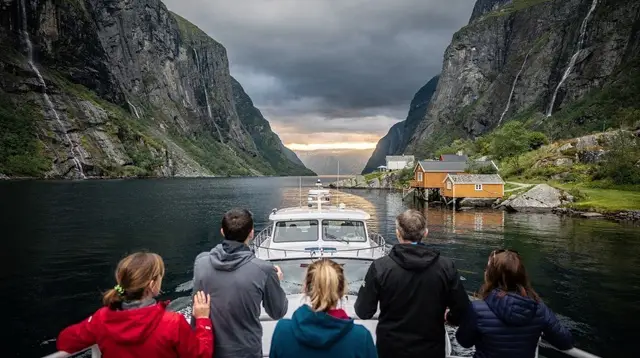
From the water, Preikestolen reads as a piece of the Lysefjord’s geology rather than a destination in its own right. You see the full height of the cliff at once, the plateau’s flat top set against 1,000 m fjord walls on the opposite shore, and a genuine sense of how deep and narrow this fjord is. Boats generally keep a respectful distance from the base of the cliff for safety, which actually helps the scale register: you are not craning your neck at a close wall, you are taking in the whole formation from a position that makes sense of it.
What the cruise does not give you is any sense of the drop itself. From below, Preikestolen looks solid and almost architectural, more like a shelf built into the rock than an edge with a void beyond it. People who have only seen it from the water are often surprised, when they later see photographs from the top, at how exposed the plateau actually is. The two views genuinely do not prepare you for each other. For a fuller sense of what is and is not visible on a typical sailing, see our guide to what a Lysefjord cruise actually shows you, which covers the rest of the route beyond just this one landmark.
Practically, a cruise past Preikestolen suits a specific kind of traveller well: someone on a tight schedule, someone travelling with a person who cannot manage an 8 km trail, someone visiting outside the hiking season, or someone who simply prefers boats to blisters. None of those are lesser reasons. A three-hour sailing that takes in Preikestolen, the fjord walls and often Flørli or other points along the water is a complete day out, not a consolation prize.
What the Hike Actually Gives You
The hike gives you exactly the thing the cruise cannot: the edge itself. Preikestolen’s plateau has a sheer drop on three sides and no railing, and standing near that edge, with the fjord 604 m directly below, is a specific physical sensation that no photograph or boat window reproduces. It is also, for most visitors, the entire point of making the trip to Rogaland in the first place. Full detail on distance, timing and elevation gain is in our dedicated guide to how long the hike takes, and on crowd patterns in our guide to avoiding the busiest hours on the trail, so this page will not repeat that ground.
What matters for this comparison is the direction of view. From the top, you look out along the Lysefjord rather than up at a cliff face — a completely different composition, and one that puts you, rather than the rock, at the centre of the photograph. You also get context the boat cannot offer: the texture of the plateau itself, glacier-scoured and uneven rather than flat, and the crowd of other hikers who have made the same climb, which is its own kind of scene in peak season.
The hike is not without real conditions attached. It requires roughly half a day, reasonable fitness, appropriate footwear, and — outside the main season — genuine caution around ice and snow, covered in our guide to hiking Preikestolen in winter. Rain changes the trail’s difficulty more than most visitors expect, which we address separately in our guide to what wet-weather conditions do to the route. None of this makes the hike impractical for most reasonably fit adults, but it does mean the choice between cruise and hike is not purely about interest — fitness, weather and time genuinely factor in.
Side by Side
| Cruise past Preikestolen | Hike to the plateau | |
|---|---|---|
| What you see | The full cliff face from the water, fjord scale | The drop, the plateau, the view along the fjord |
| Typical duration | 2-3 hours | 4-5 hours round trip |
| Physical demand | Low — sitting on a boat | Moderate — uneven terrain, real elevation gain |
| Weather sensitivity | Low — sailings run in most conditions | High — rain, wind and ice change the trail significantly |
| Cost structure | Paid ticket for the whole sailing | Free trail, paid trailhead parking |
| Best suited to | Limited time, limited mobility, poor hiking weather | Anyone who wants the edge experience and can manage the walk |
Neither column is the “better” one. They answer different questions about what kind of trip you want.
When the Cruise Alone Is the Right Call
There is no shame in choosing the boat and stopping there. It is the right call if you are docked for a single day from a cruise ship and need a landmark experience without a half-day commitment, if you are travelling with young children or a member of the group who cannot manage the trail, if the forecast is genuinely bad and the trail conditions are questionable, or if you simply are not interested in the physical challenge and would rather spend the day on the water taking in the whole Lysefjord rather than one landmark on foot.
Options here range from a straightforward Lysefjord boat trip to Preikestolen departing from Forsand, which keeps the sailing itself short and focused, to fuller-route sailings such as the Lysefjord and Pulpit Rock boat tour from Sandnes, which spends more time on the fjord beyond just this one stretch. If you want more detail on comparing sailings by length and departure point before booking, see our guide to how long each cruise option takes and which to pick.
When the Hike Is Worth the Effort
Choose the hike, on its own or in addition to a cruise, if the point of your trip is specifically to stand at that edge and feel the exposure rather than observe it from a distance. It is also the only option if you want a photograph taken from the plateau rather than of it — a distinction that matters more to most people, once it is spelled out, than it initially sounds. If you are also weighing Preikestolen against the significantly more demanding hike to Kjeragbolten, our comparison of how different the two hikes actually are lays out which suits which kind of hiker.
If a full boat sailing feels too slow and you want a faster, more physical way to see the fjord from the water before or after the hike, a Lysefjorden Pulpit Rock RIB safari from Stavanger covers similar ground to a standard cruise in less time and with more of the fjord’s texture at speed — worth reading about first in our guide to what a RIB safari on the Lysefjord actually involves.
Doing Both, Properly
Combining the two is entirely realistic if you plan the day around it rather than trying to improvise. The hike alone takes 4-5 hours round trip; a cruise typically runs 2-3 hours. Attempting both from a single base in one day is possible but long, and it works far better if you treat the cruise as a way to see Preikestolen from an angle you will not get on the trail, rather than as a shorter alternative squeezed in before or after the walk.
Some operators simplify this by combining the two directly, such as guided packages that pair a fjord sailing with a supported ascent — worth checking under combining the Preikestolen hike with a Lysefjord cruise before you book two separate tickets and end up duplicating transport. For hikers who would rather have local knowledge on the trail itself, locally guided hikes around Preikestolen can also fold in fjord context you would otherwise only get from the water.
Practical Notes Before You Choose
Departure point matters more than it might seem. Sailings run from both Stavanger and Sandnes, and picking the one closer to your accommodation saves real time on transfer days — our guide to cruises departing from Sandnes covers that side of the fjord specifically. If you are relying on public transport rather than a car, see getting to Preikestolen without a car, which also touches on how cruise departures fit into a car-free itinerary.
Season shapes this decision more than most visitors expect. Outside roughly May to September, snow and ice make the trail considerably harder and less predictable, while cruises generally keep running in some form through more of the year — though schedules thin out considerably. Our guide to the best season for a Lysefjord cruise and the seasonal notes in hiking Preikestolen in winter both go into this in more depth than belongs here.
For a same-day framing that puts this whole decision into an itinerary, see our one-day Lysefjord cruise itinerary if you are leaning toward the boat, or our two-day Stavanger and Preikestolen itinerary if you want room to do both properly rather than rushing either one. Broader operator and route options for the water portion sit under our Lysefjord activities hub.
The One Thing Not to Do
Do not let anyone, including a well-meaning tour brochure, tell you that a cruise past Preikestolen and a hike to its summit are interchangeable ways of “seeing” it. They are not competing products aimed at the same experience — they are two different vantage points on the same landmark, one showing you the rock from outside, the other putting you on top of it with nothing between you and the drop. Pick based on what you actually want to feel at the end of the day, not on which option is faster to book.
FAQ: Choosing Between the Cruise and the Hike
Can you see Preikestolen properly from a Lysefjord cruise?
Yes, you can see it clearly from the water, usually from a few hundred metres out, and get a real sense of how the plateau sits above the fjord. What you cannot see from a boat is the drop itself, the width of the plateau, or the view out over the fjord from the top.
Is the boat view a good substitute for the hike?
It is a different experience, not a substitute. The boat shows scale and setting from below; the hike shows exposure and view from above. Choose based on what you actually want, not on treating one as a lesser version of the other.
Who should just do the cruise and skip the hike?
Anyone short on time, travelling with limited mobility, uncomfortable with unfenced heights, or visiting outside the hiking season without proper winter gear. A cruise past Preikestolen is a legitimate, complete experience on its own terms.
Who should do the hike even if they also take a cruise?
Anyone who wants the specific sensation of standing at the edge with no railing, or who wants photos taken from the plateau rather than of it. That experience only exists at the top.
Can you do both in one day?
Yes, but plan carefully. The hike alone takes 4-5 hours round trip, and cruises typically run 2-3 hours, so combining both makes for a long day. Some operators sell combined cruise-and-hike products that handle the logistics for you.
Does the cruise get closer to Preikestolen than photos suggest?
Boats generally hold a respectful distance from the cliff base for safety, so you see the full sweep of the rock face rather than a close-up. It reads as more impressive in person than in most photos, mainly because of the surrounding fjord walls.
Is one option cheaper than the other?
The hike itself is free once you reach the trailhead, though trailhead parking is paid. A cruise is a paid ticket regardless. Overall cost depends more on which tour or ferry you book than on hike versus cruise as a category.
tours.fjord-cruises
Verified deep-linked GetYourGuide tours. Book through these links and we earn a small commission at no cost to you.
GetYourGuide does not provide a product photo for this activity — the image shows the meeting point, photographed by us.