Preikestolen Trail Conditions After Rain
What are trail conditions like on Preikestolen after rain?
After rain, the granite slabs near the plateau turn slick and boardwalk sections can pool with water, while low-lying stretches stay muddy for a day or two afterward. The trail remains open and clearly marked, but expect a slower, more deliberate hike than in dry conditions.
What a Wet Trail to Preikestolen Actually Looks Like
Rogaland receives somewhere around 1,180 to 1,250 mm of rain a year, which means the Preikestolen trail spends a meaningful share of any given month damp in one place or another. Our guide on hiking Preikestolen in the rain covers what to wear and carry while a shower is actually falling on you. This page picks up where that one leaves off: what the ground itself is like once the rain has stopped, sometimes for hours, sometimes still lingering from the day before.
The short version is that the trail does not behave the same way twice. A route that felt like a brisk, sure-footed walk on a dry August afternoon can feel like a genuinely different hike after a wet night in October, with the same distance and the same elevation gain but a noticeably slower, more deliberate pace required to cover it safely.
Why This Trail Reacts to Rain the Way It Does
The path up to the plateau above the Lysefjord alternates between three kinds of surface, and each one responds to moisture differently.
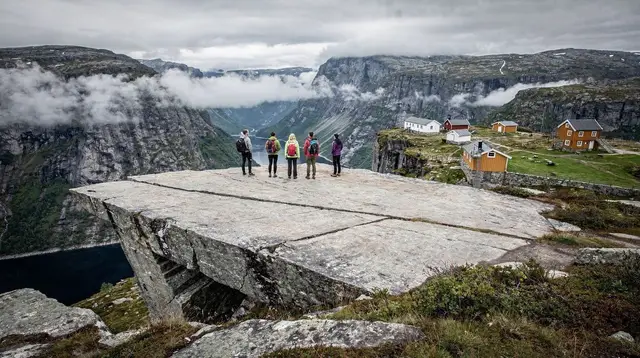
Bare granite slabs. Long stretches of the route cross exposed rock rather than dirt path. Granite itself is not inherently treacherous, but decades of boots crossing the same lines have polished certain sections smooth, and smooth wet rock holds far less grip than the coarser stone nearby. Water does not soak into granite the way it does into soil, so a rain shower leaves a thin film sitting directly on the surface you are walking on, rather than draining away.
Boardwalk and duckboard sections. Several of the wetter or boggier stretches have been fitted with wooden boardwalks to keep hikers off saturated ground. These boards are a real improvement over the mud beneath them, but wet wood carries its own slip risk, especially where boards have worn smooth or where morning dew and rain combine before the sun has had a chance to dry the surface.
Low ground between rock outcrops. The trail dips through several shallow depressions where soil rather than rock forms the walking surface. These are the sections that turn to mud after sustained rain, since they collect runoff from the surrounding higher, rockier ground rather than shedding it.
None of this makes the trail impassable. It is a well-marked, heavily used route, walked by roughly 300,000 people a year, and the Norwegian Trekking Association and local trail crews maintain it actively. But “maintained” and “uniformly dry” are two different things, and treating the trail as if it behaves identically in every weather sets hikers up for a rougher day than they expected.
Reading the Trail by How Recently It Rained
Trail condition depends less on whether it is raining right now than on how much rain has fallen over the preceding day or two, and how much sun and wind have had a chance to work on it since.
| Recent weather | What to expect underfoot | Realistic pace impact |
|---|---|---|
| Dry for 2+ days, no rain forecast | Firm rock and dirt throughout, only shaded patches possibly damp | Standard 4-5 hour round trip |
| Light shower within the last few hours | Damp but not slick rock, boardwalks starting to dry | Modest slowdown, extra care on slabs |
| Heavy rain overnight, clear morning | Slick granite on shaded slabs, some standing water on boardwalks, muddy low points | Noticeably slower, plan extra 30-60 minutes |
| Sustained rain over 2+ days | Persistent mud in low sections, wet rock throughout, reduced visibility possible | Consider postponing if inexperienced |
| Rain actively falling | All of the above plus reduced grip from wet gear and cold hands | See our separate guide on hiking in active rain |
This is a rough guide rather than a formula — wind matters as much as sunshine for drying exposed granite, and a breezy morning after rain often clears the rock faster than a still, overcast one. The point of the table is simply that “it rained” is not one condition; it is a range, and the far end of that range (multiple wet days back to back) is a genuinely different hike from the near end (a passing shower the evening before).
The Sections Hikers Report as Worst
Talking to people coming down the trail after wet weather turns up the same handful of trouble spots repeatedly.
The middle stretch of exposed rock, before the trail flattens out toward the final approach, tends to hold water in shallow depressions worn into the granite by years of foot traffic. These puddle up during rain and stay slick for a while after, since they sit in partial shade for much of the day.
The final approach onto the plateau itself, where the trail narrows and crosses smoother rock close to open ground, is where extra caution matters most. It is not that this section is objectively steeper than what came before, but that a slip here has less margin, and wet rock is exactly where a normally sure-footed step can go wrong. This is also the stretch nearest the cliff edge itself — Preikestolen has no barrier at the drop, and that fact matters more, not less, when the rock underfoot is wet.
Lower boggy dips, particularly the ones closer to the Preikestolen fjellstue trailhead where the path crosses flatter ground, are where mud rather than slick rock becomes the main issue. These sections rarely present a fall risk on the scale of the exposed granite higher up, but they are where boots and trouser cuffs pick up the most mud, and where a misjudged step can mean an ankle-deep puddle rather than a scenic photo stop.
Descending Is Where Most People Notice the Difference
Hikers consistently report that wet conditions matter more on the way down than on the way up. Climbing on damp rock is manageable because body weight and momentum are moving into the slope; descending, especially on smooth or worn granite, asks more of ankles, knees, and grip, since a slip tends to happen forward and downhill rather than being caught by the next step.
This is worth planning around rather than discovering partway down. Building in extra time for the descent after rain, rather than assuming the return leg will match the ascent’s pace, is one of the simpler ways to keep a wet-weather hike from feeling rushed or stressful near the end.
What Actually Helps on a Wet Trail
Footwear does more work here than almost anything else in the pack. Boots or trail shoes with deep, aggressive lugs grip wet granite meaningfully better than worn-out soles or anything closer to a street sneaker, and the difference shows up most on the smoother, polished rock sections rather than the rougher stone nearby. Trekking poles help on the muddy low sections and on the descent generally, giving an extra point of contact exactly where footing gets less predictable.
Pace matters more than gear. Slowing down on the slick sections, planting each foot deliberately rather than walking at a dry-day rhythm, accounts for more of the safety margin than any single piece of equipment. Hikers who treat a post-rain trail like a dry one, simply because the sky has cleared, are the ones who tend to slip.
For anyone who would rather not read trail conditions themselves in real time, going with a local guide takes that judgment off your hands entirely.
a local guided hike around Preikestolen puts someone with daily knowledge of current conditions in front of you, which matters more after rain than in dry, predictable weather. If you would rather see the plateau from the water first and decide about the trail afterward, a boat trip toward Preikestolen from Forsand gives you a look at the cliff and the fjord below it without committing to the climb.
And for a full day built around a guided ascent rather than a solo attempt, a guided Pulpit Rock hike with a local guide is worth considering specifically on days when the forecast has been wet.
Timing a Hike Around Recent Rain
Checking the forecast for the hike day itself is only half the picture; the more useful number is how much rain has fallen over the preceding 24 to 48 hours. A dry morning after two wet days is not the same trail as a dry morning after two dry days, even though both might show identical conditions on the forecast app.
Our guide to avoiding the busiest hours on the trail and the one covering how long the hike actually takes both assume roughly dry conditions as a baseline. After rain, add time rather than subtract it, and treat the standard four to five hour estimate as a floor rather than a target.
For visitors without their own transport, the Preikestolen shuttle bus runs on a schedule regardless of weather, which is worth factoring in if a wet trail slows your pace enough to affect a return connection. Anyone weighing whether to drive to the trailhead versus arriving without a car should also note that the parking area itself is paid, separate from the free trail and plateau.
Rain Doesn’t Mean the Trail Is Off Limits
None of this is meant to talk anyone out of hiking to Preikestolen in less-than-perfect weather. Given Rogaland’s rainfall totals, insisting on a fully dry trail would rule out a large share of the calendar year, and plenty of experienced hikers consider a quieter, damp trail with dramatic cloud over the Lysefjord a fair trade for slower footing. The Norwegian Petroleum Museum and other indoor options nearby remain a reasonable backup for the days when the forecast genuinely does not cooperate, but a single wet night rarely rules out the hike itself.
What matters is matching expectations to actual conditions rather than to a generic “the trail is fine” assumption. The mistake worth avoiding is treating Preikestolen as uniformly easy in every season and every weather, when in practice its difficulty swings meaningfully with how recently and how heavily it has rained. A trail that is a brisk, confident walk in August sun can be a careful, poles-out, extra-hour undertaking after two days of autumn rain, and planning for the version of the trail you are actually likely to meet — rather than the one in the brochure photo — is what keeps a wet-weather hike enjoyable rather than stressful.
For those who would still rather not gamble on conditions at all, a guided hike led by someone tracking current trail conditions removes the guesswork, particularly valuable in the shoulder seasons when rain and cold overlap. It is also worth reading our broader rain-proof Stavanger itinerary if the forecast for your whole trip, not just hike day, looks unsettled, and our comparison of the fjord cruise versus the hike itself if wet trail conditions have you weighing an alternative to the climb entirely.
Anyone building a longer visit around the region should also check our two-day Stavanger and Preikestolen itinerary, which builds in a buffer day precisely for weather like this, and our general packing notes for hiking gear suited to Rogaland’s climate.
Preikestolen After Rain: Common Questions
How long does it take for the Preikestolen trail to dry out after rain?
Exposed granite sections often dry within a few hours of sunshine and wind, but shaded, low-lying stretches and boardwalk sections can stay damp or muddy for one to two days, especially after a prolonged spell of rain rather than a single shower.
Which sections of the trail get the worst after rain?
The bare rock slabs in the middle third of the route and the final approach onto the plateau are the sections hikers report as most slippery, since water sits on smooth granite rather than draining away. Low dips between rock outcrops are where mud collects.
Is the granite near the plateau dangerous when wet?
It becomes noticeably more slippery, particularly where the rock has been polished smooth by decades of foot traffic. It is not roped or railed, so a slip near the edge carries real consequences, and hikers should slow down and test their footing rather than walking at a dry-day pace.
Should you cancel a Preikestolen hike if it rained the night before?
Not necessarily. A single evening shower followed by a dry, breezy morning often leaves the trail only briefly slick in shaded patches. A cancellation is more warranted after multiple days of sustained rain, when mud has built up and rock has had no chance to dry between showers.
Do you need different footwear for a wet trail?
Yes. Trail shoes or boots with grippy, deep-lugged soles make a real difference on wet granite, while smooth-soled sneakers or sandals become genuinely risky. Trekking poles also help on the muddier low sections, where the ground can be uneven underfoot.
Is the trail ever closed because of rain?
Rain alone rarely closes the Preikestolen trail, since it is a marked, maintained route rather than a technical climb. Closures are far more tied to winter ice and snow than to rainfall, though staff at the trailhead may still advise caution or discourage less experienced hikers during heavy, sustained downpours.
Does rain affect the descent more than the climb?
Many hikers find the descent feels harder in wet conditions, since going downhill on slick rock puts more strain on ankles and knees and makes controlled footing more important. The climb is more about pacing and stamina; the descent is where slips are more commonly reported.
How does trail condition compare between spring and autumn rain?
Autumn rain tends to fall on ground that is already saturated from a wet Rogaland summer, so mud accumulates faster and takes longer to firm up. Spring rain often follows drier winter ground, so puddles and mud can clear more quickly once a dry spell returns.
tours.pulpit-rock-hikes
Verified deep-linked GetYourGuide tours. Book through these links and we earn a small commission at no cost to you.
GetYourGuide does not provide a product photo for this activity — the image shows the meeting point, photographed by us.