What's Closed in Winter: Preikestolen and Kjerag
What actually closes in winter around Stavanger, Preikestolen and Kjerag?
The Lysebotn road that leads to Kjeragbolten's trailhead closes for the season once snow makes it impassable, cutting off that hike entirely until it reopens. Preikestolen itself stays open all year, but outside roughly May to September the trail gets icy and uneven, so it needs proper footwear and daylight planning rather than a casual approach.
If you are planning a Rogaland trip for anything between October and April, the single most useful thing you can learn before you book flights is this: not every famous view in this region behaves the same way once the weather turns. Some sites shut down in a real, physical sense. Others simply get harder, slower and less forgiving. Knowing which is which saves you from either cancelling a trip you didn’t need to cancel, or showing up at a locked road with a rental car and no plan B.
Two very different kinds of “closed”
It helps to separate two things that get lumped together in casual trip planning: a site being physically inaccessible, and a site being merely more demanding. Around Stavanger, winter produces both, and they call for opposite responses.
Physically inaccessible means the road or the transport link you need simply is not operating. No amount of fitness, gear or determination gets you past that, because the obstacle isn’t the trail — it’s the way in. The Lysebotn road that serves the Kjerag trailhead falls squarely into this category for a stretch of most winters.
Harder but open means the site itself is available, but the experience changes: ice instead of dry rock, four or five hours of daylight instead of eighteen, wind that makes an exposed plateau considerably less comfortable. Preikestolen is the clearest example of this second category, and it’s the one most likely to catch visitors off guard, because “open” quietly comes with new conditions attached.
This page exists to keep those two categories straight, and to point you toward the dedicated guides for each site rather than trying to repeat everything about them here.
What actually closes: the road to Kjerag
Kjeragbolten, the boulder wedged in a crevasse above the Lysefjord, is reached from Øygardstølen, at the top end of the road down to Lysebotn. That road is narrow, switchbacked, and runs through terrain that collects heavy snow. For a substantial part of the winter, it is closed to traffic — not as a formality, but because it becomes unsafe or physically impassable.
There is no fixed date attached to this closure, and treating it as if there were is the single most common planning mistake we see. Snowfall varies from year to year, spring thaws arrive early in some years and late in others, and the road’s operators judge each season on the conditions they’re actually looking at, not a calendar. A guide that printed “closes November 1, reopens May 15” would be wrong most years — sometimes wrong in both directions.
What this means in practice:
- If your trip falls in the core winter months, assume the Lysebotn road will be closed and build your itinerary around Preikestolen or a Lysefjord cruise instead of Kjerag.
- If your trip falls in a shoulder month — say, late April or October — check current status close to your travel dates rather than months in advance. Status pages and local operators update far more reliably than any fixed date a guide could give you.
- If Kjeragbolten is the one thing you came for, consider shifting your dates toward the middle of summer, when the road is reliably open, rather than gambling a long-haul trip on a shoulder-season road.
For the deeper comparison of what each hike actually demands once you do reach it, see our guide on Kjeragbolten versus Preikestolen, and for anyone weighing whether to attempt Kjerag with a guide at all, this guide covers that decision separately.
What stays open but changes: Preikestolen in winter
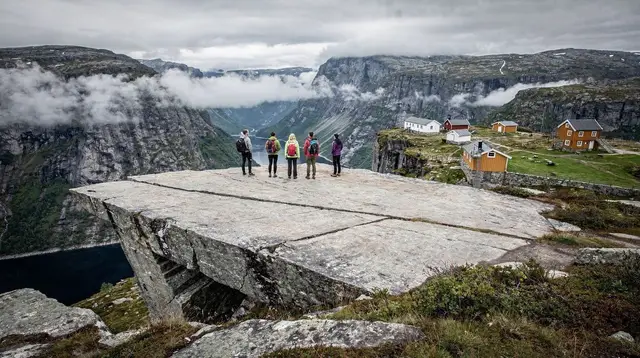
Unlike the Lysebotn road, Preikestolen has no gate, no season ticket and no official closure. The plateau at 604 metres above the Lysefjord is there in January the same as it is in July. What changes is everything around it.
The standard summer trail — around 8 km round trip, 4 to 5 hours, roughly 350 m of elevation gain — is well marked and heavily used from roughly May through September. Outside that window, several things stack up against a casual attempt:
- Ice and packed snow on sections of exposed rock and boardwalk, which are the same sections that see the heaviest foot traffic in summer and can turn genuinely slippery in winter.
- Short daylight, which in Norwegian winter can mean starting and finishing a multi-hour hike within a narrow window, with little margin for a slow pace or a late start.
- Weather that changes fast, since the plateau sits exposed with a sheer, unfenced drop on three sides — not a place where you want to be caught by sudden wind or reduced visibility.
- Fewer other hikers around, which cuts both ways: less crowding, but also less help nearby if something goes wrong.
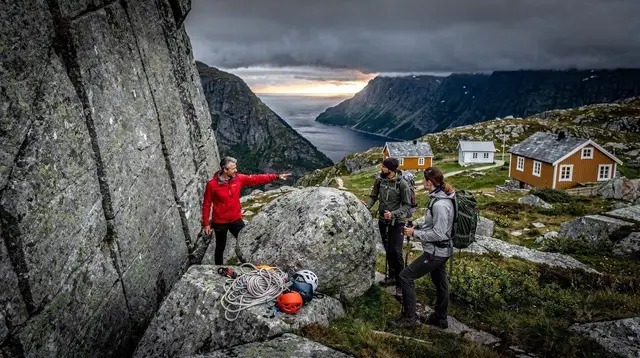
None of this means Preikestolen is off-limits in winter. It means the trip stops being the low-commitment walk it can feel like in August, and starts requiring the same basic respect you’d give any winter hike at altitude: proper boots or ice cleats, a headlamp, warm layers, and a realistic look at the weather forecast before you commit. Many visitors choose a guided winter hike specifically because a local guide reads conditions daily in a way a one-off visitor cannot. Our dedicated guide on Preikestolen in winter goes into trail-by-trail detail; this page is only the summary.
A quick reference table
Because these sites don’t all follow the same rules, a side-by-side view is often more useful than a paragraph per site.
| Site | Winter status | What actually happens |
|---|---|---|
| Preikestolen trail | Open year-round | No closure, but ice, short daylight and exposed terrain make the hike considerably harder than the summer version |
| Lysebotn road / Kjerag access | Closed for part of most winters | Snow and avalanche risk shut the road; no fixed reopening date, checked season by season |
| Lysefjord cruises | Generally running | Weather-dependent on any given sailing, but not seasonally shut down the way the road is |
| Flørli’s 4,444-step staircase | Not gated, but discouraged | Icy wooden treads and reduced ferry service make it a poor winter choice in practice |
| Månafossen waterfall trail | Open, conditions vary | A moderate trail near Frafjord that gets muddier and icier, without a formal closure |
| Gamle Stavanger, city sights | Unaffected | Indoor and street-level attractions in Stavanger itself run normally through winter |
Use this table as a starting point, not a substitute for checking conditions in the days before you travel. Snow years differ enough that a table fixed in September, however carefully written, cannot promise what a specific week in January will look like.
Why the fjord itself is often the better winter answer
If the road to Kjerag is closed and the Preikestolen trail feels like more commitment than you want in poor weather, the Lysefjord itself remains genuinely accessible by water for most of the winter. A cruise doesn’t fight snow or ice the way a mountain trail does, and it delivers scale that a trailhead view can’t: the fjord’s roughly 42 km length, walls exceeding 1,000 metres in places, and Preikestolen’s underside seen from below rather than above.
This is also where a guided option earns its keep. A combined cruise-and-hike trip run by an operator who checks conditions daily removes the guesswork of deciding for yourself whether a given day’s ice or wind makes the plateau worth attempting.
a winter cruise that combines the Lysefjord by boat with a guided hike up to the plateau is built around exactly this trade-off, pairing the reliable fjord crossing with a hike led by someone reading the trail’s actual condition that day, rather than a summer itinerary applied blindly to a January morning.
For hikers who specifically want the Preikestolen ascent itself, without adding a boat leg, a guided winter hike up to Pulpit Rock is the more direct option, with equipment and pacing suited to icy sections rather than the bare trail markers you’d rely on in summer.
If your group is undecided between the water and the trail, a combined Lysefjorden cruise and Preikestolen hike gives you both without having to choose in advance, which is a reasonable hedge against a forecast that might turn either the water or the trail into the less appealing half of the day.
Planning around uncertainty rather than a date
The honest answer to “when does it close” and “when does it reopen” is that neither has a fixed date, and any source that gives you one is guessing. The practical approach is different from date-hunting:
- Decide which experience matters most to you — standing on Kjeragbolten specifically, reaching the Preikestolen plateau, or simply seeing the Lysefjord’s scale. Only the first of these is genuinely at risk from a winter trip.
- Build flexibility into your itinerary rather than a single fixed day for the big hike. Our two-day Stavanger and Lysefjord itinerary is built with that kind of slack, so a weather day doesn’t collapse the whole trip.
- Check status close to arrival, not months ahead. Road and trail conditions are reported far closer to real time than any published guide can be, ours included.
- Have a fjord-based plan B. Because cruises are far less likely to be cancelled outright than a mountain hike is to be unsafe, keeping a boat option in your back pocket protects the trip even if the weather closes both the road and the trail on the same day.
- Consider a guided option for anything above the treeline in winter. The value isn’t just safety — it’s that a local guide already knows today’s actual conditions, rather than yesterday’s forecast or last week’s trail report.
If Kjerag turns out to be off the table for your dates, it’s worth reading honestly about what that hike actually involves before you plan around chasing it in a different season — see our piece on why Kjerag is closed more than it’s open for the fuller picture, and no northern lights in Stavanger if you’re weighing a winter trip against other seasonal expectations that don’t quite hold up here either.
Rogaland winter, in one sentence
Nothing about a Stavanger winter trip needs to be improvised at the last minute if you separate the two categories early: assume the Lysebotn road to Kjerag may be closed and build around that, and treat Preikestolen as open but demanding rather than as a simple summer walk moved to a colder month. For the month-by-month view of how the whole region behaves across the year, our guide to the best time to visit Stavanger puts this specific winter picture into its full seasonal context, and our broader look at what you can actually do in Stavanger in winter covers the activities that fill the gap when the mountains are less cooperative.
Winter closures around Stavanger and Lysefjord: your questions answered
Is Preikestolen closed in winter?
No. Preikestolen is never officially closed, and there is no gate or season ticket. What changes is the trail condition: ice, snow and short daylight make the same 8 km round trip considerably harder and slower than in summer, and the plateau’s unfenced edge is less forgiving underfoot.
Can you still hike to Kjeragbolten in winter?
Realistically, no. The Lysebotn road that gets you to the Øygardstølen trailhead is closed by snow for a large part of the year, so most winter visitors simply cannot reach the start of the Kjerag trail, regardless of their own fitness or gear.
When does the Lysebotn road close and reopen?
There is no fixed calendar date. The road closes when snow and avalanche risk make it unsafe, and reopens once conditions allow clearing and inspection, which varies from year to year. Always check current status shortly before travelling rather than planning around a remembered date.
Do I need crampons or special gear for Preikestolen in winter?
Many winter hikers use ice cleats or crampons for the exposed rock sections and carry poles for balance. It is not mandatory equipment in a legal sense, but attempting the trail in ordinary trainers after a freeze is a common way people slip on the approach.
Is a Lysefjord cruise still possible in winter?
Yes, fjord cruises generally keep running through the colder months, weather permitting on any given sailing, and they are one of the few ways to see the Lysefjord’s walls and Preikestolen’s underside when the overland trail is at its hardest.
Are Flørli’s 4,444 steps affected by winter?
The staircase itself is not seasonally gated, but ice on the wooden treads and reduced ferry frequency to Flørli in the off-season make winter a much less practical time to attempt it than late spring through early autumn.
What is the safest winter activity if the big hikes are off the table?
A guided winter hike on Preikestolen with proper equipment, or a fjord cruise from Stavanger or Sandnes, both keep the season’s signature views accessible without relying on a mountain road that may or may not be open.
tours.winter-activities
Verified deep-linked GetYourGuide tours. Book through these links and we earn a small commission at no cost to you.
GetYourGuide does not provide a product photo for this activity — the image shows the meeting point, photographed by us.