Lysefjord Cruise from Stavanger
How long is the Lysefjord cruise from Stavanger, and what does it actually show you?
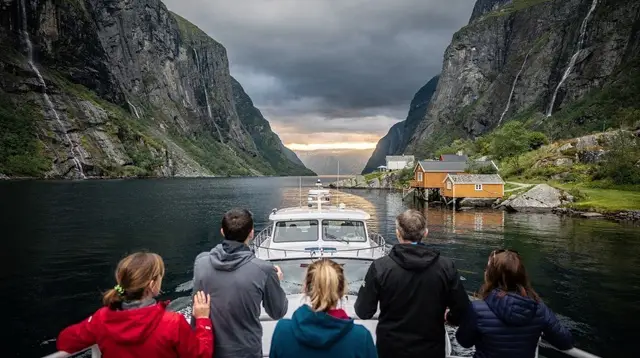
The standard Lysefjord cruise from Stavanger runs about two to three hours round trip, sailing past cliffs that rise more than 1,000 metres above the water and turning back below Preikestolen without anyone setting foot on the trail. It is a fixed-schedule boat with commentary, not a RIB safari, so expect a slower, drier, more comfortable way to see the fjord.
Seeing the Fjord Without Climbing to It
The Lysefjord is roughly 42 km long, and in places its rock walls rise more than 1,000 metres straight out of the water. Almost everyone who visits Rogaland has seen a photograph of it, usually taken from above — from the plateau at Preikestolen or the boulder at Kjeragbolten. What those photos leave out is the view from the other direction: sitting at the base of that 1,000-metre wall, looking up.
That is what a Lysefjord cruise from Stavanger gives you, and it is the reason the cruise exists as its own category of trip rather than just a boring alternative to the hike. You do not climb anything. You do not need boots, poles, or four to five hours of daylight. You board a boat in the harbour, and the fjord’s scale does the rest of the work.
This guide covers the classic, scheduled Lysefjord cruise departing from Stavanger — what it includes, how long it takes, and how it differs from the two other water-based ways to see the same fjord: the boat leaving from Sandnes, and the RIB safari. If you are trying to decide between a cruise and a hike in the first place, that is a separate question, covered in our guide comparing a fjord view from the water against actually standing on the plateau.
What “the Classic Cruise” Actually Means
Several operators run boats onto the Lysefjord from Stavanger, and the products vary in vessel type — a standard passenger ferry, a hybrid-powered ship, a fully electric ship — and in exactly how the commentary and route are framed. What they share is the basic shape of the trip: a fixed departure time, a fixed route out along the fjord to the cliffs below Preikestolen, and a return to the harbour, all without anyone leaving the boat.
That shared shape is what separates a cruise from a RIB safari. A RIB is a small, open, high-speed inflatable boat that goes faster, gets closer to the rock and to waterfalls along the shoreline, and soaks its passengers in spray as a matter of course. A cruise ship is larger, mostly or partly covered, moves at a steady cruising speed, and is built around comfort and commentary rather than an adrenaline hit.
Neither is “better” in the abstract — they are different products for different people, and mixing them up when you book is the single easiest way to end up disappointed. If you booked a calm scheduled cruise expecting speed and spray, or booked a RIB expecting a dry seat and a coffee, you picked the wrong boat. Our dedicated comparison lays out that difference in more detail.
a standard fjord cruise to Lysefjord and Pulpit Rock is the most straightforward version of this trip: board in Stavanger, sail the fjord, see the cliffs below Preikestolen, come back. It is the option to default to if you have no particular reason to pick anything more specialised.
How Long It Takes
Expect a round trip of roughly two to three hours from the Stavanger harbourside. That figure covers the sailing time out along the fjord to the cliffs beneath Preikestolen and back — it is not a full-day excursion, and it does not stop anywhere en route for a meal or a walk.
Some products are built around a fixed, named duration and a guide narrating the route throughout, such as a two-hour guided cruise to Pulpit Rock and beyond, which keeps close to that shorter end of the window while still reaching the cliffs. Others frame the same core route as part of a slightly longer sailing, particularly when the itinerary continues further up the fjord or combines the cruise with another stop. If your day has a hard deadline — a flight, a train, another activity booked for the afternoon — check the specific listed duration for whichever departure you book rather than assuming every option runs to the same length.
What’s Included, and What Isn’t
A cruise ticket buys you a seat on the boat — usually a mix of indoor seating and open outdoor deck space — plus the route itself and commentary on the landscape, the fjord’s geology, and its history. It does not typically include a meal, though food and drink are usually available for purchase onboard, and it does not include anything on land: no transfer to Preikestolen’s trailhead, no time on the plateau, no hiking of any kind.
| What you get | What you don’t get |
|---|---|
| A scheduled sailing along the Lysefjord | A stop at the Preikestolen trailhead |
| A close view of the cliffs below Preikestolen, from the water | Time on the Preikestolen plateau itself |
| Onboard commentary on the fjord’s landscape and history | A guaranteed meal (usually available to buy, not included) |
| Deck access for photos of the rock walls | The speed, spray, and closer approach of a RIB |
This is the crux of the “no confusion” rule that matters most for this trip: a cruise shows you the cliffs below Preikestolen, it does not put you on top of them. If seeing the plateau from underneath is enough for your trip, the cruise delivers that fully. If your goal is to actually stand at 604 metres above the fjord, you need the hike as well — our guide on whether the boat view is enough covers that decision directly, since it is the single most common source of disappointment among cruise passengers who expected something the boat was never built to provide.
The Scale You’re Actually Looking At
It is worth knowing, before you board, roughly what you are looking at, because the Lysefjord’s numbers are the whole point of the trip. The fjord runs about 42 km from its mouth near Forsand to its innermost point at Lysebotn. Its walls, in the stretch the cruise typically covers, rise well over 1,000 metres in places — more than double the height of most of the tallest buildings on earth, rising directly out of water that is itself up to roughly 400 metres deep in parts of the fjord.
A boat puts those numbers in front of you in a way that no photograph quite manages, because you are moving past the scale rather than looking at a single framed shot of it. The cliffs below Preikestolen are the highlight most cruises are built around, but the same walls continue well beyond that point toward Lysebotn, and further up the fjord toward Flørli and its famous 4,444-step wooden staircase, though most standard cruises from Stavanger turn back before reaching that far.
Stavanger or Sandnes: Where Should You Board?
Stavanger and Sandnes both sit on the same body of water and both run scheduled cruises onto the Lysefjord, so the fjord you see is essentially the same regardless of which harbour you leave from. The practical difference is logistics: where you are staying, how the specific departure times line up with your day, and which harbour is easier for you to reach.
If you are staying in central Stavanger, departing from the city’s own harbour usually saves you a transfer. If your accommodation or itinerary puts you closer to Sandnes, or if a Sandnes departure’s schedule simply fits your plans better, it is worth comparing both directly rather than assuming Stavanger is automatically the right choice. Our companion guide to the Sandnes departure covers timing and access from that side in full, so treat this section as the flag to go read it before booking if you are unsure which harbour suits your trip.
Cruise, RIB, or Hike — Picking the Right Trip
Because “see the Lysefjord” can mean at least three different products, it is worth being explicit about how they differ before you book anything.
| Option | Pace | What you get wet with | Time commitment |
|---|---|---|---|
| Standard fjord cruise | Steady, scheduled | Nothing, under normal conditions | Around 2-3 hours |
| RIB safari | Fast, close to the rock | Spray, routinely | Often shorter, more intense |
| Hike to Preikestolen | Walking pace | Weather-dependent | Around 4-5 hours on the trail alone |
A cruise, such as the hybrid-ship cruise to Lysefjord and Preikestolen or the electric fjord cruise to Lysefjord and Preikestolen, suits travellers who want the fjord’s scale without a hike, who are travelling with people who cannot manage the Preikestolen trail, who have limited time in Stavanger, or who simply prefer a calmer, drier experience.
If speed and closer contact with the water and cliffs matter more to you than comfort, a RIB is the better match — our RIB-specific guide covers what that trip actually feels like and what to wear for it, since it is genuinely a wetter, rougher experience than a cruise and worth going in prepared. And if standing on the plateau itself is the actual goal, no boat trip substitutes for the hike; some operators do combine a cruise with a guided hike in a single day, an option covered separately for travellers who want both.
Season and Weather
Rogaland’s climate means rain and wind are live possibilities on any cruise at any time of year, not an occasional inconvenience — this is a wet part of Norway, and the fjord itself funnels wind along its length regardless of what the forecast says for Stavanger’s city centre a few kilometres away. A warm, windproof layer is worth having even in summer, and a waterproof layer is a reasonable default rather than an overreaction.
Scheduled cruises generally run through the year, though with reduced frequency outside the main summer season and colder, windier conditions on deck. This puts the cruise in a different category from Kjerag and the Lysebotn road, which close outright in winter due to snow — the lower fjord stays accessible by boat well after the high mountain routes have shut for the season. If you are visiting outside the main summer months, our guide to the best season for a Lysefjord cruise goes through what changes month to month in more detail, and our broader guide on what closes in winter around Preikestolen and Kjerag is useful for separating what is seasonally limited from what genuinely shuts down.
Booking Notes
A few practical points worth knowing before you commit to a departure time:
- Check the vessel type if it matters to you. Hybrid and fully electric ships run quieter and with lower emissions than a standard diesel ferry, which some travellers specifically look for; the route and views are otherwise comparable.
- Guided commentary varies. Some cruises run with live narration throughout in multiple languages; others rely more on recorded or written information. If a specific language matters, check the listing rather than assuming.
- Dress for the deck, not the harbour. Stavanger at the quayside can feel calm while the fjord itself has a steady breeze; bring a layer you would not otherwise have packed for a short walk into town.
- Combining activities. If your day also includes hiking, a private boat option, or a guided add-on, options such as the boat trip to Preikestolen from Forsand are worth comparing against a Stavanger-harbour departure, since the Forsand side sits closer to the Preikestolen trailhead itself.
Planning Around the Cruise
A Lysefjord cruise slots naturally into a short Stavanger stay because it needs no advance physical preparation and no full day set aside. It pairs well with a morning or afternoon spent in Gamle Stavanger or around Øvre Holmegate, and it is a realistic option even for a single day in the city if you are trying to fit in a sense of the fjord without committing to the Preikestolen hike itself.
If you want a fuller structure for that kind of day, our one-day Stavanger itinerary and our guide to a single day built around the cruise port both work through the logistics in more detail. Anyone building a longer trip that includes both the water and the trail should look at the two-day Stavanger and Lysefjord itinerary, which sequences a cruise or RIB day against a hiking day rather than trying to force both into one.
Lysefjord Cruise from Stavanger: Frequently Asked Questions
How long does the Lysefjord cruise from Stavanger take?
Most standard cruises run around two to three hours round trip from the harbour in Stavanger, including the sailing time out to the cliffs below Preikestolen and back. Guided options built around a specific commentary or route, such as the two-hour guided sailing, keep close to that window; hybrid and electric ships run on broadly similar schedules.
What does the cruise actually include?
You get a seat (indoor and outdoor deck space) on a scheduled boat, a route along the Lysefjord to the cliffs beneath Preikestolen, and commentary on the landscape and its history. Food and drink are usually available onboard rather than included, and the cruise does not include any hiking, so nobody sets foot on the Preikestolen trail during the trip.
Will I see Preikestolen from the boat?
You will see the cliff and the plateau from below, looking almost straight up at the rock face from the water. It is a genuinely dramatic angle, but it is not the same view as standing on the plateau itself, and the boat does not let passengers off to climb up.
Is the Lysefjord cruise the same as a RIB safari?
No. A standard cruise uses a larger, covered vessel on a fixed schedule at a gentle pace, while a RIB safari uses a smaller open speedboat that goes faster, gets closer to the cliffs and waterfalls, and gets passengers wet. They cover similar water but are different experiences with different clothing needs.
Should I sail from Stavanger or from Sandnes?
Both towns sit on the same fjord system and both run boats onto the Lysefjord, so the choice usually comes down to where you are staying and which schedule fits your day rather than a difference in the fjord itself. Our separate guide to the Sandnes departure covers timings and access from that side in detail.
What should I bring on the boat?
A warm, windproof layer regardless of season, since the deck is exposed and the fjord funnels wind even on mild days. A waterproof layer is worth having too, given how often it rains in this part of Norway, plus a camera or phone with a wide-angle lens for the cliff walls.
Does the Lysefjord cruise run in winter?
Scheduled cruises generally continue year-round, though frequency drops outside the main season and conditions on deck are colder and windier. This is different from Kjerag and the Lysebotn road, which close for winter entirely; the boat route on the lower fjord stays more consistently accessible.
tours.fjord-cruises
Verified deep-linked GetYourGuide tours. Book through these links and we earn a small commission at no cost to you.
GetYourGuide does not provide a product photo for this activity — the image shows the meeting point, photographed by us.