Preikestolen: Best Time to Avoid the Crowds
What is the best time to hike Preikestolen to avoid crowds?
Start before 8am or after 4pm in summer, when the trail carries a fraction of the midday traffic. Preikestolen sees around 300,000 visitors a year, almost all arriving in a narrow late-morning to early-afternoon window, and that concentration — not the hike itself — is what turns the plateau into a queue for a photo.
The number that decides your day
Preikestolen is not a quiet trail with a famous rock at the end of it. It is one of Norway’s most visited natural attractions, drawing on the order of 300,000 people a year to a single trailhead, a single main path, and a plateau with a fixed amount of usable edge. Almost none of that volume is spread evenly across the day. It arrives in a compressed window, roughly late morning through early afternoon, when tour buses, cruise-ship excursions from Stavanger, rental cars, and the day’s independent hikers all reach the trail at once.
That single fact matters more than most of the practical advice people ask for before this hike. Trail conditions, boots, and how much water to carry are the same whether you are on the Lysefjord plateau at 7am or 1pm. What changes completely is who else is standing next to you when you get there, and how long you wait for your turn at the edge. This guide is only about that one variable: when to start, so the plateau feels like a place rather than a queue.
What actually happens on the plateau at midday
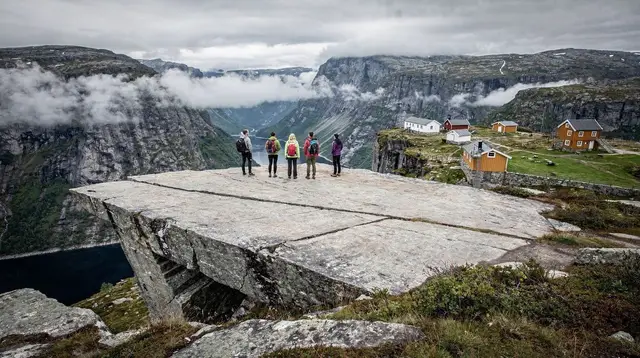
Preikestolen’s summit is a flat rock shelf, roughly the size of a football pitch corner, with a sheer drop on three sides. There is no barrier, which is part of its appeal and also part of why people move carefully and deliberately near the edge — nobody rushes past someone else at the drop. That caution is entirely reasonable, but it has a side effect: when fifty or a hundred people are on the plateau at the same time, movement near the edge slows to a crawl, and the classic photograph — one person, the cliff, the fjord below — becomes something people queue for.
At midday in July or August, that queue is real. Visitors take turns walking out, posing, and stepping back so the next group can do the same. It is not dangerous, and it is not the trail’s fault, but it changes the character of the visit from a hike that ends at a dramatic viewpoint into a hike that ends at a viewpoint with a waiting list. If you have pictured Preikestolen as a moment of quiet, exposed grandeur above the fjord, the midday version of that moment is shared with a crowd doing the same thing you are.
The trail itself compounds the effect. Because it is a single main route in and out, the busiest hours also mean passing traffic in both directions on narrower sections, and a fuller car park at the Preikestolen fjellstue trailhead. None of this is unsafe — the trail is well marked and heavily used precisely because it is safe and accessible — but it is a materially different experience from the same trail at 7am.
Early start: the option that works most of the year
Starting before 8am is the single most reliable way to avoid the crowd, and it works across most of the hiking season, not just midsummer. An early start gets you to the plateau before the bulk of tour groups and cruise excursions have arrived, often while the light is still low and soft rather than the flat overhead glare of midday. The trailhead car park is easier to find space in, the trail itself carries a fraction of its peak traffic, and the plateau — even on a busy August day — can still feel close to empty for a stretch in the early morning.
The trade-off is logistics. An early start usually means driving yourself to the trailhead, since public transport and organised shuttle buses tend to begin service later in the morning; anyone relying on scheduled transport should check timing against a start well before the peak window opens. It also means an earlier alarm than most holiday itineraries are built around, particularly if you are staying in central Stavanger and need travel time to the trailhead first.
Late-day start: the summer daylight trick
In June and July, Rogaland’s long summer daylight makes a second option realistic: starting the hike in the afternoon, after 4pm, and finishing well after the day’s tour groups have already come back down. Daylight at this latitude lasts long enough in midsummer that an afternoon start does not mean finishing in the dark, and it sidesteps the midday peak just as effectively as an early start — arguably more comfortably, since it does not require an early alarm.
This option narrows outside the height of summer. As daylight hours shorten into September, a late start carries more risk of finishing the descent as the light fades, so it is worth treating as a midsummer-specific strategy rather than a year-round substitute for an early start. Whichever window you choose, going in early morning or late afternoon rather than the middle of the day is the actual lever — the specific hour matters less than staying outside the 10am-2pm band where the trail and the plateau are at their fullest.
| Start time | Typical plateau crowd | Notes |
|---|---|---|
| Before 8am | Light | Best for photos with an empty foreground; trailhead access usually means driving yourself |
| 8-10am | Building | Still calmer than midday, tour groups beginning to arrive |
| 10am-2pm | Peak | Cruise excursions, tour buses and most independent hikers overlap here |
| 2-4pm | Still busy | Peak crowd descending as new arrivals continue |
| After 4pm (June-July only) | Light | Long summer daylight allows a comfortable late finish |
Weekdays, weekends, and the cruise-ship effect
Day of the week is a second, smaller lever on top of time of day. Weekends add local and regional visitors on top of the usual tourist volume, so a Saturday or Sunday midday climb is measurably busier than the same slot on a Tuesday. If your schedule allows any flexibility at all, a weekday climb — especially a weekday early morning — compounds with the time-of-day effect rather than working against it.
Cruise ship schedules are the other multiplier worth knowing about, even if you are not tracking them in detail. When a large ship is in port at Stavanger, a portion of its passengers typically join shore excursions to Preikestolen, arriving and departing within a tight window that lines up closely with the ordinary midday peak. The effect is to sharpen an already busy period rather than to create a new one, which is one more reason the early or late strategy holds regardless of what else is happening in the harbour that day.
Parking and shuttle timing, briefly
Trailhead parking at Preikestolen fjellstue is paid, and the car park fills fastest during the same midday window that crowds the trail — arriving early does double duty, securing an easier parking spot and a quieter trail in the same decision. Shuttle buses running from Stavanger and Sandnes generally begin later in the morning and run through the day, which makes them a reasonable option for a mid-morning or afternoon start but a poor fit for anyone determined to be on the plateau before 8am, since the earliest buses typically will not have you there in time.
Anyone planning an early start by shuttle rather than by car should check the specific timetable rather than assuming service matches sunrise. For the fuller picture on cost and logistics, the dedicated guides on parking and shuttle timing cover ground this page does not.
Choosing between a guided hike and going on your own
Guided options change the crowd calculation slightly, because a guide typically sets a departure time chosen to avoid the worst of the midday window rather than to match a group’s preferred wake-up time. A small-group guided hike around Preikestolen often leaves early enough to reach the plateau ahead of the bulk of the day’s visitors, which takes the timing decision off your plate entirely.
For anyone who would rather set their own pace and start time, a self-directed hike to Pulpit Rock booked with a flexible time slot makes it straightforward to commit to a genuinely early or late departure rather than defaulting to whatever the rest of the day’s crowd is doing. And for a version that combines the guided structure with a private or small-group pace timed away from the peak, a Pulpit Rock hike with a local guide is worth comparing against the fully independent option.
A realistic hour-by-hour picture
Picture the trail on a clear day in late July. At 6:30am, the car park has scattered cars and the trail carries a handful of hikers moving at their own pace, with long stretches where nobody else is visible. By 9am, the pace has picked up — groups forming, more voices on the trail, the car park filling steadily. By 11am, the trailhead has the feel of a small event: buses unloading, the trail carrying a near-constant stream in both directions, and the first crowds gathering on the plateau itself.
Between roughly 11am and 1pm, the plateau is at its fullest. This is the window when the queue for the classic edge photograph is most likely to form, when finding a quiet corner to simply sit and look at the Lysefjord below without other people in the frame becomes genuinely difficult, and when the trail itself feels busiest underfoot. By mid-afternoon the crowd thins gradually rather than suddenly, as the day’s tour groups begin their descent, and by early evening in midsummer the plateau can return to something close to its early-morning calm.
None of this changes what the hike itself involves, and it is not a reason to avoid Preikestolen — the crowding is a predictable, manageable feature of one of Norway’s most rewarding short hikes, not evidence that the trail has been ruined by its own popularity. It is simply a variable worth planning around deliberately, the same way you would plan around ferry times or opening hours, rather than discovering it by accident at 11:30am on the busiest day of the summer.
Building it into a wider Stavanger day
If Preikestolen is one stop in a longer day or trip rather than the sole objective, timing the hike around the crowd also tends to fit naturally with the rest of a Lysefjord itinerary. An early climb finished by mid-morning leaves the rest of the day free for a fjord cruise or a slower return to Stavanger, while a late-afternoon climb pairs well with a morning spent elsewhere in the region before heading to the trailhead. Either way, treating the hike’s start time as a planning decision — not just a matter of when you happen to wake up — is what separates a crowded midday slog from the quieter version of the same trail.
Travellers combining the hike with a longer look at the fjord sometimes prefer a single outing that covers both. A guided hidden-nature route to Preikestolen from Stavanger or Sandnes departs on a schedule built to reach the plateau before the busiest hours, which folds the timing strategy into the booking itself rather than leaving it to a solo early alarm.
For the practical basics beyond crowds — how long the trail actually takes, what the weather does to it, and how to get there without a car — those are each covered in their own dedicated guides rather than repeated here, so it is worth reading this page alongside the trail duration guide and the guide to hiking without a car if either applies to your trip.
Frequently asked questions about Preikestolen’s crowds
What time should I start the Preikestolen hike to avoid crowds?
Aim to be on the trail by 7-8am, or start after 4pm in June and July when daylight lasts into the evening. Both windows sit outside the 10am-2pm peak, when the trailhead car park, the trail itself and the plateau all fill at once.
Is Preikestolen always crowded, or only in summer?
The crush is a summer phenomenon, roughly June through August, driven by cruise-ship schedules, tour buses and school holidays across Europe. Shoulder-season months still draw hikers, but nothing close to the same density arriving in the same two-hour window.
Are weekends worse than weekdays at Preikestolen?
Yes, noticeably. Norwegian weekend visitors stack on top of the usual tourist volume, so a Saturday or Sunday midday climb is busier than the same time slot on a Tuesday or Wednesday.
Does a cruise ship in port make Preikestolen busier?
Substantially. A single large ship docking in Stavanger can put several hundred passengers on the Preikestolen trail on shore excursions, almost all departing and arriving within the same few hours, which sharpens the midday peak beyond the ordinary summer baseline.
Is an early morning start on Preikestolen safe to do alone?
In peak season, yes — the trail never empties out completely, and other early hikers are usually visible ahead or behind. Outside summer, an early or late start on a quiet trail is a different judgment call, and solo hikers should tell someone their plan regardless of the hour.
Can I still get a clear photo on the Preikestolen plateau if I go at midday?
It is possible but often means waiting your turn at the cliff edge behind a line of other visitors doing the same thing. An early or late start removes that wait almost entirely rather than shortening it.
Does starting early or late change how hard the hike is?
No. The distance, elevation gain and terrain are identical regardless of start time — only the number of people sharing the trail and the plateau with you changes.
Should I book a guided hike specifically to avoid crowds?
A guided departure can help, since guides often choose start times outside the peak window as a matter of routine, but it is not required — an independent hiker who simply commits to an early or late start gets the same benefit without needing to match a group schedule.
tours.pulpit-rock-hikes
Verified deep-linked GetYourGuide tours. Book through these links and we earn a small commission at no cost to you.
GetYourGuide does not provide a product photo for this activity — the image shows the meeting point, photographed by us.