Hiking Preikestolen in the Rain: What to Wear and What to Expect
Do you need special gear to hike Preikestolen in the rain?
Yes, but nothing exotic: a real waterproof jacket and trousers, boots with grip rather than trainers, and layers underneath that aren't cotton. Rain is a normal part of Stavanger weather, not a reason to postpone — most hikers who show up prepared have a genuinely good day on the trail.
Rain is not a reason to change your plans
If you’re checking the forecast for your Preikestolen hike and seeing rain, you are looking at completely ordinary weather for this part of Norway. Stavanger and the surrounding Lysefjord area get somewhere between 1,180 and 1,250 mm of precipitation a year, spread across far more days than a drier climate would give you. Waiting for a rain-free window before you commit to the trail is, statistically, a bad strategy — you might wait out your whole trip.
This guide is about the part almost nobody writes down clearly: what to actually wear, how a wet hike up to the 604 m plateau feels while it’s happening, and how to manage your expectations for the view. It is not about mud, puddles, or how the path behaves once the rain has already stopped and moved on — that’s a separate question covered in our guide to trail conditions after rain. Here, the rain is still falling, and you’re the one deciding what to put on before you leave the car.
What Stavanger rain is actually like on the trail
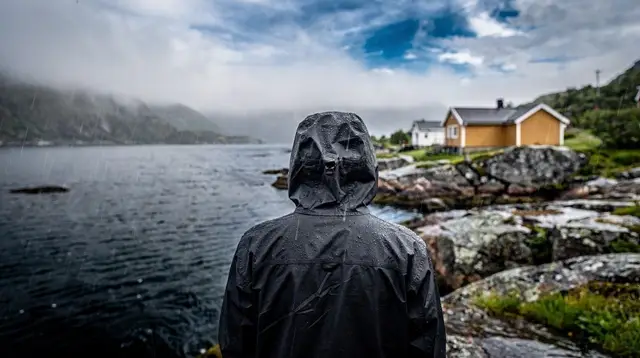
A few things are worth knowing before you dismiss rain as a single category of weather. Rogaland rain tends to arrive as a steady, persistent drizzle-to-moderate mix rather than short tropical downpours — it soaks rather than pounds. It can also clear and return within the same afternoon, since the Lysefjord’s steep walls and the plateau’s exposed position create their own microclimate that shifts quickly.
That means two things for planning. First, a “rain” icon on your weather app for the day doesn’t mean six straight hours of rain on the trail — it might mean twenty minutes of it, twice. Second, it can also mean genuinely sustained rain the whole way up and down, and you should be equipped for that possibility rather than hoping the app under-delivers. If you want a broader sense of what to expect month by month, our seasonal guide to visiting Stavanger breaks down which months tend to be wettest, though every month here sees some rain.
Dressing for the hike: layers that actually work wet
The standard hiking advice about layering applies here, but the wet-weather version has specific failure points that matter on this particular trail.
| Layer | What works | What fails in rain |
|---|---|---|
| Base layer | Merino wool or synthetic wicking fabric | Cotton t-shirts — they stay wet and cold for hours |
| Mid layer | A light fleece or synthetic insulator | Heavy cotton hoodies, which soak through and add weight |
| Outer shell | A genuine waterproof jacket (not just water-resistant) | Showerproof windbreakers, umbrellas (wind makes them useless) |
| Legs | Waterproof or quick-dry hiking trousers | Jeans, which become heavy and cold when wet |
| Feet | Waterproof hiking boots with ankle support | Trainers or sandals — poor grip and no water protection |
| Hands/head | A brimmed cap and light gloves | Nothing — cold hands make gripping rock and poles harder |
The single most common mistake is treating “water-resistant” as good enough. A genuinely waterproof shell — taped seams, a proper hood — is worth buying or borrowing before this hike specifically, because you will be out for four to six hours with no shelter along most of the route.
Footwear matters more than the jacket
People obsess over rain jackets and underrate boots, but footing is where wet weather actually changes the experience. The trail includes stretches of bare granite that get slick when wet, along with wooden boardwalks over the boggier sections that can be slippery too. Boots with real lugged tread, ideally already broken in, make a bigger practical difference than any jacket upgrade. If you only own trainers, this is the hike to rent or buy boots for rather than push through in.
Trekking poles are genuinely useful in the rain — more so than in dry conditions — because they give you two extra points of contact on wet rock, particularly on the descent when tired legs are more likely to slip. If you’re assembling a full kit rather than a one-off list, our broader guide to what to pack for hiking in Rogaland goes into daypack contents and layering systems in more depth.
What packing to protect matters as much as what to wear
Rain gear for your body is only half the job. Your pack and its contents get just as wet as you do unless you plan for it.
- Line your daypack with a plastic bag or use a proper dry bag/pack cover — even a “water-resistant” backpack will let water in through the zippers over several hours.
- Put your phone, camera, and any spare layers inside a resealable bag or dry sack, not just loose in a side pocket.
- Bring food that survives damp conditions — a soggy paper-wrapped sandwich is a worse lunch on this hike than a sealed energy bar or a thermos of something hot.
- Pack a full dry change of clothes to leave in the car. Getting out of wet layers the moment you’re back at the trailhead makes a bigger difference to how the day feels in memory than almost anything else on this list.
What the hike actually feels like in the rain
The 8 km round trip with its roughly 350 m of elevation gain doesn’t change distance or grade because of weather, but the sensory experience shifts. Expect condensation inside your hood, breath fogging your glasses if you wear them, and a rhythm of getting warm from exertion on the climbs and cold again the moment you stop moving. Pacing yourself to avoid overheating inside a sealed rain shell is a real skill — many hikers underdress slightly on purpose and accept getting a little wet from the outside, rather than sweating heavily inside a fully zipped jacket.
The forest and boulder sections early in the trail feel closer and quieter in rain — sound is muffled, and the wet rock and moss actually look more vivid than under flat grey light. The more exposed upper sections, closer to the plateau itself, are where wind becomes the bigger factor alongside the rain; a jacket that’s fine lower down can feel thin once you’re higher and more exposed. If you’re weighing whether the standard timing estimates still apply, see our guide on how long Preikestolen actually takes — rain generally adds time on the descent rather than the ascent, since cautious footing slows you down more when gravity is working against your grip.
The view: managing expectations honestly
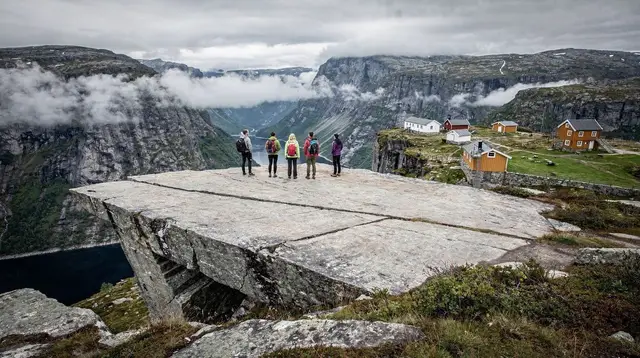
This is the part most guides skip. Rain and low cloud often travel together at 604 m above the fjord, and there is a real chance you reach the plateau to find grey mist instead of the postcard view down the Lysefjord. It is also entirely possible to hike up in steady rain and have it clear right as you arrive, or to have a dry forecast and still get socked in by cloud that has nothing to do with rain at all.
Neither outcome should be treated as bad luck or a wasted trip. Being on the plateau itself — the flat rock, the sheer drop on three sides, the scale of it even half-seen in mist — is its own experience distinct from the photograph you might not get. If the view is genuinely the priority and you’d rather not gamble a full hike on it, seeing the rock from below is a real alternative: a boat trip up the fjord gets you a clear look at Preikestolen’s cliff face from the water even on a day when the plateau itself is in cloud.
a Lysefjord boat trip from Forsand that passes right beneath the Preikestolen cliff is worth considering as a lower-commitment way to see the landmark on a day when you’re not confident about conditions up top, and it pairs naturally with a look at what a cruise actually shows you versus the hike.
Hiking with a guide in wet weather
If uncertain footing or navigation in low visibility is a worry, going with a local guide removes most of the guesswork — someone who knows the trail’s wet-weather trouble spots can set a sensible pace and know exactly where the slippery sections are before you reach them. guided hikes around Preikestolen led by people who know the terrain in any weather are a reasonable option specifically for less confident hikers or first-time visitors who’d rather not make weather calls alone.
For those who want to combine the hike with time on the water rather than choosing one or the other, a combined fjord cruise and Preikestolen hike lets you see the fjord from both angles in a single day, which can be a good way to hedge against one leg of the trip being clouded out.
When rain does actually matter for safety
To be clear about the distinction this guide is drawing: ordinary rain is not a safety issue on this trail, and treating it as one leads people to cancel good hiking days for no reason. What should actually change your plans is different weather entirely — thunderstorms and lightning, which are genuinely dangerous on an exposed plateau with no cover; sustained strong wind, which matters more than rain near the cliff edge since Preikestolen has no barrier at all; and ice or snow outside the main hiking season, which is a winter-specific concern covered in our guide to hiking Preikestolen in winter. Rain alone doesn’t belong in the same category as any of those.
Getting to the trailhead in the rain
Wet weather doesn’t change how you reach Jørpeland or the Preikestolen fjellstue trailhead, but it’s worth planning transport in advance so you’re not standing around getting soaked while figuring out logistics. If you’re not driving, our guide to visiting Preikestolen without a car and the shuttle bus guide cover the practical routes from central Stavanger, and it’s worth checking parking costs ahead of time so that isn’t one more thing to sort out in a downpour.
For visitors staying in Stavanger itself and building rain into a wider trip rather than a single hike, our one-day Stavanger itinerary and two-day Stavanger and Preikestolen itinerary both assume changeable weather rather than planning around a dry forecast — which, in this climate, is the only realistic approach.
It’s also worth reading why rain here isn’t bad luck but simply the climate if you want the bigger picture on why locals shrug at forecasts that would cancel plans elsewhere, and why a weather app forecast for the plateau specifically should be read with some skepticism given how fast conditions shift at altitude above the fjord.
Rain and Preikestolen: common questions
Is it dangerous to hike Preikestolen in the rain?
Ordinary rain is not dangerous — thousands of people walk the trail in it every year. What matters is footing on wet rock and roots, so slow down, wear boots with real tread, and use poles if you have them. Lightning, high wind, or ice are separate concerns, not rain itself.
Should I cancel my Preikestolen hike if rain is forecast?
No. Given Rogaland’s climate, waiting for a dry day can mean waiting all week. Rain here is routine weather, not a storm warning, and the hike is done in it constantly. Check for wind and thunder specifically rather than rain alone.
What shoes should I wear on Preikestolen in wet weather?
Sturdy hiking boots or trail shoes with grippy soles, ideally worn in already. Smooth-soled sneakers get genuinely slippery on the wet granite slabs near the plateau, and cotton socks stay cold once damp.
Will I still be able to see the view from Preikestolen if it’s raining?
Sometimes yes, sometimes the plateau sits inside cloud with visibility down to a few metres. Both are common. A rainy forecast doesn’t guarantee a lost view, and a dry forecast doesn’t guarantee a clear one — Lysefjord’s weather changes fast.
How long does the hike take in the rain compared to dry weather?
Budget extra time rather than a fixed number — most hikers add 30 to 60 minutes to the usual 4-5 hour round trip because of more careful footing on descents, not because the distance changes.
What should I pack specifically for a wet hike, beyond a rain jacket?
Waterproof trousers, a dry base layer to change into at the car, a pack cover or dry bag for electronics, and food that doesn’t turn to mush in a damp pocket. A warm layer still matters even in summer rain.
Is the trail more slippery after rain has already fallen versus during active rain?
Both have their own footing challenges, but they’re different questions. This guide covers dressing for and hiking through active rainfall; trail surface conditions after rain has passed are covered separately in our guide to trail conditions after rain.
tours.pulpit-rock-hikes
Verified deep-linked GetYourGuide tours. Book through these links and we earn a small commission at no cost to you.
GetYourGuide does not provide a product photo for this activity — the image shows the meeting point, photographed by us.