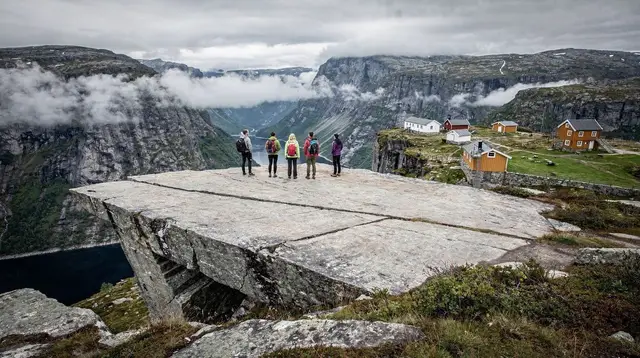
How Long Does the Preikestolen Hike Take?
How long does the Preikestolen hike take?
The standard round trip from the Preikestolen fjellstue trailhead is about 8 km, with roughly 350 m of elevation gain, and takes most hikers 4 to 5 hours at a normal pace. That figure assumes dry, clear conditions on a well-marked but uneven trail, not a paved walk, and it stretches noticeably in mud, rain or heavy summer crowds.
The Short Answer, and the Fine Print Behind It
If you search for nothing else before you go, this is the number that matters: the standard Preikestolen round trip from the Preikestolen fjellstue trailhead is about 8 km, with roughly 350 m of elevation gain, and it takes most hikers between 4 and 5 hours. That includes the climb up, the descent back down, and a normal amount of stopping to catch your breath, but it does not include any time spent sitting at the plateau itself.
That range is not a marketing rounding. It is a genuine spread, and which end of it you land on depends on things you can partly control and a few things you cannot. Fitness and pace explain some of the variation. Weather explains more of it than most people expect. And in the busiest weeks of summer, other hikers on the trail become a real factor in how long the day takes, independent of how fast you personally can walk.
This page sticks to that one question: how long the hike takes. It does not get into when to start to dodge the crowds, or what the trail is like specifically after rain — those each have their own dedicated guide, linked further down, because the honest answer to each is longer than a paragraph.
Why “4 to 5 Hours” Is a Range, Not a Number
The 8 km figure is a straight-line description of the round trip distance. It says nothing about the surface, and the surface is where the real variability comes from. This is not a paved path or a boardwalk from end to end. Large stretches are natural rock, worn smooth or left rough depending on the section, interspersed with stone steps, wooden boardwalk over boggy ground, and a genuinely steep pitch in the first third of the ascent. Later sections of the Lysefjord trail network share this same mixed-surface character, which is part of why guided groups on nearby routes often move at a noticeably different pace than solo hikers used to groomed trails.
Elevation gain of 350 m sounds modest next to a mountain hike, and in absolute terms it is. What makes it feel like more is that a large share of that gain happens early, close to the trailhead, before muscles are warmed up. Hikers who arrive expecting a gentle warm-up followed by a climb are often surprised that the climb starts almost immediately.
Two other variables matter as much as fitness:
- Group composition. A hiking party moves at the pace of its slowest member. A group with a mix of ages, a member with limited hiking experience, or young children will naturally take longer than the fastest person in that group could manage alone — sometimes by an hour or more.
- Photo and rest stops. The trail has several genuinely scenic overlooks before the plateau itself, and it is common to stop repeatedly. Ten short stops of two or three minutes each adds thirty minutes to the day without anyone consciously deciding to linger.
What Actually Stretches the Time Beyond 5 Hours
Two factors do more to push hikers past the standard estimate than anything about personal fitness: weather and crowding.
Rain and mud. Several sections of exposed rock become genuinely slippery when wet, and the boardwalk sections, built to protect boggy ground, get slick too. On a wet day, careful hikers slow down noticeably on the descent in particular, since downhill travel on wet rock carries more risk than the climb up. It is entirely normal for a rainy-day round trip to run 5.5 to 6 hours even for a fit, experienced group, simply because everyone is moving more cautiously. The specifics of trail conditions after rain, and how much they change footing and pace, are covered in a dedicated guide rather than here.
Crowding. Preikestolen draws in the order of 300,000 visitors a year, and the overwhelming majority of them hike in a compressed window from June through August. On a clear Saturday in July, the trail can feel less like a hike and more like a queue at certain pinch points — narrow sections of rock or boardwalk where faster and slower hikers bunch up in both directions at once.
This does not usually change the total distance walked, but it changes the rhythm of the day: instead of a steady walking pace, you get stretches of normal movement interrupted by waiting. The best time of day to avoid this bottleneck effect is its own separate question, addressed in the guide to Preikestolen’s quietest hours.
Season and daylight. Outside the roughly May-to-September window, snow and ice change the trail meaningfully — not just underfoot, but in terms of visibility and route-finding on the higher sections. A hike that takes 4.5 hours in August dry conditions is a materially different undertaking in November ice, and should be planned and timed differently rather than treated as the same hike with a coat.
A Realistic Timing Table
The numbers below assume you start at the Preikestolen fjellstue trailhead and return to the same point. They are meant as planning ranges, not guarantees for any specific person or day.
| Scenario | Round trip time | Notes |
|---|---|---|
| Fit, experienced hiker, dry trail, light crowds | 3.5-4 hours | Minimal stops, steady pace throughout |
| Average fitness, dry trail, typical summer crowds | 4.5-5 hours | The most common outcome for most visitors |
| Family with children, dry trail | 5.5-6.5 hours | Pace set by the slowest member, frequent breaks |
| Any group, wet or muddy trail | 5.5-6 hours | Slower, more cautious descent on slick rock |
| Guided group hike, normal conditions | 5-6 hours | Includes scheduled stops and pacing for the whole group |
| Winter conditions with proper gear | 6+ hours | Route-finding and ice underfoot both add time |
None of these figures include extended time at the plateau. If you want to sit, eat, and take in the view of the Lysefjord below without feeling rushed, add 20 to 40 minutes on top of whichever row applies to you.
Building the Hike Into a Full Day
Because the hike itself runs 4 to 6 hours depending on conditions, most visitors treat Preikestolen as the anchor of a full day rather than a quick stop. Factor in the drive or ferry connection from central Stavanger to the trailhead, parking, and the return journey, and a Preikestolen day easily fills 7 to 9 hours door to door.
If you would rather not manage the logistics of parking, timing and pacing yourself, a guided option removes most of that planning. A guided hike to the plateau with a local guide sets a steady, predictable pace for the group and handles the trailhead logistics, which is one way to make the day’s total time more predictable rather than open-ended. For visitors who would rather explore beyond the main trail with a smaller group, a guided hidden nature hike from Stavanger or Sandnes covers some of the surrounding terrain alongside the standard route.
Hikers who want to see the plateau from the water as well as from above sometimes split their Preikestolen day differently. A combined hike and Lysefjord cruise pairs the two perspectives in one longer day, though it obviously adds hours rather than saving them. If your schedule is tighter than a full hiking day allows, it is worth reading honestly about whether seeing Preikestolen from the fjord below is enough on its own.
If You Are Short on Time or Fitness
Not every visitor to Stavanger has 7 to 9 hours to give to one hike, and not every visitor wants to walk 8 km on uneven terrain. If that describes you, it is worth being honest about alternatives rather than attempting a shortened version of the hike, since there is no partial or reduced version of the Preikestolen trail — you either reach the plateau or you do not.
A Lysefjord cruise from Stavanger or from Sandnes gets you close to the base of the cliff below Preikestolen without any hiking at all, on a schedule measured in hours rather than a full day. For hikers with some fitness who simply want a shorter outing in the same region, the easiest hikes near Stavanger are a gentler alternative that will not require the same time commitment.
If children are part of the group, timing expectations should shift further still — a family pace on this trail is genuinely different from an adult pace, which is covered in more detail in the dedicated guide to hiking Preikestolen with kids.
How Preikestolen Compares to Kjeragbolten for Time
Visitors planning a Rogaland trip sometimes assume Kjeragbolten, the boulder wedged above the Lysefjord further along the same fjord system, is a similar undertaking with a similar time budget. It is not. The Kjerag trail runs 10 to 12 km round trip and typically takes 6 to 8 hours, with three steep sections secured by chains that Preikestolen simply does not have. It is a considerably more demanding day, and one that is only accessible when the Lysebotn road is open, since it closes for winter. If you are weighing the two against each other, the comparison of Kjeragbolten and Preikestolen lays out how differently they should each be planned for.
For hikers determined to do both in a short visit, a two-day itinerary covering Preikestolen and Kjerag spreads the two demanding days apart rather than stacking them, which matters more than it might seem given how much recovery a full Kjerag day requires.
Practical Notes That Affect Your Timing
A few logistics sit just outside the hike itself but still affect how your day actually unfolds. Parking at the Preikestolen fjellstue trailhead is paid, and arriving later in the morning during peak season can mean extra time spent finding a space, which effectively adds to your day even before the trail begins — a factor covered in full in the guide to Preikestolen parking costs. If you are relying on public transport rather than a rental car, the shuttle bus schedule shapes your start and return time more rigidly than driving does, and is worth checking against the shuttle bus guide before you fix a plan.
For those without a car at all, reaching the trailhead is still entirely possible, but it changes the shape of the day — see the dedicated notes on doing Preikestolen without a car. And if the forecast looks uncertain, it is worth reading about the trail specifically in winter conditions before assuming the same 4-to-5-hour window applies outside the main hiking season.
Some visitors prefer a smaller, more personal group than a large scheduled departure offers. A wild hike to Preikestolen off the most crowded stretches of trail is one way to keep a similar overall time budget while avoiding some of the bottlenecks that build up on the main route in peak season. For visitors coming outside the summer window, a guided winter hike to Pulpit Rock accounts for the slower pace and route-finding that snow and ice require, rather than applying summer timing to a winter trail.
The One-Sentence Version to Remember
Plan for 4 to 5 hours of walking across an 8 km round trip with 350 m of climbing, add time at the top for yourself, add more time again if the trail is wet or the season is busy, and never treat the lower end of that range as a promise rather than a best case.
Preikestolen Hike Duration FAQ
How long does the Preikestolen hike take round trip?
Plan on 4 to 5 hours for the full 8 km round trip in normal conditions, including some time at the plateau itself. Add extra time if you are hiking with young children, if the trail is wet, or if you want more than a few minutes at the top.
Is 4 hours enough time for Preikestolen?
Four hours covers the hiking itself for most people at a steady pace, but it leaves little room for a long break at the plateau, photos, or delays from crowding on narrow sections. Many hikers prefer to budget 5 hours so the trip does not feel rushed.
How long is the walk up to Preikestolen in kilometres?
The trail from the Preikestolen fjellstue trailhead to the plateau and back is about 8 km in total, roughly 4 km each way, with the elevation gain concentrated in the first half of the ascent.
Is the Preikestolen hike difficult for beginners?
It is manageable for a reasonably fit beginner with no technical climbing involved, but the surface is uneven rock, stone steps and boardwalk rather than pavement, and about 350 m of climbing is enough to feel demanding without regular hiking experience.
Does the hiking time include the stop at the top?
No. The 4 to 5 hour estimate covers walking time up and down. Time spent at the plateau itself, whether that is 10 minutes or an hour, is on top of that figure.
Why do some people take much longer than 5 hours?
Rain and mud slow the descent significantly because the rock and boardwalk sections become slippery, and a crowded trail in July and August can create bottlenecks at pinch points. Group pace, fitness level and how long you linger at the top all add to the base estimate as well.
Can you do Preikestolen in under 4 hours?
Fast, experienced hikers moving at a brisk pace with minimal stops sometimes complete the round trip in 3 to 3.5 hours, but this is not a realistic target for most visitors and should not be planned as the default.
tours.pulpit-rock-hikes
Verified deep-linked GetYourGuide tours. Book through these links and we earn a small commission at no cost to you.
GetYourGuide does not provide a product photo for this activity — the image shows the meeting point, photographed by us.