Preikestolen with Kids: What Families Need to Know
Is Preikestolen safe and manageable for kids?
The 8 km round trip suits reasonably fit children from around age 8 up, given breaks and a slow pace, but the plateau at 604 m has no safety railing. For families with toddlers, unpredictable runners, or a child who ignores instructions near edges, the summit itself is the real risk, not the walk to get there.
Weighing Preikestolen Against What Your Kids Can Actually Handle
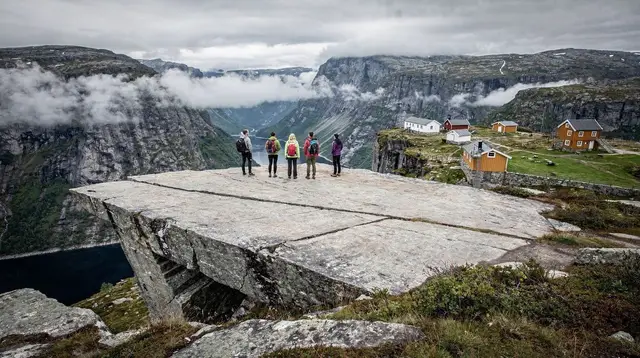
Preikestolen shows up on almost every list of things to do near Stavanger, and it is tempting to fold it into a family itinerary without thinking too hard about it. The trail is well marked and heavily used, which makes it feel more tame than it is. It is still an 8 km round trip over real, uneven terrain, it still takes most adults 4 to 5 hours, and it still ends at a flat rock shelf 604 m above the Lysefjord with a drop on three sides and nothing between your child and the edge. None of that makes it a bad idea for a family. It does make it a decision worth thinking through properly rather than assuming it will be fine because everyone else on the trail seems to be managing.
This guide focuses specifically on the family question: what ages tend to cope well, how the distance and terrain actually feel to short legs, and how you manage a group of children at a summit with no barrier. For a breakdown of the trail’s official markings, distance splits, and general pacing, that ground is already covered in the guide on how long the hike actually takes, and this page will not repeat it.
How the Terrain Feels When You Are Small
The numbers alone, 8 km and roughly 350 m of elevation gain, understate what the trail feels like for a child. It is not a flat gravel path. Large sections are uneven rock and root, with some short, steeper pitches early on that catch out anyone expecting a smooth walk. For an adult these are minor obstacles. For a 6 or 7 year old, each one is a small climbing problem, and a string of them adds up to real fatigue well before the halfway point.
What tends to catch families out is not the total distance so much as the pacing. A child who is enjoying themselves in the first 20 minutes can be flatly done an hour later, with no obvious warning in between. Build in stops before anyone asks for one, treat food and drink as pacing tools rather than rewards for finishing, and accept that your group’s average speed will be well below what a solo hiker or a fit couple would manage. Families commonly take 5 to 7 hours round trip once breaks are factored in, against the 4 to 5 hours often quoted for adults moving at a steady pace.
Trail conditions change this equation further. After rain, sections of exposed rock become genuinely slippery, and a child’s smaller stride and lighter weight make sure footing harder, not easier. If the forecast looks wet, it is worth reading through conditions after rain before you commit a young family to a summit day, since the same trail can shift from a manageable walk to a route that demands real care underfoot.
The One Real Risk: No Railing at 604 Metres
Everything else about Preikestolen is manageable with planning. This part is not something to plan around so much as something to be honest about before you go: the plateau has no fence, no railing, and no barrier of any kind along its edge, and the drop is 604 m, sheer, on three sides. This is not a detail to soften for a family audience. It is the single fact that should shape how you behave once you arrive, more than fitness level or trail length.
In practice, this means deciding, before you reach the top, how your group will behave at the summit. Some families set a hard rule that children hold an adult’s hand from the moment the plateau comes into view until they are well back from the edge. Others designate one adult whose only job for those minutes is watching the children, with no photography duties and no conversation to distract them. What does not work is assuming a child who has behaved well all trail will automatically understand the stakes at the edge of a 604 m drop, especially once excitement, tiredness, and a dramatic view are all working against careful judgment at the same time.
If you are travelling with a toddler who cannot reliably follow an instruction to stop, or a child who tends to run ahead when excited, it is worth being honest that the plateau, not the walk to reach it, is the part of this trip that does not have a workaround. A guided small-group hike can help here, since an experienced local guide has managed exactly this moment many times and can help position a family safely once you arrive; see the local guided hikes in the area around Preikestolen for that option, or a private guided hike with pickup if you would rather have one guide focused entirely on your own group.
Realistic Age Guidelines
There is no official minimum age for Preikestolen, and plenty of families with younger children have done it successfully. The guidance below reflects what tends to go smoothly rather than a hard rule.
| Age range | How it typically goes |
|---|---|
| Under 4 | Only realistic in a carrier, and only if the adult carrying is confident and experienced on uneven terrain; the summit edge is the harder problem to solve at this age |
| 4 to 7 | Doable for strong, enthusiastic walkers, but expect a long day, frequent breaks, and a real chance of needing to carry a tired child for part of the return |
| 8 to 11 | Generally the age where most children manage the distance on their own legs without heroics, provided the pace is slow and breaks are frequent |
| 12 and up | Distance and terrain stop being the limiting factor; summit behaviour and following instructions near the edge remain the thing to manage |
Fitness and temperament matter more than age within these bands. A cautious, rule-following 6 year old at the summit can be an easier day than an impulsive 10 year old who does not naturally slow down near a view.
Building a Schedule With Slack
Set out earlier than you think necessary. The trailhead at Preikestolen fjellstue gets busy, and starting early gives you a quieter trail in both directions and more daylight buffer if the round trip runs long, which with children it usually does. Parking at the trailhead is paid; the trail and the plateau itself are free to enter.
Plan the day in blocks rather than as one continuous walk: a steady 20 to 30 minutes, then a proper stop with food, water, and a chance to sit down, repeated for as long as the trail takes. Treat the return leg as equally demanding as the ascent, since tired legs on uneven descent are where trips and stumbles are most likely, not on the way up when everyone is fresh. If the weather looks unsettled, check conditions after rain before you leave, since a wet trail changes both your pace and your footing choices.
What to Pack for a Family Day on the Trail
- More water than feels necessary, since there is nowhere to refill after the trailhead kiosk
- Snacks that double as pacing tools, not just treats for the summit
- Layers for both children and adults, since Stavanger’s weather shifts quickly even in summer
- Proper footwear with grip, not sandals or smooth-soled trainers, for both parents and kids
- A small first aid kit, given how far from help you are on the middle section of the trail
- A carrier or child backpack if any member of the group might need to be carried partway
- A whistle or a simple, agreed signal for a child to use if they get separated from the group at any point
For the fuller mountain-hiking packing list that covers layering and footwear in more depth, see what to pack for hiking in Rogaland.
If the Full Hike Feels Like Too Much
Preikestolen is not the only way to see it. Seeing the plateau from below, on a Lysefjord boat trip, removes both the distance and the summit edge entirely, and it is often the better choice for families with very young children, a member of the group with limited mobility, or simply a day when energy or weather are not cooperating. The boattrip to Preikestolen from Forsand covers this route, with the same dramatic rock face visible from the water and none of the exposure at the top.
A guided hike is worth considering even for families confident in their own fitness. Beyond company and pacing advice, a local guide who does this route regularly can help manage the summit moment itself, which is often more useful than any amount of pre-trip planning.
The Preikestolen Pulpit Rock hike with a local guide runs at a group pace with someone experienced watching the terrain; the sunrise hike with buffet breakfast is worth considering for families who prefer an early, quieter trail before the crowds arrive, since a thinner crowd at the summit also makes it easier to keep track of children at the edge.
For the rest of a Stavanger trip built around a family with a range of energy levels, see the guide to Stavanger with kids for other easier days that do not involve a 604 m drop.
Related Reading Before You Go
If Preikestolen with kids is only one piece of your planning, these cover the parts this guide deliberately left out: exact trail markings and pacing live in the guide on how long the hike takes, the best windows to avoid the worst of the crowds are in the guide on timing your visit, and wet-weather trail behaviour is covered in the guide on conditions after rain. For a gentler, family-oriented day near Stavanger that swaps a cliff edge for a garden and animals, see the Flor og Fjaere family guide.
Other useful planning pages: the destination overview for Preikestolen, background on the Lysefjord itself, the full activity list for things to do at Preikestolen, an easier hikes roundup for days when the whole family wants something shorter, notes on getting to the trailhead without a car, parking costs at the trailhead, the shuttle bus guide if you are not driving, and a one-day Stavanger itinerary built around families that includes a version of this route.
Preikestolen With Kids: Common Questions
What age is realistic for Preikestolen?
Most families do fine from around age 8, when a child can reliably walk 8 km over uneven ground and understand and obey an instruction to stop at an edge. Younger children have done it, but the trip gets noticeably harder to manage the younger the child, both on legs and on judgment near the plateau.
Is there a railing or fence at the top of Preikestolen?
No. The plateau has a sheer, unprotected drop of 604 m on three sides, and there is no barrier anywhere along it. This is the one fact worth planning around when children are involved, more than fitness or trail length.
How long does the hike take with young children?
Adults without kids typically take 4 to 5 hours round trip; with children, budget 5 to 7 hours once you include rest stops, snack breaks, and a slower pace on the steeper sections near the start and the final approach.
Can I bring a baby or toddler in a carrier?
A backpack carrier can work for a toddler who cannot yet manage the distance, since the trail itself has no technical climbing. The unresolved problem is the summit: a carried toddler at the cliff edge is entirely dependent on the adult’s footing and judgement, which is worth deciding on before you commit to the hike.
What happens if my child refuses to walk any further?
It happens on this trail more than people expect, usually on the rocky, uneven middle section rather than right at the start. Build slack into your schedule, carry more snacks than you think you need, and treat turning back as a normal, acceptable outcome rather than a failure.
Is there a shorter or easier alternative for families?
Yes. Seeing Preikestolen from a boat on the Lysefjord below removes the climb and the edge risk entirely, and works well for families with very young children or anyone uneasy about the summit.
Does the trail have shade, water, or toilets along the way?
There is a toilet and a kiosk at the Preikestolen fjellstue trailhead, but nothing along the trail itself, so pack all the food and water your group needs for the round trip.
tours.pulpit-rock-hikes
Verified deep-linked GetYourGuide tours. Book through these links and we earn a small commission at no cost to you.
GetYourGuide does not provide a product photo for this activity — the image shows the meeting point, photographed by us.