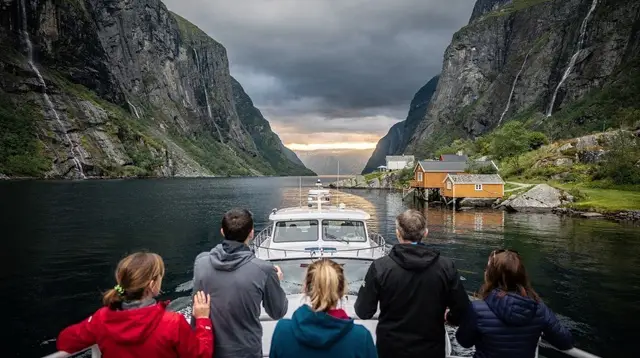
The Best Season for a Lysefjord Cruise
When is the best season for a Lysefjord cruise?
Late May through August gives the longest daylight, the calmest water and the best odds of a dry departure, with July offering the mildest air at around 16-17°C. June and early September are quieter alternatives with slightly cooler air but similar light, while rain gear is worth packing in any month you choose.
Weather, Light and the Timing of a Lysefjord Cruise
Ask ten people in Stavanger when the best time for a Lysefjord cruise is, and most will say “summer” without thinking much further. That answer is basically right, but it hides a more useful question: what exactly changes across the seasons, and which of those changes actually matter once you are sitting on a boat looking up at rock walls over a thousand metres high. Rainfall, daylight, wind and boat schedules do not move together, and treating them as one variable called “season” leads to some avoidable disappointment.
This guide is narrowly about the Lysefjord cruise itself — when the light is best, when the water is calmest, and when you have the best odds of a dry, clear departure. It is not a month-by-month calendar for the whole Stavanger region; that lives in the general seasonal guide at Best Time to Visit Stavanger: A Month-by-Month Guide. If you are still deciding between a cruise, a RIB safari or the hike up to Preikestolen itself, that comparison is handled separately too.
Rogaland’s Climate Is the Starting Point, Not an Afterthought
Before anything else: Stavanger receives somewhere between 1,180 and 1,250 mm of rain a year, spread across every single month. There is no dry season here in the way a Mediterranean destination has one. Some months are wetter than others, and some months bring calmer, more settled stretches of weather, but a rain-free week is never something you can plan around with confidence, even in the height of summer. Any guide that implies otherwise is setting you up to be annoyed on the one day it matters.
What summer does reliably deliver is temperature and daylight, and both genuinely change the cruise experience. July averages around 16-17°C, which is mild for this latitude of 58.97°N but still cool enough on open water that a light jacket is not optional. January, by contrast, averages roughly 1-2°C, and standing on a boat deck at that temperature with fjord-channelled wind is a different kind of trip altogether. Daylight swings even more dramatically than temperature: near midsummer, Stavanger has long, late evenings, while December days are short and grey. None of this changes whether it will rain on a given day. It changes how much usable daylight you get around the rain, and how comfortable you are on deck between showers.
The Best Window: Late May to Late August
If the goal is the classic Lysefjord cruise experience — open decks, good visibility of the cliffs, Preikestolen visible from the water, and a reasonable chance of at least some sun — late May through late August is the strongest window. Three things line up here that do not line up the rest of the year.
First, daylight. Long summer days mean cruise operators run more departures, including later ones, so you are not squeezed into a single late-morning slot. Second, temperature: with July and August averaging around 16-17°C, being on open water for two or three hours is comfortable rather than something to endure. Third, and less obvious, boat traffic and demand: this is also the busiest season on the fjord, since it overlaps with the roughly 300,000 annual visitors heading up to Preikestolen from the trailhead above. A cruise does not get “crowded” the way a hiking trail does, but the busiest midsummer weeks do mean more competition for tickets on popular departures.
None of this window is dry. Expect scattered rain showers even in July; the difference from other seasons is how quickly conditions can turn back to sun, and how much daylight remains around any given shower to still get a clear stretch on the water.
June vs. July vs. August: The Small Differences That Matter
Within the summer window, the three months are more similar than different, but a few small distinctions are worth knowing before you book.
| Month | Typical air temperature | Daylight | What stands out |
|---|---|---|---|
| June | Cooler side of summer, low-to-mid teens °C | Longest of the year, very late evenings | Calmer water on average, fewer families on school-holiday trips |
| July | Warmest month, around 16-17°C | Long, slightly shorter than June | Peak demand for departures, busiest cruise season |
| August | Close to July, often mild into late month | Noticeably shortening by month’s end | Good light, still busy, occasional early-autumn weather shifts late in the month |
June tends to have marginally calmer conditions on the water and slightly less competition for seats than the peak of July, without giving up much in temperature. August holds warmth well but starts to show the first signs of shortening days and shifting weather patterns as the month closes out — nothing dramatic, but worth knowing if you are booking for the very end of August rather than the middle.
Shoulder Season: May and September
Late May and early-to-mid September form a reasonable second choice, and for some travellers a better one. Air temperature drops a few degrees compared with peak summer, daylight is shorter than the June peak but still generous, and departures are noticeably less crowded. Cruise schedules do thin out compared with the June-August core, so it is worth checking actual departure times rather than assuming the summer frequency holds through the shoulder weeks.
The trade-off is variability. Shoulder-season weather in Rogaland swings more sharply than midsummer — a clear, still morning can be followed by a genuinely raw, wet afternoon, and vice versa. If your schedule is flexible enough to pick the better-looking day within a multi-day stay, May and September can actually reward you with some of the sharpest light of the year, since low autumn or spring sun angles rake across the fjord walls more dramatically than the high, flatter light of a July midday.
Winter on the Lysefjord: What Actually Closes
Winter is not the season for a first Lysefjord cruise, and it is worth being direct about why. Daylight is short, wind chill on open water is considerable even when the air temperature itself is mild for the latitude, and several cruise operators reduce their schedules or pause them altogether outside the main season. Where departures do continue, expect fewer options per day and more day-to-day weather cancellation than in summer.
Winter also closes off part of the wider fjord experience rather than just the cruise. The road down to Lysebotn, at the fjord’s far end, closes for the winter months, which cuts off road access to Kjeragbolten from that side entirely. A cruise itself does not depend on that road, but it is a useful marker of how much winter changes what is reachable around the fjord as a whole.
If a winter Stavanger trip is what you are actually planning, the dedicated guide on What’s Closed in Winter: Preikestolen and Kjerag covers the fuller picture, and Stavanger in Winter: What You Can Actually Do covers what remains realistic at that time of year.
Rain Is Not a Reason to Cancel — Low Cloud Is the Real Risk
Because rain falls in every month here, it is worth separating “it’s raining” from “the trip is ruined.” Most Lysefjord cruise boats have covered seating or an enclosed cabin, and a light-to-moderate shower rarely stops a departure. Passengers step outside for photos between showers and retreat when it picks up. Cruising in drizzle under a bright grey sky, with the fjord walls still fully visible, is a completely normal Lysefjord experience, not a failed one.
What actually degrades the experience is persistent low cloud, the kind that settles into the fjord and obscures the upper cliffs, including the view up toward Preikestolen’s plateau from the water. This is a different weather pattern from ordinary rain, and it can happen in any season, including a July heatwave elsewhere in Norway. There is no reliable way to guarantee against it beyond building a flexible day or two into your schedule so a washed-out cruise day can be swapped for a clearer one. If you’re deciding whether a view from the water is enough on its own, without also doing the hike, that trade-off is covered in Preikestolen from the Fjord: Is the View Enough?.
What Time of Day Works Best, Regardless of Season
Independent of which month you choose, time of day shifts the experience in a way many first-time visitors overlook. Morning departures generally see calmer water, since wind tends to build through the day, and lower boat traffic, which matters if you are hoping for clean photos without other vessels in frame.
Early morning and early evening light, when the sun sits lower, rakes across the fjord’s rock walls and across Preikestolen’s cliff face with far more contrast and texture than the flatter, more washed-out light of midday. In the long daylight of a June or July evening, a later departure can catch this low light without sacrificing warmth. In shoulder-season months, an early sailing is often the safer bet before afternoon cloud has a chance to build.
One of the most useful things to compare, once you’ve settled on when to go, is how a full Lysefjord cruise stacks up against a shorter RIB safari, since the two suit different weather tolerances and schedules — see Lysefjord Cruise or RIB Safari? and, on the RIB side specifically, RIB Safari on the Lysefjord: What to Expect.
Choosing a Cruise for Your Season
Several operators run Lysefjord cruises with slightly different routes, durations and boat types, and some of that choice interacts with season. A fully enclosed or hybrid vessel is a more comfortable pick for shoulder-season or cooler days, while an open-deck boat makes more sense when you are chasing photos on a calm midsummer morning.
For a classic route combining the fjord with a pass below Preikestolen, the Stavanger fjord cruise to Lysefjord and Pulpit Rock is a straightforward option that runs through the core summer season and into the shoulder months.
For a quieter, lower-emission ride that suits calmer summer mornings particularly well, the electric fjord cruise from Stavanger to Lysefjord and Preikestolen is worth comparing on price and duration. If your dates fall on the cooler edge of the season and you’d rather trade some open-air time for comfort, the hybrid-ship Lysefjord and Preikestolen cruise from Stavanger is built with that in mind.
Whichever operator you book with, checking the specific departure’s boat type against the day’s forecast is worth the two extra minutes — an open boat on a 12°C, drizzly May morning is a very different two hours than the same boat on a calm July evening.
A Straight Answer
There is no dry season on this coast, and no guide can promise you one. What late May through August offers is not an absence of rain but the best combination of everything else: the longest daylight to work around any showers, the mildest air for standing on deck, the fullest cruise schedules, and the best odds of at least a partly clear view of the fjord walls and Preikestolen from the water. June edges out July and August slightly on calm water and lower demand; the shoulder months of May and September trade a little warmth and schedule density for quieter departures and often sharper light. Winter is workable for a committed visitor but comes with a shorter, less certain schedule and a colder ride.
If you’re building out the rest of a fjord-focused trip around your cruise dates, the guides on how long a Lysefjord cruise actually takes, what you actually see on the water, and whether to add an overnight in the Ryfylke region are the natural next reads.
For a broader look at every cruise, kayak and sailing option on the fjord in one place, the fjord cruises category lists the full range, and the general sailing the Lysefjord guide and kayaking the Lysefjord guide cover the quieter, self-paced alternatives to a scheduled cruise.
FAQ: Timing a Lysefjord Cruise
Is there a dry season in Stavanger for a Lysefjord cruise?
No. Stavanger gets around 1,180-1,250 mm of rain a year spread across every month, so there is no season where rain is unlikely. Summer simply brings slightly fewer wet days and much longer daylight than the rest of the year.
What is the warmest month for a Lysefjord cruise?
July is typically the warmest, averaging around 16-17°C, with June and August close behind. Even in July, bring a windproof layer, since the fjord air is noticeably cooler than the deck of a sunny quay in Stavanger.
Can you take a Lysefjord cruise in winter?
Some operators run shorter or reduced-schedule cruises into the colder months, but daylight is short, wind chill on the water is significant, and the Lysebotn road at the fjord’s far end closes for winter, cutting off any onward route to Kjerag.
Does a Lysefjord cruise run in the rain?
Yes, cruises normally depart in light to moderate rain since the boats are covered or have indoor seating. Visibility of the fjord walls and Preikestolen from below drops in low cloud, so a persistent low-pressure day is the main risk to the view, not the boat’s ability to sail.
Is June or August better for a Lysefjord cruise?
Both sit inside the best-light window and see similar rainfall. June has slightly longer daylight and a touch cooler air; August often feels a little milder and is busier with summer traffic on Preikestolen above the fjord.
Do fjord cruise schedules change with the season?
Yes. Departure frequency is highest from roughly May to September and thins out considerably outside that window, so shoulder-season and winter travellers should check timetables in advance rather than assuming a same-day departure.
Is early morning or afternoon better for photos on the fjord?
Morning departures tend to have calmer water and lower boat traffic, while low sun in early morning or early evening rakes across the fjord walls and Preikestolen’s cliff face, giving more contrast than the flat light of midday.
tours.fjord-cruises
Verified deep-linked GetYourGuide tours. Book through these links and we earn a small commission at no cost to you.
GetYourGuide does not provide a product photo for this activity — the image shows the meeting point, photographed by us.