What to Eat in Stavanger: Seafood, Local Dishes and the City's Food Scene
What should you actually eat in Stavanger?
Stavanger's food identity is built on North Sea seafood — cod, halibut, mackerel, langoustines and mussels — alongside traditional Norwegian dishes like brown cheese, cured meats and dark rye bread. Expect a genuinely strong, increasingly New Nordic dining scene, but also genuinely high prices; Norway is one of the most expensive countries in Europe for eating out.
Why the Sea Shapes What You Eat Here
Stavanger’s food culture starts with geography, not trend. The city sits directly on the North Sea, has a long working relationship with a fishing fleet, and grew wealthy first on herring and later on oil — not on agriculture. That history shows up on the plate. Cod, halibut, mackerel, langoustines, mussels and crab move through Stavanger’s kitchens in a way that feels routine rather than showcased, because for a long time this was simply what people here ate, not a marketing angle.
That coastal identity is easiest to see around Vågen harbour, where fishing boats, seafood counters and restaurants sit within a few hundred metres of each other. It is a useful anchor point if you want to understand the city’s food geography before deciding where to eat — see our walk through eating around Vågen harbour for how that area actually functions for food, rather than how it looks in photographs.
It is worth being blunt from the outset: Stavanger is not a place to visit for cheap food. Norway is regularly ranked among the most expensive countries in Europe for eating out, and Stavanger’s oil-industry wealth has, if anything, kept prices firmly at the national average or above. This guide describes what is genuinely worth eating and why the scene is strong — it does not pretend that any of it is affordable.
The North Sea on a Plate: Stavanger’s Seafood
Seafood is the closest thing Stavanger has to a signature food category, and it earns that status honestly rather than through tourism branding.
Cod (torsk) is the backbone of the local diet, served fresh, dried, salted or as the base of fish soup. Halibut (kveite) and other North Sea flatfish appear on more upscale menus, often simply prepared to let the fish itself carry the dish. Mackerel (makrell), cheap and abundant compared to other fish here, is a genuinely local, seasonal catch rather than an imported staple.
Langoustines (sjøkreps) — small, sweet, cold-water crustaceans — are a Rogaland speciality worth seeking out specifically, distinct from the larger prawns found elsewhere. Blue mussels (blåskjell) are farmed along this stretch of coast and show up steamed in white wine or cream, in the closest thing Norway has to a bistro classic. Brown crab (taskekrabbe), in season through late summer and autumn, is another regional draw.
A useful way to frame it: this is not “Scandinavian seafood” in the abstract sense marketed to tourists elsewhere in the region. It is North Sea seafood specifically, shaped by cold, rough water and a fishing industry that predates the oil economy by centuries.
| Seafood | What it is | Best season |
|---|---|---|
| Cod (torsk) | Year-round staple, fresh or salted | Best in winter (skrei season) |
| Langoustine (sjøkreps) | Small, sweet cold-water crustacean, Rogaland speciality | Spring through autumn |
| Mussels (blåskjell) | Farmed blue mussels, usually steamed | Autumn through winter |
| Brown crab (taskekrabbe) | Regional crab, rich meat | Late summer to autumn |
| Mackerel (makrell) | Oily, affordable, locally caught | Summer |
| Halibut (kveite) | Prized North Sea flatfish | Year-round, best supply in summer |
If you want to combine a coastal experience with the food scene rather than treat them separately, an afternoon on the water gives useful context for why the seafood here tastes the way it does — a short sailing trip out of Stavanger’s harbour puts you on the same water the fishing fleet works, which is a different way of understanding the ingredient than reading a menu.
Beyond the Sea: Traditional Norwegian Dishes
Stavanger’s food is not only fish. Norway’s broader food traditions are well represented here too, and several are worth actively seeking out rather than treating as a footnote.
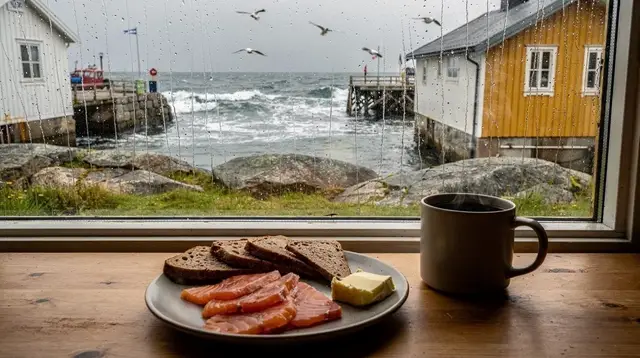
Brunost, Norway’s caramel-coloured brown cheese made from whey, is a genuine national obsession and turns up at breakfast on bread or waffles more often than in any composed dish — it is an acquired taste, sweet and slightly tangy rather than savoury in the way “cheese” implies elsewhere. Rundstykker, soft bread rolls, are a standard breakfast item, usually with cheese, ham or brown cheese.
Cured and smoked salmon (gravlaks and røkt laks) appear widely, often simply with mustard-dill sauce, bread and potatoes. Pickled herring (sursild) is a classic, especially at more traditional or older-style restaurants. In autumn, fårikål — mutton and cabbage stewed together with whole peppercorns — is Norway’s unofficial national dish and worth trying if you are visiting in September or October, when it is genuinely in season rather than served out of habit.
Norway’s dairy and grain culture is more central to daily eating than many visitors expect, given how strongly seafood dominates the country’s food reputation abroad. A rustic open sandwich (smørbrød) with cured meat or fish, dark rye bread and pickle is as representative a Stavanger lunch as a plate of langoustines — it is simply less photogenic.
What “New Nordic” Looks Like in Stavanger
Stavanger’s oil wealth has funded a genuinely serious upscale dining scene over the past two decades, and it draws heavily on the New Nordic movement associated more famously with Copenhagen and Oslo: local, seasonal, foraged ingredients; minimal, precise plating; a deliberate move away from heavy sauces and imported produce.
In practice, that means Rogaland’s own ingredients — North Sea seafood, Ryfylke-area produce, foraged herbs and berries from the surrounding countryside — treated with fine-dining technique rather than home-style cooking. This is where Stavanger’s food scene punches above its size relative to a city of roughly 145,000 people: several restaurants here have reputations that extend well beyond Norway, built specifically on this local-ingredient, high-technique approach.
This tier of dining is also where prices climb furthest. Tasting menus at this level in Norway are a genuine investment, not a casual dinner decision, and worth planning for specifically rather than assuming you will simply walk in.
Markets, Casual Eating and Everyday Food
Not every meal in Stavanger needs to be a sit-down restaurant experience, and understanding the more casual layer of the food scene matters for both budget and time.
Bakeries (bakeri) are a good source of a relatively affordable breakfast or snack — cinnamon buns (skillingsboller), simple pastries and coffee are a genuine Norwegian daily ritual, and coffee culture here is taken seriously. Supermarkets are worth using deliberately: self-catering, even partially, is one of the few real ways to control food costs in Norway, and supermarket fish counters can be surprisingly good given the coastal supply chain. Food trucks and simpler harbour-side kiosks around Gamle Stavanger and the harbour area offer a lower-cost alternative to full restaurants, though “lower-cost” in Norway is relative rather than genuinely cheap.
If you are exploring the old town on foot, pairing it with a look at where locals actually eat rather than where the postcards point is worth the detour — see the self-guided walk through Gamle Stavanger for how the neighbourhood’s cafés and food shops sit alongside its preserved 18th- and 19th-century houses.
The Honest Cost Conversation
This has to be said plainly rather than hinted at: Norway is expensive for food and drink, consistently and by a wide margin compared to most of Europe. Stavanger, sitting in an oil-wealthy region with correspondingly high wages and living costs, is not a discount option within Norway — if anything, prices here track the national high end.
A few things follow from that. First, alcohol specifically is taxed heavily and sold under restrictions that make it noticeably pricier than food itself — a beer or glass of wine with dinner can add a disproportionate amount to a bill. Second, restaurant dinners cost more than lunches almost everywhere in Norway, so shifting your main meal earlier in the day is a genuine cost-reduction strategy, not just a scheduling preference. Third, tipping is not obligatory in the way it is in some countries — service is generally included — which offsets the bill total slightly compared to destinations where tipping is expected on top of already high menu prices.
None of this means the food isn’t worth it. It means budgeting honestly rather than assuming a “Nordic” food scene will behave like a budget-friendly Mediterranean one. If you are planning a trip around cost more broadly, it is worth reading how Norway’s position outside the eurozone affects your budget before you arrive, since currency confusion compounds the price shock for first-time visitors.
Food as Part of a Wider Day Out
Eating in Stavanger works well when it is folded into other activities rather than treated as a separate errand, particularly given how compact the city centre is. A day that combines a harbour walk, a museum visit and a meal near Vågen covers a lot of ground without much travel time — see our one-day Stavanger without a car itinerary for how that can be sequenced.
For a genuinely food-focused activity rather than a meal alone, an apple orchard visit outside the city offers a different, more agricultural side of Rogaland’s food story than the seafood-heavy city centre — the apple picking and pressing tour at Odland Farm near Haugesund is a rare chance to see fruit production rather than fish landed, and pairs naturally with a wider trip toward Haugesund and Karmøy.
If you are travelling with children and want a food-adjacent activity that is playful rather than purely culinary, a chocolate-making session in Stavanger is a straightforward way to combine food and entertainment on a rainy afternoon — genuinely useful given how often Stavanger’s weather turns, as covered in our guide to what’s closed in winter around Preikestolen and Kjerag.
None of these substitute for the seafood and traditional dishes described above — they simply round out a trip where food is one part of a broader day rather than the entire plan.
Practical Notes Before You Eat
A short list of things worth knowing before your first meal in Stavanger. Norway is in the Schengen area but outside the European Union and the eurozone, so prices are set in Norwegian krone (NOK), not euros — do not assume euro pricing or availability anywhere. Card payment, including contactless, is accepted almost universally; carrying cash for meals is rarely necessary and sometimes not possible at all.
Tap water is safe and free almost everywhere, and asking for it is completely normal rather than unusual. Restaurant bookings are advisable for well-regarded restaurants, particularly on weekends, given the relatively small size of the dining scene. Sunday opening hours for supermarkets and some casual food outlets are more restricted than on weekdays, which catches some visitors out.
If you want a broader sense of low-cost activities to offset a food-heavy budget, our guide to free things to do in Stavanger pairs well with the honest cost picture laid out here — walking Gamle Stavanger, the Norwegian Petroleum Museum’s more affordable exhibits, and harbour-side wandering all cost little or nothing, which can help balance a trip where the food itself will not be cheap.
For a more playful, food-adjacent way to spend an evening once dinner is done, a themed adventure game in central Stavanger or a guided kayaking trip on the Lysefjord the following morning both work well as bookends to a meal-focused day, without competing with the food itself for attention.
Frequently Asked Questions About Eating in Stavanger
Is Stavanger a good place for seafood?
Yes. Stavanger sits directly on the North Sea and has a working fishing fleet, so cod, halibut, mackerel, langoustines, mussels and crab are locally landed rather than trucked in. Restaurants along Vågen harbour in particular lean heavily on this.
Is eating out in Stavanger expensive?
Generally, yes. Norway is consistently ranked among Europe’s most expensive countries for food and drink, and Stavanger is no exception. A restaurant meal or even a casual lunch will cost noticeably more than the equivalent in most of continental Europe.
What traditional Norwegian dishes should I try in Stavanger?
Look for brunost (brown cheese), cured and smoked salmon, pickled herring, fårikål (mutton and cabbage stew) in autumn, and rundstykker (bread rolls) at breakfast. Seafood soup and freshly caught fish are also widely available given the city’s coastal setting.
Are there cheaper ways to eat well in Stavanger?
Self-catering from a supermarket, eating your main meal at lunch rather than dinner, and sticking to bakeries or simple fish counters rather than full-service restaurants all reduce costs. There is no genuinely cheap way to eat out in Norway, but some approaches cost less than others.
Do restaurants in Stavanger take euros?
No. Norway is not in the eurozone, and the currency is the Norwegian krone (NOK). Card payment is accepted almost everywhere, so carrying cash is rarely necessary, but prices are set and charged in NOK, not euros.
Is there good vegetarian food in Stavanger?
Vegetarian options exist, especially in the city’s newer, more international restaurants, but the traditional food culture here is built around fish and meat. Vegetarians should expect decent but not extensive choice compared to larger European capitals.
Food and drink tours on GetYourGuide
Verified deep-linked GetYourGuide tours. Book through these links and we earn a small commission at no cost to you.
GetYourGuide does not provide a product photo for this activity — the image shows the meeting point, photographed by us.