Stavanger's Street Art and the Nuart Festival
Is Stavanger's street art still there outside the festival?
Yes. Nuart has run in Stavanger since 2001 and most murals are permanent, curated works that stay on their walls for years, not temporary festival decoration. You can see the bulk of the collection on any visit, in any month.
A third layer, not a footnote
Most first-time visitors arrive in Stavanger with two stories already in their head: the Viking-age history that runs back through Stavanger Cathedral and the swords of Sverd i Fjell, and the oil story that turned a modest fishing and canning town into one of Norway’s wealthiest cities after the Ekofisk discovery in 1969.
Both are real and both are worth your time — you can read more about the oil story in what oil did to this city and about the cathedral’s unusual survival in the cathedral that never got rebuilt. But walk through the city centre for half a day and a third layer becomes just as obvious: large, deliberate, well-made murals on the sides of ordinary buildings, appearing on a bank wall here, a stairwell there, a gable end you would otherwise walk straight past.
That layer has a name and a date. It comes from Nuart, a street art festival that has been running in Stavanger since 2001. It is not new. It is not a passing decoration put up for a summer and taken down. By the time you visit, the scene will have had more than two decades to grow, mature and, in places, quietly disappear as buildings are repainted or redeveloped and new works take their place elsewhere. Treating it as a recent discovery misses what actually makes it interesting: this is one of the longer-running, more established street art programmes in Europe, and Stavanger’s relationship with it is closer to how a city treats its public sculpture than how it treats a pop-up event.
What Nuart actually is
Nuart began in Stavanger in 2001 and has continued in the city every year since, making it, at this point, a genuinely long-running fixture rather than a one-off arts initiative that happened to stick around for a season. Each edition brings international artists to the city to paint new large-scale murals directly onto building walls, alongside talks, tours and other events built around the new work. The festival format has also since been exported — a related Nuart event now runs in Aberdeen, Scotland — but Stavanger is the original, and the city carries the accumulated weight of every year’s additions.
What that means practically is that Nuart is less a single week you either catch or miss, and more an ongoing curatorial project that has been adding to the city’s walls, one commissioned piece at a time, for more than twenty years. Some early works have since been lost to demolition or repainting, which is normal for any outdoor mural collection; others have stayed in place for well over a decade. The net effect, walking around Stavanger today, is a body of work that reads as settled and intentional rather than scattered or accidental.
How the murals sit in the city
This is not a scene you experience by visiting one museum or one gallery. The murals are worked into the ordinary fabric of the city centre — on the sides of shops, on stairwells, on gable walls facing car parks, on buildings you would otherwise register only as backdrop on your way to Vågen harbour or the Norwegian Petroleum Museum. That placement is deliberate.
Street art of this kind is meant to be encountered rather than sought out on a checklist, which is also why this guide is not going to hand you a wall-by-wall map. Individual pieces come and go over the years as buildings change hands or get renovated, so a precise inventory printed today would already be partly wrong by the time you use it. What stays constant is the general experience: walk the centre with your eyes up, past the harbour, through the older commercial streets, around Valbergtårnet, and murals will find you.
It is worth being precise about one common mix-up. Øvre Holmegate, the street of boldly painted wooden houses that has become one of the most photographed corners of Stavanger, is not a Nuart project. It is a separate initiative — a commercial street that repainted its buildings in strong colours to draw in shoppers and visitors — and it predates and sits alongside the mural scene rather than being part of it.
Both give parts of the city a similarly saturated, high-colour character, and both reward slow walking rather than a rushed drive-by, which is why they are easy to fold into the same afternoon. But if you go looking for “the street art” on Øvre Holmegate specifically, you are looking in the wrong register: that street is about painted houses, Nuart is about painted murals on otherwise plain walls, and the two traditions happen to overlap geographically more than they overlap in origin.
Two decades of a scene, not one summer of it
It is worth stating plainly what this guide’s angle is built around: Stavanger’s street art is not a recent discovery and it is not ephemeral. Twenty-plus years of an annual festival, commissioned works painted with building owners’ consent, and pieces that in many cases have stayed on their walls for a decade or longer — that is the profile of an established public art programme, not a pop-up trend that a travel guide happened to notice this year. If you compare it with the graffiti you might see removed within weeks in some cities, the difference is the sanctioning: these are agreed, funded, professionally executed murals, which is exactly why they have been able to last.
That maturity also shows in how the city talks about itself. Stavanger’s tourism identity has three real pillars now, not two: the Viking and medieval history around the cathedral and Gamle Stavanger, the industrial oil story told at the petroleum museum, and this ongoing contemporary art layer that has been adding to the streetscape since 2001. None of the three is more “authentic” than the others just because it is older — a twenty-year-old mural programme is a legitimate part of a city’s fabric, the same way a shopping street repainted decades ago has become part of how Stavanger is photographed.
Seeing it for yourself
There is no single correct way to encounter the murals, and most visitors end up doing some mix of the following.
| Approach | Best for | What to know |
|---|---|---|
| Self-guided walk | Independent travellers, flexible schedules | Walk the city centre streets around the harbour and old town at your own pace; no fixed route needed |
| Guided walking tour | Visitors who want artist names and context | A guide can point out pieces you would otherwise walk past and explain who painted what and when |
| Combined with other sights | Anyone doing a single day in the centre | Easy to fold into a walk that also takes in Gamle Stavanger, Vågen and Øvre Holmegate |
If you would rather not plan your own route, joining a guided walking tour through the old town and harbour is a straightforward way to see murals alongside the historic wooden streets without having to research either in advance.
Guides who work the city centre regularly tend to know which walls currently carry active pieces and which have changed since the last repaint, which matters more here than it would for a fixed historic monument. For something a little more off the obvious route, a guided walk built around Stavanger’s lesser-known corners can turn up murals and small details that a standard old-town loop skips entirely.
None of this requires a car, and it does not require timing your trip to a festival week. Because the collection is mostly permanent, a walk in January shows you the same core set of works as a walk in July — the difference is mainly daylight and weather, not what is on the walls. For a broader sense of what a car-free day in the centre looks like more generally, see one day in Stavanger without a car and, for planning purposes, how many days do you need in Stavanger.
Pairing it with the rest of the city centre
Street art works well as one thread in a longer city-centre day rather than as a destination on its own, mostly because the murals are spread through streets you would want to walk anyway. A natural loop links Vågen harbour, the old town, and the commercial streets where most of the murals sit.
Start near the harbour and work up into Gamle Stavanger, whose roughly 170 preserved white wooden houses give you the oldest visual layer in the city — worth reading about separately in the gamle stavanger self-guided walk and, for a sharper look at what the district’s restoration involved, what restoration erased in Gamle Stavanger.
From there it is a short walk to Øvre Holmegate for the painted houses, covered on its own in the Øvre Holmegate colourful street guide, and then back through the newer commercial blocks where most Nuart-era murals sit on plainer, more modern walls. If you are undecided between doing this on your own or joining a tour, guided versus self-guided walking tour Stavanger walks through the trade-offs.
Two of Stavanger’s other landmark sights sit close enough to fold into the same day. The Norwegian Petroleum Museum, on the harbour in a building designed to echo offshore platform architecture, covers the industry that funded modern Stavanger — background covered in the Norwegian Petroleum Museum guide.
And for the older history the murals sit alongside rather than replace, the Viking House offers an immersive look at the Battle of Hafrsfjord and the unification story marked by Sverd i Fjell — read more in the swords in rock guide, Sverd i Fjell and the myth of national unity, and the dedicated Viking House VR experience guide.
If you would like an expert-led version of that history rather than reading panels on your own, a guided VR experience at the Viking Museum puts the Hafrsfjord story in front of you with narration built in.
None of this needs to happen in a single exhausting day. Break it up, eat somewhere central — what to eat in Stavanger and eating around Vågen harbour both cover that — and treat the murals as something you notice between the other stops rather than a separate errand.
When to go, and what not to expect
Because most of the collection is permanent, there is no wrong season for seeing Stavanger’s street art in general terms. What changes with the season is comfort and light: long summer evenings make an unhurried walk easier, while a wet or dark winter afternoon rewards planning a shorter loop and finishing indoors. Stavanger’s climate is genuinely wet by any standard — annual rainfall runs in the range of 1,180 to 1,250 millimetres — so pack for rain whenever you visit rather than assuming a street-art walk will be a dry one.
What you should not expect is a museum-style, static display. Buildings get sold, repainted, or torn down, and individual murals disappear as a result, sometimes after a decade or more on the same wall. That is a normal feature of street art as a medium everywhere, not a sign that Stavanger’s scene is shrinking or that the festival has stopped adding work — new pieces continue to appear as new walls become available. If you visit expecting a fixed, permanent gallery you may notice a piece you’d read about is no longer there; if you visit expecting an evolving, decades-old public art programme, that is exactly what you will find.
Beyond the city centre
Everything above focuses on the murals inside Stavanger itself, but the city sits at the edge of a region built around water and rock rather than walls, and it is worth acknowledging that most visitors split their time between the two. If a day of walking city streets leaves you wanting to get out onto the fjord instead, a guided kayaking trip on the Lysefjord or a paddle-and-sauna outing closer to the city are both easy to combine with a street-art morning, since neither requires a full day on its own.
The scale is completely different from anything you will see on a wall — cliffs over 1,000 metres, a fjord roughly 42 kilometres long — but the same principle applies: Stavanger rewards slowing down and looking closely, whether that is at a mural on a stairwell or at the water below Preikestolen.
Treat the street art, in the end, as what it is: a genuine, twenty-plus-year layer of the city’s identity, sitting alongside — not underneath — its Viking history and its oil wealth, visible on any visit, in any season, without needing a festival calendar to catch it.
tours.street-art
Verified deep-linked GetYourGuide tours. Book through these links and we earn a small commission at no cost to you.
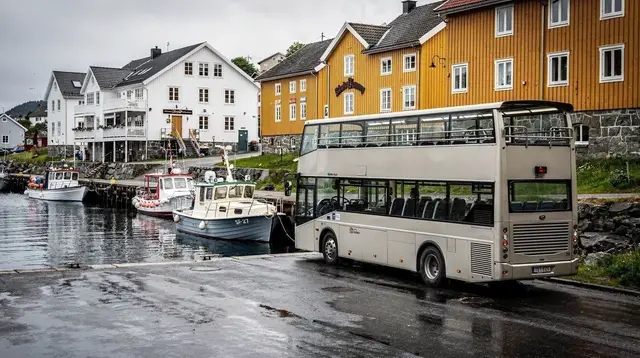
GetYourGuide does not provide a product photo for this activity — the image shows the meeting point, photographed by us.