Øvre Holmegate: Stavanger's Colourful Street Explained
What is Øvre Holmegate and why is it so colourful?
Øvre Holmegate is a short pedestrian street of 19th-century wooden buildings in central Stavanger, painted in bright colours since the mid-2000s as a deliberate initiative by local shop and café owners to revive a quiet street. It is not a historic monument — the colour is recent branding, layered onto old houses.
A Street That Turned Colourful Recently, Not Historically
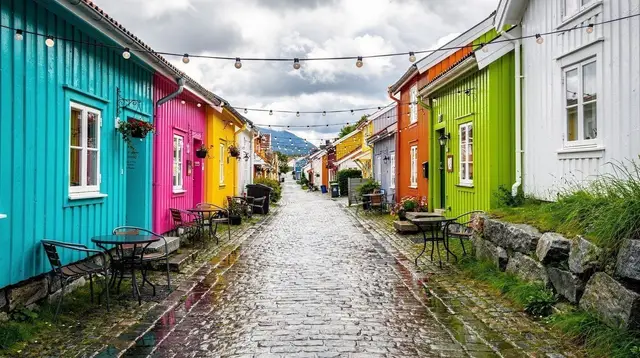
Every visitor photo of Stavanger’s centre seems to include one particular street: a short row of wooden buildings in pink, orange, turquoise, yellow and purple, packed close together and impossible to miss. That’s Øvre Holmegate, locally nicknamed Fargegata — Colour Street. It’s worth being clear from the outset about what you’re looking at, because it’s easy to assume otherwise: the colour is not a preserved historic feature.
The houses themselves are old, dating from the 19th century, roughly the same era as the white wooden houses of Gamle Stavanger across town. The paint is not. Øvre Holmegate was repainted in bold colours starting in the mid-2000s, a deliberate initiative by the street’s own shop and café owners to bring life and customers back to a stretch of the city centre that had gone quiet.
That distinction matters for how you plan your visit. If you’re expecting a heritage district with information boards and a centuries-old colour tradition, you’ll be looking for something that isn’t there. If instead you treat it as what it is — a small, lively commercial street that reinvented its own image and succeeded — it makes a lot more sense, and it’s a genuinely pleasant stop rather than a slightly confusing one.
Where Øvre Holmegate Actually Is
Øvre Holmegate runs through central Stavanger, a short walk inland from Vågen harbour and close to Breiavatnet, the small lake near Stavanger Cathedral. It sits comfortably within the compact core of the city, near Valbergtårnet and the streets that connect the harbour to the newer parts of downtown. You won’t need transport to reach it if you’re already in the centre — it’s a five-to-ten-minute walk from most points around the harbour, and it slots naturally into a longer walk through Stavanger rather than requiring a special trip of its own.
Because it’s so short, Øvre Holmegate is not a destination that fills an afternoon on its own. Most people walk it in fifteen to twenty minutes, longer if they stop to sit down. It works best as one stop on a wider loop of the centre — paired with the harbour, the cathedral, and Gamle Stavanger — rather than as a standalone outing.
Why the Houses Are Painted Like This
The story behind the colour is straightforwardly commercial, and there’s no need to dress it up as anything more. By the early 2000s, Øvre Holmegate had a mix of small, independent businesses — hairdressers, boutiques, cafés — but relatively little foot traffic compared with the main shopping streets closer to the harbour. Business owners on the street began repainting their buildings in bright, saturated colours as a way to stand out and draw people in. It worked: the street built a reputation, picked up the Fargegata nickname, and gradually filled in with more cafés, bars and small shops that leaned into the same colourful identity.
It’s a useful case study in how a place’s image can be built quickly and deliberately, rather than inherited. Compare it with Gamle Stavanger, where the appeal is the accumulated result of roughly 170 wooden houses surviving largely unchanged since the 18th and 19th centuries. Øvre Holmegate is the opposite kind of appeal — new, intentional, and updated as trends shift. Neither is more “authentic” than the other; they’re just different kinds of authenticity, one preserved and one actively created.
What You’ll Find Beyond the Photo
The photo is the reason most visitors first hear about Øvre Holmegate, but the street earns a return visit for what’s actually inside the buildings. It has one of the highest concentrations of independent cafés, bars and small restaurants in central Stavanger, several with outdoor seating that makes use of the colourful backdrop rather than just posing in front of it. Alongside the food and drink, you’ll find barbershops, hairdressers (some of the same trades that first repainted their storefronts), small design and homeware shops, and a handful of vintage or secondhand clothing stores.
It has a slightly different rhythm depending on the time of day. By day, it’s a normal working street — people getting coffee, running errands, sitting outside if the weather allows, which in Stavanger is never guaranteed. In the evening, the bars and restaurants take over, and the street becomes one of the livelier spots for a night out in the city centre. If your itinerary allows it, seeing Øvre Holmegate twice — once for photos in daylight, once for a drink or dinner after dark — gives you a much fuller sense of the place than a single quick walk-through.
If you’re looking to eat nearby, it connects easily with the wider food scene around the harbour — worth reading alongside a look at what to eat in Stavanger and the options clustered around Vågen harbour.
Best Time to Visit and How to Photograph It
Øvre Holmegate is popular enough that timing changes the experience noticeably. In summer, particularly around midday and into the early afternoon, the street fills with visitors, tour groups and cruise-ship day-trippers looking for the same photo everyone else wants — which means waiting your turn for an empty-looking shot, or accepting that other people will be in it. Early morning, before most shops open, is the quietest window and gives you the cleanest photos of the facades. Early evening, once the midday crowds thin out but before the street’s night-time crowd builds, is a reasonable middle option.
Light matters as much as crowd levels. The colours read most vividly in soft, even light — an overcast morning, given Stavanger’s rainfall, actually photographs the street quite well, since harsh midday sun can wash out or overexpose the more saturated colours. Direct low sun in the early morning or evening picks out the texture of the wooden cladding without flattening the colour, which tends to give the most striking results.
| Time of day | Crowd level | Photo conditions |
|---|---|---|
| Early morning (before 9:00) | Low | Best light, quiet street, shops mostly shut |
| Midday (11:00-15:00) | High, especially in summer | Busiest; direct sun can wash out colours |
| Early evening (17:00-19:00) | Moderate | Good light, street starting to fill for the evening |
| Night | High around bars and restaurants | Lively atmosphere, harder for clean daytime-style photos |
Øvre Holmegate and the Rest of Stavanger’s Old Town
It’s worth being direct about how Øvre Holmegate relates to the rest of central Stavanger’s historic fabric, because the two are often confused. Gamle Stavanger is the genuine 18th- and 19th-century wooden-house district, kept in its original white paint, described as the largest concentration of preserved wooden houses in Northern Europe. It’s a residential area people still live in, not a shopping street. Øvre Holmegate is a separate, shorter street in a different part of the centre, built around the same era but repainted recently and run as a commercial strip of cafés, bars and shops.
If your time is limited and you have to choose, Gamle Stavanger is the better use of an hour for anyone interested in the city’s actual architectural history — a fuller walking route through it is covered in the self-guided Gamle Stavanger walk. Øvre Holmegate is the better stop for a short break, a coffee, a bit of colour in your photos, and a sense of the city’s more contemporary, informal side.
Most visitors end up doing both, since they’re close enough together to combine on one walk through the centre — an approach laid out in the one-day Stavanger without a car plan. If you’d rather have the connections between the centre’s sights explained as you go, it’s also worth weighing a guided versus self-guided walking tour of Stavanger.
Øvre Holmegate also sits within the same general area as some of Stavanger’s other street-level colour and art, including the murals connected to the Nuart street art festival, which has run in the city since 2001 and has left a scattering of large-scale works around the centre — a different, more explicitly artistic tradition from the shopfront colour scheme on Øvre Holmegate, but one that rewards similar unhurried wandering.
Getting There and Combining It With a Walking Tour
Øvre Holmegate doesn’t require planning to reach — it’s inside the walkable core of Stavanger, a short stroll from the harbour, the cathedral and the main shopping streets. If you’re staying anywhere near the centre, you can simply walk there directly; there’s no dedicated parking, ticket, or transport connection specific to the street itself.
For visitors who’d rather have context along the way — how the street fits into the city’s history, what else is worth seeing nearby, and how it connects to the harbour and cathedral — a guided city walk is a straightforward way to see it without having to plan the route yourself.
A guided walk through Stavanger’s old town and harbour typically passes near or through the area, tying Øvre Holmegate into the wider historic centre rather than leaving it as an isolated photo stop. For a version that digs into corners of the centre most visitors miss, a guided walk covering the city’s lesser-known spots is worth considering as an alternative or a follow-up.
If you’d rather structure your walk around Stavanger’s most recognisable landmark, a walking tour that takes in views of Stavanger Cathedral is another way to link the centre’s key sights, including the streets around Øvre Holmegate, into a single guided route. And if the Viking history of the wider Rogaland region has caught your interest alongside the city walk, a guided VR experience at the Viking museum makes a good complement on the same day, since it’s a short trip from the centre.
None of this requires much logistics on your part — Øvre Holmegate is small, free, and forgiving of a loosely planned visit. The one thing worth carrying with you is the context: this is a street that made itself colourful on purpose, recently, to survive as a business district, not a fragment of old Stavanger left over from another century. Once that’s clear, it’s easier to enjoy it for what it actually is — a good coffee stop, a reliable photo, and a small example of how a city’s newer identity gets built one shopfront at a time.
tours.city-walking-tours
Verified deep-linked GetYourGuide tours. Book through these links and we earn a small commission at no cost to you.
GetYourGuide does not provide a product photo for this activity — the image shows the meeting point, photographed by us.