A Small Watchtower on a Big Harbour View
Valbergtårnet is easy to overhear about and easy to overrate. It shows up on city maps of central Stavanger, it sits on a hill with a clear line of sight over the harbour, and it photographs well — all of which can make it sound like a must-see landmark on the level of Stavanger Cathedral or the coloured houses of Øvre Holmegate. It isn’t, and treating it as one is the surest way to be mildly disappointed by a genuinely pleasant few minutes.
What Valbergtårnet actually is: a modest stone tower built in the middle of the 19th century, originally to serve a practical purpose for a town built largely of wood, and today kept as a viewpoint people pass through on their way somewhere else. It is not staffed as a paid attraction, it does not have a permanent exhibition to work through, and it does not need an hour of your day. It needs about fifteen minutes and a short uphill walk from Vågen harbour, and it rewards that fifteen minutes with one of the better free views in central Stavanger.
This page treats Valbergtårnet exactly as it deserves to be treated: as a well-placed stop inside a longer walk through the city centre, not as a destination that carries a day on its own.
Why the Tower Is There at All
Stavanger’s old town centre, including what is now preserved as Gamle Stavanger, was built almost entirely of wood for centuries. That made fire the single biggest recurring threat to the town — a threat serious enough that keeping watch for smoke was a formal, organised job rather than something left to chance. Valbergtårnet was built on a natural high point above the harbour specifically to give that watch a clear line of sight over the rooftops below.
The same elevated position that made it useful for spotting fires also made it useful for keeping an eye on shipping traffic moving in and out of the harbour beneath it. In a town whose economy depended on what came and went by boat, a lookout point that could see ships arriving before they reached the quay had an obvious practical value that had nothing to do with tourism.
None of that makes Valbergtårnet architecturally remarkable. It is a plain stone tower built to do a job, not to impress — closer in spirit to a fire station than to a cathedral. What is worth appreciating is what that practical origin tells you about the town underneath it: a densely packed wooden settlement where fire and shipping were the two things worth watching for, and a harbour that mattered enough to justify building a tower specifically to oversee it.
The View: What You Actually See
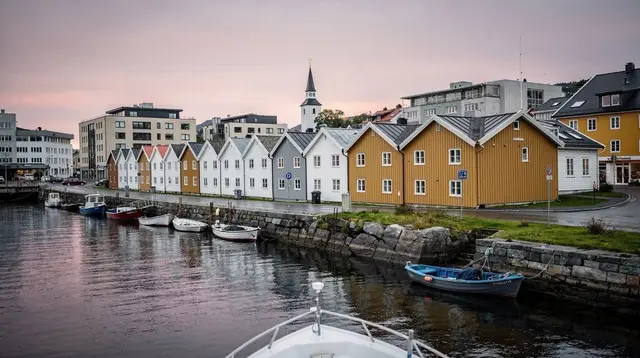
The reason Valbergtårnet still earns a stop, more than a century after fire watches stopped being necessary, is the view. From the top you look almost directly down onto Vågen harbour — its boats, its quaysides, the pattern of buildings around its edges — and out across the rooftops of the surrounding old town toward the wider city.
It is worth being precise about the kind of view this is, because expectations set from photographs of Norway’s dramatic fjord scenery will not match what you find here. This is a rooftop-level city and harbour view, not a panorama over the Lysefjord or the kind of elevated wilderness view you get from Preikestolen. It is a good, compact, walkable version of a city viewpoint — the kind of spot where you can see how a working harbour town is laid out from just above street level — and it is worth judging on those terms rather than against Norway’s bigger natural sights.
Light matters more here than at most stops on a Stavanger walk, because the whole point is the view rather than the structure itself. Later morning through mid-afternoon tends to light the harbour and the pale house fronts around it more evenly than early morning, when long shadows can flatten the scene. On a clear day between roughly May and September you get the best combination of daylight hours and dry conditions underfoot on the walk up; outside that window, Stavanger’s wetter, greyer months can make the same view feel considerably less rewarding, though the tower itself remains accessible.
Getting There and What to Expect on Arrival
Valbergtårnet sits close enough to the centre that almost no visitor needs transport to reach it — it is a five- to ten-minute walk from Vågen harbour or from Stavanger Cathedral, on foot, over a short but genuinely uphill stretch of streets. Anyone already exploring Stavanger on foot, which is how most people see the city centre, will pass close to it without much of a detour.
There is no ticket booth, no fixed opening hours to plan around, and no admission fee — you walk up, take in the view, and walk back down or continue on toward your next stop. That makes it an easy addition for visitors trying to fit a lot into a short amount of time, including cruise passengers with only a few hours ashore before their ship departs. It is also an easy one to skip without guilt if you are short on time or the weather has turned, because nothing about the visit requires advance planning or a booked slot.
Footing on the approach is uneven in places — old stone steps and sloped streets rather than a flat paved path — so it is not the easiest stop for visitors with mobility limitations or for strollers. It is, however, entirely manageable for most walkers, including families with older children, as one stop among several rather than a destination requiring special preparation.
Fitting Valbergtårnet Into a Longer Walk
The honest way to think about Valbergtårnet is as one waypoint on a walking loop through central Stavanger, not as a stop that justifies a trip by itself. Most visitors link it with the white wooden streets of Gamle Stavanger, the painted shopfronts of Øvre Holmegate, and a pass along Vågen harbour itself, treating the tower as the high point — literally — in the middle of that loop.
If you would rather follow a structured route than improvise one, a self-guided walk through Gamle Stavanger or a dedicated guide to Øvre Holmegate’s colourful street both work well paired with a short detour up to the tower partway through. For visitors without a car trying to cover the city centre in a single outing, a one-day Stavanger itinerary or a broader guide to seeing Stavanger without a car will naturally route you close enough to Valbergtårnet to add it in without extra planning.
The table below is a rough sense of how Valbergtårnet compares to the other city-centre landmarks it often gets mentioned alongside, useful mainly for setting expectations before you go.
| Sight | What it is | Typical time needed | Cost |
|---|---|---|---|
| Valbergtårnet | Old fire watchtower, harbour view | 15-20 minutes | Free |
| Stavanger Cathedral | Medieval cathedral, consecrated around 1125 | 30-45 minutes | Free to enter |
| Gamle Stavanger | Preserved 18th-19th century wooden streets | 45-90 minutes | Free |
| Øvre Holmegate | Colourful shopping street | 20-30 minutes | Free (shopping optional) |
The pattern across all four is the same: none of them individually demands a full day, but strung together on foot they add up to a satisfying half-day or full-day walk through the parts of Stavanger that are actually worth seeing on foot.
Where the Harbour Below Leads
Part of what makes the view from Valbergtårnet worth the short climb is that Vågen harbour, spread out below it, is not just a scenic backdrop — it is the departure point for a large share of what people actually do in and around Stavanger. Boats heading out toward the Lysefjord, RIB trips, and sightseeing cruises leave from quays you can pick out from the tower, which makes it a useful spot for getting your bearings before you commit to a longer excursion later the same day or the next morning.
If a look down at the harbour leaves you thinking about getting out onto the water yourself, that instinct is well placed — Stavanger’s most memorable half-days generally involve leaving the harbour rather than staying in the city centre.
A boat tour from Sandnes combining the Lysefjord and views up toward Pulpit Rock departs not far from where you are standing, and gives you the scale of the fjord that no city viewpoint, including this one, can show you. For a shorter option closer to central Stavanger, a boat trip toward Preikestolen from Forsand covers similar ground on a more compact schedule.
For visitors who would rather see the same landscape from above than from the water, a helicopter tour over Pulpit Rock and the fjord turns the rooftop-scale view from Valbergtårnet into something considerably larger — the difference between looking down at a harbour and looking down at an entire fjord system. And for a slower, more active way to be out on the water, a guided paddle tour combining two fjords with a sauna stop is a way to spend an afternoon on the water rather than simply looking at it.
None of these need to be booked or even decided on before you visit the tower — they are simply worth knowing about while you are standing above the harbour they all leave from, in case the view talks you into wanting more of it.
Photography and Timing Notes
Valbergtårnet is popular with visitors carrying a camera or a phone specifically for the harbour shot, and a few practical notes make that easier. The view works best in flatter, more even light — overcast days actually do this particular scene few favours by muting the colour of the boats and house fronts below, while direct low-angle sun in early morning or evening can throw hard shadows across the harbour that make a clean wide shot harder to get. Late morning through mid-afternoon on a clear day is the most reliable window.
Because the tower itself is small and unstaffed, there is rarely a queue or a crowd-management issue the way there can be at busier landmarks — you are unlikely to need to wait for a clear shot, even in the busier summer months. That also means there is little reason to plan around avoiding crowds here specifically; the busier stops on a central Stavanger walk are Øvre Holmegate and the harbourfront itself, not the tower.
Practical Notes for a City-Centre Day
A few things are worth knowing before you build Valbergtårnet into a wider day in central Stavanger, most of which apply to the city centre generally rather than to the tower specifically.
Norway is not part of the European Union and does not use the euro — prices in and around Stavanger are in Norwegian kroner (NOK), and card payment is accepted almost everywhere, including for small purchases, so there is little practical need to carry cash. Norway is a genuinely expensive country for food, drink, and organised activities by most visitors’ standards, and central Stavanger is no exception; a coffee and a light lunch bought out will typically cost more than the equivalent would in most of continental Europe, which is worth budgeting for honestly rather than being surprised by later.
Weather is worth planning around loosely rather than precisely. Stavanger sees meaningful rainfall across most of the year, and a walk that includes an uphill stretch to a viewpoint is more pleasant, and considerably safer underfoot, in dry conditions. There is no need to cancel a visit over light rain, but a genuinely wet or windy day is a reasonable reason to push the tower to a later point in your trip rather than force it.
If you are combining Valbergtårnet with food, the streets around Vågen harbour hold most of the city centre’s cafes and restaurants, and a guide to eating around the harbour is a reasonable way to plan a meal either side of the walk. Visitors interested in how Stavanger’s older buildings survived into the present, rather than only in fire-watch history, will get more of that story from Gamle Stavanger itself than from the tower.
Valbergtårnet and the Stavanger Watchtower: FAQ
Is Valbergtårnet worth a special trip to Stavanger?
No. It is worth a stop if you are already exploring central Stavanger on foot, for a free harbour view, but it is not substantial enough to plan a dedicated visit around.
Is Valbergtårnet the same as Stavanger Cathedral?
No, they are different sights a short walk apart. Stavanger Cathedral is the city’s medieval church, consecrated around 1125 and still in use, while Valbergtårnet is a much younger stone watchtower built to keep watch over the wooden town and harbour below.
Is it free to visit Valbergtårnet?
Yes, walking up to the tower and taking in the view is free. There is no ticket booth and no fixed opening hours in the way a museum has them.
How long does it take to see Valbergtårnet?
Most visitors spend fifteen to twenty minutes at the tower itself — enough time to walk up, take in the view over Vågen harbour, and take a few photos before continuing on.
What is the view from Valbergtårnet like?
You look down over Vågen harbour, the roofs of the old town, and out toward the wider Stavanger cityscape. It is a rooftop-level city view rather than a dramatic fjord panorama.
Why was Valbergtårnet built?
It was built as a watchtower for a town built mostly of wood, used to spot fires early and to keep an eye on ships arriving in the harbour, at a time when both were serious practical concerns for Stavanger.
Can you combine Valbergtårnet with Gamle Stavanger and Øvre Holmegate?
Yes, that is the natural way to see it. All three are within easy walking distance of each other and of Vågen harbour, and most visitors link them into a single loop rather than visiting any one of them in isolation.
Is Valbergtårnet suitable for visitors with limited time, like cruise passengers?
Yes, it works well for a short shore visit because it sits close to the harbour and adds a view without requiring transport or a long detour.