Should You Stand on Kjeragbolten? What It Actually Involves
Do you have to stand on Kjeragbolten to say you did the hike?
No. Reaching the boulder and seeing it wedged above the Lysefjord is the achievement; stepping onto it is a separate, optional choice many hikers decline. Plenty of people who complete the full route to Kjerag never put a foot on the rock itself.
The Boulder Is Not the Hike, It’s a Choice at the End of It
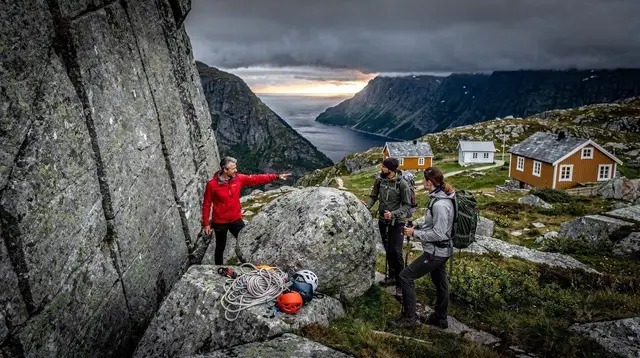
Somewhere in the planning for a trip to Kjerag, a single image tends to take over: a person standing on a boulder wedged in a crevasse, arms out, roughly 984 metres above the Lysefjord, with a fall of close to 1,000 metres just past their toes. It is one of the most photographed spots in Norway, and it is easy to arrive at the trailhead assuming that standing on it is simply what you do once you get there — the natural last step of a long day’s walk.
It isn’t. The route to Kjerag, its chained sections and the long approach through Lysebotn, are covered elsewhere; this page is only about what happens once you are standing in front of the boulder itself, and about the decision that follows. That decision is entirely separate from the hike. You can walk the full distance, deal with the exposure of the trail, reach the viewpoint above the crevasse, and still decide the boulder itself is not for you — and that is a complete, ordinary way to do this hike, not a failure to finish it.
What Standing on It Actually Involves
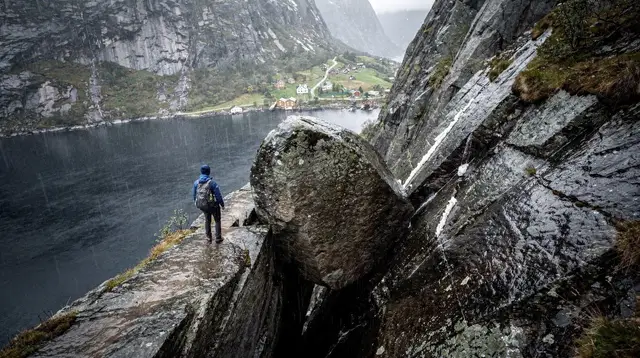
The boulder is wedged between two rock faces, spanning a narrow gap. It does not move, has not moved in the time people have been visiting it, and is not the risky part in a structural sense. What makes it different from the rest of the trail is what is on either side of it: open air, and a drop toward the fjord below that most people have never stood this close to.
To stand on it, you have to leave the solid rock ledge beside the gap, cross the few steps onto the boulder itself, and stand where there is nothing solid to hold and no barrier of any kind. There is no rope, no railing, no marked safe zone. Whatever confidence you have about heights on a viewing platform or a marked trail does not automatically transfer to this — it is a different kind of exposure, and plenty of experienced hikers who are entirely comfortable on the approach still find this specific spot unsettling in a way they did not predict.
That gap between what people expect to feel and what they actually feel is the whole story of this decision.
Why People Change Their Mind Right There
Ask anyone who has done this hike and skipped the boulder, and the story is usually the same: they planned to stand on it, felt confident about it the whole way up, and then something shifted once they were actually a few steps from the edge with nothing between them and the drop. That reaction is common enough to be the norm, not the exception, and it is worth taking seriously before you go rather than being surprised by it on the day.
A few things tend to drive it:
- The scale is different in person. Photos flatten the drop into something abstract. Standing there, the depth reads as real in a way a screen never quite manages, and that recalibration happens fast.
- There is no controlled entry point. On via ferratas or climbing routes, exposure is usually introduced gradually with gear. Here, the transition from solid trail to open boulder happens in a handful of steps, with no equipment and no pause built in.
- Wind and rock condition matter more than expected. A day that felt calm on the walk in can still produce a gust right at the exposed point, and a rock surface that looks dry can be damp enough to change how confident your footing feels.
- Other people’s reactions are contagious. Watching someone else hesitate, or watching someone else look completely relaxed, both shift how steady the next person feels stepping up.
None of this means the boulder is more dangerous than it looks. It means that the gap between deciding at home and deciding at the edge is real, and that changing your mind on the day is not a sign anything went wrong.
Fatal Falls Have Happened Here
This is not a place to treat lightly or as a casual photo op, and presenting it that way would be dishonest. Fatal falls have occurred at Kjerag over the years, generally connected to the exposure right around the boulder and to the steep, chain-secured sections of the approach trail rather than to any failure of the rock itself. The boulder does not move; people do, and the margin for a bad step, a gust of wind, or a moment of overconfidence is genuinely thin at that specific point.
That history is the reason this page exists as a separate question from “how do I get there.” Deciding whether to stand on the boulder deserves the same seriousness as deciding whether to attempt the hike at all, and it deserves to be made with a clear head at the trailhead, not locked in months earlier from a photo on a website.
What Weather Changes About the Decision
The approach to Kjerag already depends heavily on conditions — when the Lysebotn road is open, whether the chained sections are wet or icy, whether visibility is good enough to be worth the walk at all. The same conditions apply, more sharply, to the boulder itself.
| Condition | Effect on the boulder decision |
|---|---|
| Dry, calm, good visibility | Best-case scenario; still a personal call, not a guarantee |
| Wind, even moderate | Gusts at the exposed point can be stronger than at the trailhead; many people decline in wind |
| Wet or damp rock | Reduces footing confidence significantly; a common reason to skip it even on an otherwise fine day |
| Fog or low cloud | Removes the view that is the entire reason to stand there in the first place |
| Outside the road-open season | Not a relevant question — access to Kjerag itself is closed |
A day that looks fine from the parking area at Øygardstølen is not a promise of fine conditions right at the boulder several hours later. Reassessing on the spot, rather than sticking to a plan made in advance, is the right approach here.
You Can Get the View Without the Photo
The photograph is not the only reward at the end of this hike, and it is worth separating the two in your head before you set off. The view from the ledge beside the boulder — across the crevasse, out over the Lysefjord, down toward water that is roughly 1,000 metres below — is available to anyone who reaches that point, whether or not they set foot on the rock itself. Most people who skip the boulder still describe the moment of arriving there as the high point of the hike.
If you want a photograph without standing fully out on the boulder, the common approach is to photograph someone else from a stable position on the ledge a few metres back, which produces a similar-looking image without either person committing to the exposed section. It is a reasonable compromise, and one a lot of hikers land on without feeling they missed anything.
What matters is deciding this for yourself, on the day, based on how you actually feel standing there — not based on an image you saw before you ever left Stavanger.
If You’d Rather Not Decide Alone
Some hikers prefer having someone experienced alongside them for the final stretch and the boulder itself, partly for the route-finding and partly for the reassurance of not facing that specific moment solo. A guided option removes some of the uncertainty around timing, conditions, and pacing that otherwise falls entirely on you to judge.
a full-day guided hike to Kjeragbolten from Stavanger covers the whole route with a guide who has read the conditions many times before, which can make the boulder decision feel less like a solo judgment call under pressure.
If the plan is closer to Preikestolen rather than Kjerag, the exposure question is different but related — Pulpit Rock’s cliff edge has no barrier either, just without a boulder to step onto. a local guided hike around the Preikestolen area is worth considering if that comparison helps you calibrate what kind of exposure you’re comfortable with before committing to the longer Kjerag day. For a look at how the two compare more broadly, that’s covered separately.
There’s also a way to see Kjerag’s cliffs from water level rather than from above them. a Lysefjord boat trip from Forsand towards Preikestolen shows the same fjord walls from below, which is a genuinely different, and for some people more comfortable, way to take in the scale of the place without ever facing the boulder question at all.
Making the Call on the Day
A few honest guidelines, based on what actually seems to help people decide well in the moment rather than regret either choice afterward:
- Decide at the boulder, not before. Plans made at home carry no obligation once you’re standing there. Give yourself permission to change your mind in either direction.
- Check the wind right at the spot, not just at the trailhead or on a forecast checked that morning. A minute of standing near the edge, without stepping on, tells you more than any app.
- Don’t decide based on the group around you. Other people’s comfort with exposure has nothing to do with your own footing or balance.
- If the rock is wet, treat that as a real reason to skip it, not an inconvenience to push through.
- Remember the hike is already complete once you’re standing there. The boulder is a bonus decision layered on top of an achievement you’ve already had.
None of this is about talking anyone out of it. Plenty of hikers stand on Kjeragbolten every season, get the photo, and have no regrets. The point is only that it is optional, that the hike does not require it, and that deciding not to is exactly as valid an ending to the day as deciding to step out onto the rock.
Common Questions About Standing on Kjeragbolten
Is it actually dangerous to stand on Kjeragbolten?
The boulder itself is wedged firmly and does not move, but there is no railing, no harness, and a drop of roughly 1,000 metres to the Lysefjord on one side. The danger comes from the exposure and from how a person’s own legs and balance respond to it, not from the rock failing.
Do I need to stand on it to finish the hike?
No. The marked trail ends at the boulder, and reaching that point is the hike. Whether you then step onto the rock is a separate decision that has nothing to do with completing the route.
Why do some people turn back right at the boulder?
Adrenaline and fear respond differently to real exposure than to a plan made at home. Many hikers who intended to stand on it find their legs will not cooperate once they are actually facing the gap, and that reaction is common, not embarrassing.
Is there a safer way to get the photo without stepping fully onto the boulder?
Most people photograph others from a stable position a few metres back on the rock ledge, which gives a similar picture without either person committing to stand fully out on the wedged rock above the drop.
Has anyone died at Kjeragbolten?
Yes, fatal falls have occurred at Kjerag over the years, generally linked to the exposure near the boulder and the steep chained sections of the approach rather than to any equipment failure. It should be treated as a serious location, not a casual photo stop.
Does the weather change the decision?
Yes. Wind, rain, or a wet rock surface all increase the real risk of standing on the boulder, and a calm, dry day that looks fine at Øygardstølen can still be gusty right at the exposed point above the fjord.
Will I feel like I missed out if I don’t stand on it?
Most hikers who skip it say the view and the sense of having reached Kjerag were the actual reward, and that the boulder photo is a bonus rather than the point of the day.
For more on what the approach itself involves before you ever reach this decision, see do you need a guide for Kjeragbolten, what the Lysebotn road’s opening dates mean for your plans, and a broader look at how a five-day Rogaland itinerary fits Kjerag and Jæren together. If you’d rather see the same cliffs from the water, what a Lysefjord RIB safari actually involves and what you’ll actually see on a Lysefjord cruise are both good starting points.
For solo hikers weighing this specific stretch, a guide to solo hikes near Stavanger and a wider read on why Kjerag is closed more of the year than it’s open both help set expectations before you commit to a date. You can also browse things to do at Kjeragbolten and the full range of Kjeragbolten hikes listed for the area.
tours.kjeragbolten-hikes
Verified deep-linked GetYourGuide tours. Book through these links and we earn a small commission at no cost to you.
GetYourGuide does not provide a product photo for this activity — the image shows the meeting point, photographed by us.