Do You Need a Guide for Kjeragbolten?
Do you need a guide to hike to Kjeragbolten?
No permit or guide is legally required, and plenty of experienced hikers do the six to eight hour route alone. A guide is worth paying for if you lack experience on exposed, chain-assisted terrain, but hiring one does not remove the fall risk on the route's three chained sections.
The real question isn’t yes or no
Kjeragbolten does not require a guide. There’s no gate, no permit, and no ranger checking credentials at the start of the trail from Øygardstølen. People with genuine mountain experience walk in on their own all summer. So the honest framing isn’t “is a guide required” — it isn’t — but “does your own experience match what this route actually demands.” That’s a narrower, more useful question, and it has a different answer for almost everyone who asks it.
This hike is six to eight hours round trip, roughly 10 to 12 km, and it includes three sections where the trail runs up steep rock secured only by a fixed chain. Between those sections there’s a lot of ordinary, if strenuous, mountain walking. The chained sections are short in distance but long in consequence — a slip on unfamiliar chain technique, in wind, with a pack that shifts your balance, is a different kind of mistake than a slip on flat ground.
What the chained sections actually demand
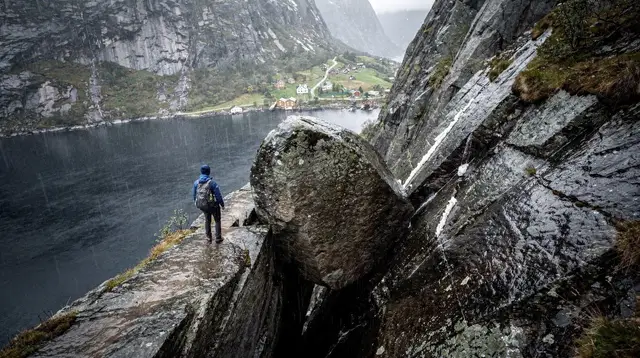
None of the three chained pitches require technical climbing skill in the rope-and-harness sense. What they do require is comfort moving your weight over rock at a steep angle while holding a chain rather than a handrail, judging where your feet actually have grip versus where the rock only looks like it does, and doing this with real air below you rather than a two-metre drop. If you’ve used via ferrata style fixed protection before, or you regularly scramble on exposed ridgelines, this will feel familiar. If your hiking has mostly been on maintained trails without exposure, it will not.
Weather changes this equation quickly. Wet rock on these pitches is measurably more slippery, wind at the Lysefjord rim can knock your balance at the worst possible moment, and low cloud can turn a straightforward navigation problem into a genuinely confusing one. A guide’s real value often shows up here — not on a clear July afternoon, but in the judgment call to slow down, wait out a squall, or turn back entirely when conditions shift partway through the hike.
The case for going with a guide
If you’re weighing whether to book a guided hike, the strongest reasons are experience-based, not convenience-based:
- You have limited or no experience with chain-assisted terrain. Reading the first chained section correctly on sight, rather than working it out under pressure, is exactly what a guide teaches in the first few minutes.
- You’re uneasy with exposure and don’t know how you’ll react under it. A guide who has watched hundreds of hikers freeze or panic on this exact terrain can talk you through it in real time, which is very different from reading advice in advance.
- You’re hiking solo and want a second set of eyes on weather and pacing. Rogaland’s mountain weather can turn faster than a forecast updates, and a guide’s local judgment on when to abort is worth more than most gear.
- You want the context, not just the summit. A guide who works this route regularly can explain what you’re looking at — the scale of the Lysefjord below, why the boulder wedged where it did, how the access road down to Lysebotn closes for winter — turning a physical challenge into something you actually understand.
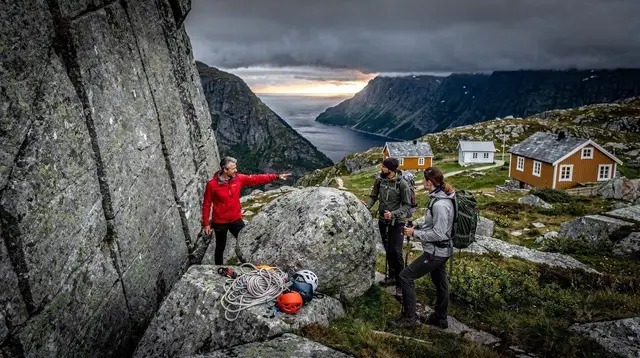
a full-day guided hike to Kjeragbolten from Stavanger covers transport, pacing on the chained sections, and a guide who knows current trail conditions before you commit to the exposed pitches — useful precisely because conditions here can differ meaningfully from what a forecast or trip report from last week suggested.
The case for going without one
Plenty of hikers are better served skipping the guide, and it isn’t about saving money — though a guided day does cost meaningfully more than fuel and parking. It comes down to genuine self-assessment:
- You’ve done comparable exposed hikes before — via ferrata routes, scrambles with fixed chains or cables elsewhere, or ridge walks with real drop-offs — and know how your body and nerves respond.
- You hike at your own pace and prefer it. Guided groups move at the pace of the slowest confident member on the chains, which can mean long waits at pinch points if you’re an efficient mover.
- You’ve checked the Lysebotn road opening and closing dates yourself and understand the access window, checked the forecast for the specific day, and know how to read cloud building over the fjord as a turn-back signal.
- You’re comfortable navigating and pacing a six to eight hour day without someone else managing the schedule, water stops, and weather calls for you.
None of this makes the hike easier. It just means the judgment calls that a guide would otherwise make for you are calls you’re equipped to make yourself.
What a guide does not remove
This is the part worth being blunt about: a guide reduces risk, but does not eliminate it, and fatal falls at Kjeragbolten have happened in guided groups as well as to people hiking alone. The chained sections are still steep rock with real consequence for a fall, the boulder itself still sits above roughly a thousand metres of air, and no amount of local knowledge changes the physics of a slip on wet rock in wind. Anyone who tells you a guide makes this hike safe, rather than safer, is not describing the mountain accurately.
What a guide changes is the margin around your own mistakes — catching a bad foot placement before it becomes a fall, making the call to turn back before conditions deteriorate further, keeping a nervous hiker from freezing at the worst point on the chain. That margin has real value for the right hiker. It is not a substitute for physical readiness, and it is not a guarantee.
Guided or independent: a quick comparison
| Factor | With a guide | Independent |
|---|---|---|
| Chain-section technique | Taught and coached in real time | You arrive knowing it or figure it out |
| Pace | Set by the group, often slower on chains | Set by you |
| Weather judgment | Guide’s local experience decides | Your own reading of forecast and sky |
| Cost | Higher — includes transport and instruction | Fuel, parking, your own time |
| Best suited to | First exposed hike, solo travellers wanting company, uneasy with heights | Hikers with prior chain/exposure experience |
| Risk removed | None — reduced margin only | None — full responsibility on you |
If you decide to go independently
Preparation does most of the work a guide would otherwise do for you. At minimum:
- Check the forecast for Kjeragbolten specifically, not just Stavanger — conditions at altitude near the fjord rim differ from the city.
- Confirm the Lysebotn road is open for the season you’re travelling in; it closes with snow and cuts off access to Øygardstølen entirely.
- Pack for a genuine mountain day, not a stroll — see what to actually pack for hiking in Rogaland, including layers, grippy footwear, and more water than feels necessary.
- Start early. Six to eight hours plus a buffer for the chained sections means an early departure from Jørpeland or Forsand matters more than it seems.
- Read honestly about the boulder itself and whether you should actually stand on Kjeragbolten before you’re standing at the crevasse deciding in the moment.
- Tell someone your planned return time, and treat any doubt about weather or your own condition as a reason to turn back, not push through.
None of this is guide-exclusive knowledge. It’s simply the preparation a guide would otherwise be doing on your behalf.
Alternatives if the hike itself isn’t the right fit
Not everyone who wants to see Kjeragbolten needs to stand on it. Seeing the boulder and the scale of the drop from the water, on a Lysefjord boat trip from Forsand, gives a real sense of the terrain without any exposure at all. It’s also worth knowing what a Lysefjord cruise vs a RIB safari actually shows you, since the two aren’t the same experience.
If chain-assisted hiking generally feels like a bigger step than you want to take on your first Rogaland trip, easing in with a guided hike in the area around Preikestolen is a reasonable way to test how you handle exposure before committing to Kjeragbolten on a future visit.
For context on nearby options once the road is open for the season, a five-day Kjerag and Jæren itinerary sketches out how this hike fits alongside the rest of the region, and Kjerag is closed more than it’s open is worth reading if you’re trying to plan around the access window rather than around the hike itself. If the famous 4,444-step staircase at Flørli is also on your list, note that it’s a separate outing on the other side of the fjord, not a variation on this route.
Kjeragbolten questions, answered
Do you need a guide to hike to Kjeragbolten?
No. Kjeragbolten sits on open mountain with no entry gate and no requirement to hire anyone. Many hikers with solid mountain experience complete it independently every summer. A guide becomes worth considering when you lack experience with chains, scrambling, or long exposed drops, not because the route is legally restricted.
Is the Kjeragbolten hike dangerous without a guide?
It carries real risk regardless of whether you go with a guide or alone. The three chained sections involve steep rock with significant exposure, and fatal falls have occurred here, including in groups led by guides. A guide can reduce risk through pacing, route knowledge, and reading conditions, but cannot eliminate the exposure itself.
What hiking experience should you have before attempting Kjeragbolten alone?
You should be comfortable with several hours of steep, uneven terrain, have used fixed chains or via ferrata style aids before, and have no significant discomfort with heights and drop-offs. Experience judging weather and turning back matters as much as physical fitness. If any of that is new to you, going with a guide is the safer choice.
Does hiring a guide make Kjeragbolten safe?
No, and no guide should claim otherwise. A guide manages pacing, points out where footing is unreliable, and can make a sound call to turn back in bad weather, but the chained sections and the drop below the boulder are unchanged. Treat a guide as reducing risk, not removing it.
How long does the guided hike to Kjeragbolten take compared to going solo?
Both typically run six to eight hours round trip. A guide may move a mixed-ability group more slowly on the chained sections and add time for teaching technique, while a well-prepared solo hiker moving at their own pace often finishes nearer the six hour end.
What does a guide actually do on the Kjeragbolten route?
A capable guide sets pace for the group, gives hands-on instruction on the chained sections, watches for early signs of fatigue or panic near exposure, checks weather and turns the group back if conditions turn, and carries basic first aid. What a guide cannot do is remove the exposure or guarantee the boulder photo.
Is Kjeragbolten suitable for a first serious hike?
Not on your own. As a first long, exposed mountain hike, Kjeragbolten is a demanding choice, and going with a guide is the sensible way to attempt it if you’re new to this kind of terrain. Save the solo attempt for once you have comparable exposed terrain under your belt elsewhere.
tours.kjeragbolten-hikes
Verified deep-linked GetYourGuide tours. Book through these links and we earn a small commission at no cost to you.
GetYourGuide does not provide a product photo for this activity — the image shows the meeting point, photographed by us.