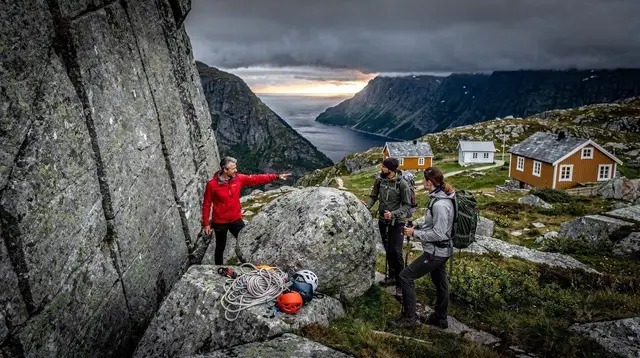
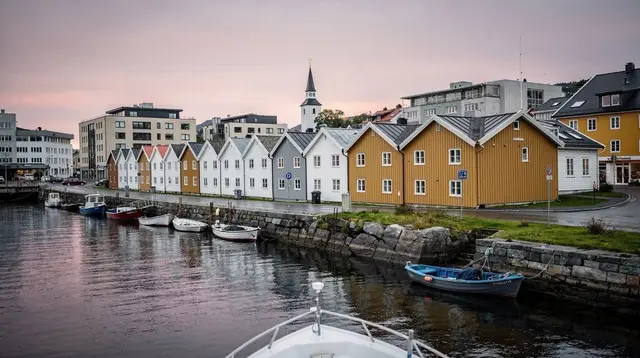
If your picture of adventure in this region is a mountain plateau above a fjord, Skogsprett will look almost modest by comparison — and that’s exactly the point. It’s a treetop ropes course and climbing park on a wooded hillside near Sandnes, built for a controlled, harnessed few hours rather than a full day of hiking. For families travelling with children, or for anyone who wants an active outing without the elevation, exposure, and time commitment of Preikestolen or Kjeragbolten, it fills a real gap in a region better known for its big hikes.
What Skogsprett Actually Is
Skogsprett belongs to a familiar Nordic category of outdoor attraction: a network of wooden platforms, rope bridges, wobbly logs, nets, and zip lines built between trees, graded into courses of increasing height and difficulty. Visitors clip into a continuous safety line at the start of each course and stay attached to it the entire way around, so a slip means dangling in a harness rather than a fall to the ground. It’s the same idea you’ll find at ropes parks across Norway and Scandinavia more broadly — low barrier to entry, real physical challenge at the top end, and enough variety that a family with a five-year-old and a fourteen-year-old can each find a course that fits.
The setting is unglamorous in the best way: ordinary Norwegian forest, not a dramatic backdrop, which keeps the focus on the courses themselves rather than the view. That also means weather and light matter less here than they do at an outdoor viewpoint — you’re not chasing a sunset or hoping the cloud lifts off a plateau, you’re moving between trees at your own pace.
Getting There from Stavanger and Sandnes
Skogsprett sits close enough to Sandnes to work as a half-day trip from central Stavanger without eating your whole itinerary.
| From | Distance | Travel time | How |
|---|---|---|---|
| Stavanger city centre | Around 20 km | 20-25 minutes by car | Car, or Kolumbus bus with a short final stretch |
| Sandnes centre | A few kilometres | 10-15 minutes | Car or local bus |
| Sola Airport (SVG) | Around 25 km | About 30 minutes | Car, rental, or taxi |
A car is the most straightforward option, particularly if you’re travelling with children, snacks, spare clothes, and the general clutter a family day out generates. Kolumbus buses connect Stavanger and Sandnes reliably, but the last leg to the park itself is easier with a short taxi ride or a lift than on foot, especially with young kids. If you’re renting a car for the wider region anyway — for Ryfylke, Jæren, or a Lysebotn run — folding Skogsprett into the same rental period costs nothing extra.
The Courses: What to Expect
Skogsprett is organised into graded courses rather than a single circuit, so you choose your level rather than being funnelled through one fixed route.
| Course level | Typical starting age/height | Rough duration | Indicative price range (NOK) |
|---|---|---|---|
| Kids’ course | From around 4-5 years, adult nearby | 45-60 minutes | Lower end of the day-budget range |
| Junior course | From around 8 years | 1-1.5 hours | Mid-range |
| Adult / high course | Teens and adults | 1.5-2.5 hours | Upper end of the range |
| Combined ticket (several courses) | Mixed-age groups | 2-3 hours | Highest, for a full visit |
Treat those price bands as a planning guide rather than a fixed quote — ropes parks in Norway commonly adjust pricing by season and by exactly which courses are bundled into a ticket, so it’s worth checking current prices before you go. Booking the entry ticket ahead of time is the simplest way to lock in a visit, especially on a weekend or during the summer school holidays:
book a Skogsprett net park entry ticket in advance and you can head straight to the safety briefing instead of queuing at a ticket desk.
Most visits start with a group safety talk covering how to clip and unclip from the line, how the zip lines work, and what to do if you get stuck partway across an obstacle. After that, you’re largely self-paced — move between courses, take breaks, and let kids repeat a course they liked rather than being pushed through a set schedule.
Who Skogsprett Suits
Skogsprett is built for a specific kind of day, and it’s worth being clear about who gets the most out of it.
Families with a spread of ages. Because the courses are graded, a family with both a cautious six-year-old and a confident twelve-year-old can each find a course pitched right for them, and regroup for a shared course or a break in between.
Groups and teams. Corporate away-days and school groups use ropes parks like this precisely because the format naturally mixes independent challenge with group encouragement — someone finishing a tricky obstacle gets cheered on by whoever’s already through it.
Anyone who wants “active outdoors” without “hiking.” Not every visitor to this region wants a four-to-eight-hour mountain trail, however famous the view at the end. Skogsprett gives you a genuinely physical, slightly nerve-jangling few hours without needing hiking boots, a packed lunch for the trail, or several hours of daylight in reserve.
Not the Lysefjord: A Different Kind of Adventure
This is worth stating plainly, because the region’s biggest attractions can make it easy to lump every “adventure” activity together. Skogsprett is not a version of the Lysefjord hikes, scaled down for families. It’s a different category of activity altogether.
Preikestolen is an 8-kilometre round-trip trail with real elevation gain, uneven terrain, and a cliff edge with no barrier at the top. Kjeragbolten is longer again, with chained sections on exposed rock and a route that closes for winter once the Lysebotn road shuts. Both demand fitness, suitable footwear, and respect for mountain weather that can change fast. Neither is remotely comparable to Skogsprett’s fixed platforms and continuous safety line a few metres above a forest floor.
If a hiking trip to the fjord is what you actually want, start with our comparison of Kjeragbolten and Preikestolen, or our guide to taking Preikestolen with kids before deciding whether the family should attempt the real hike at all. Skogsprett, by contrast, is the outing you book when you want the adrenaline and the group energy without any of that mountain-day planning.
Practical Details: Tickets, Season, and Safety
Skogsprett typically runs its full schedule from late spring into early autumn, broadly May to September, matching the region’s better weather window. Outside that stretch, hours can shrink or the park may operate on a reduced or seasonal basis, so it’s worth confirming opening dates before building a special trip around it, particularly if you’re visiting outside peak season.
Safety equipment — harness, helmet where used, and the clip system for the safety line — is provided and fitted on site. Staff run a briefing before you’re allowed onto any course, and closed-toe shoes are the one piece of kit worth bringing yourself; sandals and flip-flops generally aren’t allowed on the courses for obvious reasons. Heavy rain, high wind, or lightning can pause individual courses or the whole park for the afternoon, since wet platforms and cables become genuinely slippery rather than just unpleasant — the same caution that applies to Skogsprett’s more famous outdoor cousins elsewhere in Rogaland.
Booking ahead matters more in July and August, when local families and visiting groups overlap, and it removes one variable from a day that otherwise runs on a fairly loose, self-paced schedule.
Making a Day of It in Sandnes and Jæren
Skogsprett rarely needs to be the entire day’s plan. Paired with a stop in Sandnes itself, or a stretch of the Jæren coastline, it becomes one half of a satisfying, low-stress day that mixes an active morning with something calmer in the afternoon.
Families looking for a rainy-day backup nearby often pair Skogsprett with a visit to Vitenfabrikken, Sandnes’s indoor science centre — useful if the forecast turns and the ropes course has to pause for the afternoon. For a broader look at keeping children entertained across the region, our family-friendly Stavanger guide and the Stavanger-with-kids itinerary both build days around exactly this kind of low-drama, high-activity mix.
If part of your group wants a taste of the fjord landscape without a mountain hike, Skogsprett’s forest setting pairs surprisingly well with a water-based alternative on the same trip. A short RIB ride gets non-hikers onto the Lysefjord itself:
a Sandnes RIB fjord tour on the Lysefjord covers the scale of the fjord in an hour or two, which works well the same day as a morning at the ropes course.
For a calmer water option, a guided paddle is another way to see the coastline at a gentler pace than a hike:
a guided SUP and sauna paddle tour around Stavanger’s fjords suits adults or older teens who’d rather glide across the water than sit in a boat.
For hikers in the group who do want to tackle the fjord properly while the rest of the family climbs trees at Skogsprett, our guide to easy hikes near Stavanger and the Dalsnuten hike guide both cover shorter, gentler trails than Preikestolen or Kjerag — a middle ground between a ropes course and a full mountain day. And if logistics are the sticking point, our guide on whether you need a car in Stavanger covers the honest trade-offs of driving versus relying on Kolumbus buses for a day that involves Sandnes, Jæren, and the city centre in one loop.
However you build the day, the core distinction is worth keeping in your head when you’re planning: Skogsprett is a secured, family-scaled attraction close to Sandnes, and the Lysefjord’s big hikes are a separate, much bigger commitment entirely. Treating them as the same kind of “adventure” is the one mistake worth avoiding.
Questions About Visiting Skogsprett Adventure Park
Is Skogsprett suitable for young children?
Yes. The park is built around several course levels, and the lowest ones are designed for children from around four or five years old, always with an adult close by. Staff at the entrance can point you to the right starting course for a child’s age and confidence.
How long does a visit to Skogsprett take?
Most families spend two to three hours on site once you count the safety briefing, a rest between courses, and a snack break. A single course can be finished faster, but the appeal is usually working through more than one level in a visit.
Do you need climbing experience or your own gear?
No previous climbing experience is expected. Harnesses and safety equipment are provided on site, and staff run a short safety briefing before anyone starts. Wear closed shoes and clothes you don’t mind getting a little dirty.
Is Skogsprett the same kind of activity as Preikestolen or Kjeragbolten?
No, and this is the most common mix-up. Preikestolen and Kjeragbolten are unmarked-in-places, multi-hour mountain trails above the Lysefjord with real elevation, weather exposure, and at Kjeragbolten, a genuine fall risk. Skogsprett is a fixed course on a low wooded hillside with a continuous safety line — a controlled attraction, not a hiking route.
What happens if it rains?
Light rain usually doesn’t stop a visit, but the park can pause or close individual courses in heavy rain, strong wind, or thunder, since platforms and cables get slippery and unsafe. If the forecast looks rough, it’s worth checking conditions before you drive out.
Do you need a car to get there?
A car is the easiest way to reach Skogsprett from central Stavanger, at around 20-25 minutes’ drive. It’s possible to combine a Kolumbus bus into Sandnes with a short taxi or walk for the last stretch, but a car keeps the trip simple, especially with children and gear in tow.
What’s the best time of year to visit?
Late spring through early autumn, roughly May to September, is when the park runs its full schedule and the trails between courses are driest. Outside that window, opening hours can be reduced or seasonal, so it’s worth confirming before you plan a special trip around it.
Can adults visit without children?
Yes. The higher courses are built for teenagers and adults, and groups of friends, colleagues, or couples use Skogsprett as a stand-alone activity or a team-building outing without any children involved.