Should You Actually Stand on Kjeragbolten?
I got to the boulder a little after two in the afternoon, legs heavy from the third chained section, and found seven people ahead of me, phones out, waiting their turn.
What the line at the boulder is actually for
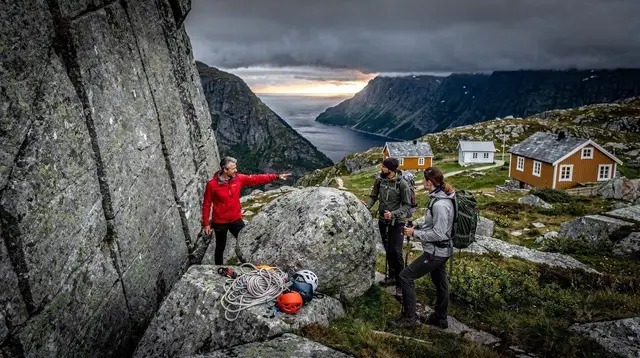
By that point I had been walking for close to seven hours. The trail out of Øygardstølen does not ease you in — it takes the elevation gain early, hands you three sections where you are grateful for the chains bolted into the rock, and then, with no warning I remember reading anywhere as clearly as I should have, opens onto a shelf of grey rock with the Lysefjord laid out nearly a kilometre below. Somewhere in that view sits a boulder wedged into a crevasse at around 984 m, famous enough that people who have never hiked a mountain in their life know its shape from a single photograph.
The line was orderly. Nobody pushed. Someone’s friend was directing “hands up,” “now sit,” “look at me, not down” from the ledge. I watched four people take their turn before I let myself think about whether I wanted mine.
The hesitation
Here is the honest version of what went through my head, standing at the back of that line with my knees still shaking slightly from the descent off the last chain: I had already seen the thing I came for. The drop was right there, from the rock I was standing on — a good five metres from the boulder, no less real, no less vertiginous. The fjord looked exactly as immense whether I was on the boulder or beside it. What the boulder added was not a better view. It was a photograph of me in the view.
I want to be fair to the people in that line, because I understand the pull better now than I did that morning. Six to eight hours of chained ascents, exposed rock, and a legitimate physical effort — Do You Need a Guide for Kjeragbolten? covers what that effort actually demands — earns you the right to want proof you did it. A photo on the boulder is compact, unambiguous evidence in a way “I walked to a ledge and looked at a fjord” simply is not, on a phone screen or in a family group chat. That is not vanity, or not only vanity. It is how we have learned to carry an experience home.
But standing there, watching each person’s turn take somewhere between thirty seconds and two full minutes — sit, stand, wave, argue about the angle, climb back off — I could not convince myself the boulder was doing anything for the hike itself. Kjeragbolten is a landmark, not a summit. The Kjerag plateau around it, with its own drops and its own unbroken view down the fjord walls, gives you the same scale, the same wind, the same slightly unsteady feeling in your stomach — for free, without a queue, and without putting your full weight on an unsecured slab of rock over a thousand-metre fall.
What actually earns the trip
If I am defending anything here, it is this: the thing worth defending about Kjeragbolten was never the boulder. It is the six to eight hours it takes to reach it, the three chained walls that make you use your arms as much as your legs, and the moment the trail stops climbing and the whole Lysefjord opens underneath you. That moment happens before you get anywhere near the crevasse the boulder sits in. It happens on ordinary rock, the kind every single person on that trail has already stood on safely.
I have read the trip reports that treat the photo as the whole point — “did Kjerag” functioning as shorthand for “got the shot.” I understand the instinct, but it flattens a genuinely serious hike into a backdrop. And I have read the opposite, people mocking anyone who climbs onto the boulder as reckless or performative, which strikes me as its own kind of dishonesty — it pretends the pull toward that photograph isn’t completely human, isn’t something most of us would feel standing in that line ourselves.
What I settled on, eventually, third from the front: I stepped out of the line. Not out of principle exactly, more because my legs were done arguing with me and the view from where I stood was already everything I had walked seven hours for. Someone behind me took my spot without a second’s hesitation, and I do not think either of us was wrong.
Fatal falls have happened at this site — not a detail to bury in a footnote, and one more reason I would rather this piece not double as a safety brief. For the trail conditions, the chained sections, what to wear and when the road to Lysebotn is even open, that belongs on its own page, not folded into an argument about a photograph — see Kjeragbolten vs Preikestolen: How Different Are They Really? and When Does the Lysebotn Road Open and Close? A Season-by-Season Guide to Kjerag Access for the practical detail, and What to Pack for Hiking in Rogaland before you go.
If you want the hike without deciding on the spot
A few ways people take the pressure off that one decision at the boulder:
| Approach | What it changes |
|---|---|
| Guided hike with transport | Someone experienced sets the pace and the chained sections; you still choose at the boulder |
| Go early or on a weekday | Shorter line, more time to decide without an audience |
| Pair it with Preikestolen on a longer trip | Compare two very different Lysefjord viewpoints, only one with a queue for a photo |
| See the fjord from the water first | A Lysefjord cruise shows the scale from below before you decide what you want from above |
If a guide takes the decision fatigue out of the chained sections and the drive down to Lysebotn, an guided Kjerag hike with transportation from Stavanger handles the logistics so the only thing left to decide is what you do once you reach the rock.
For the fuller day out, an adventurous hike to Kjeragbolten from Stavanger covers the same ground. And if you would rather see the fjord walls from underneath first — a genuinely different way to grasp the scale of the drop you would be standing over — a guided paddle tour on two Stavanger fjords puts you on the water instead.
None of this is an argument that you should not stand on the boulder. It is an argument that the decision deserves more thought than the length of the line gives it — and that the hike, the chains, the wind and the fjord underneath you are already the whole thing, with or without the photo.
For the rest of a Kjerag day — how the road closes for winter, what a five-day trip through Kjerag and the Jæren coast looks like, or where this fits against a lighter itinerary — see 5 Days: Kjerag and the Jæren Coast, Five Days of Solo Hiking Around Stavanger, Kjerag Is Closed More Than It’s Open and The Weather App That Lies About the Plateau.
Questions people ask before deciding at the boulder
Is it dangerous to stand on Kjeragbolten?
There is no railing, no harness and no attendant. Fatal falls have been documented at Kjerag, and the boulder itself sits above a drop of roughly 1,000 m to the Lysefjord below.
Do most hikers actually climb onto the boulder?
A large share do, at least in summer, which is why a line forms at the site on busy days — but plenty of people who complete the full hike choose to look rather than stand.
How long is the hike to Kjeragbolten?
Around 10-12 km round trip, typically 6-8 hours, with three steep sections secured by chains. It is a serious mountain hike, not a short walk to a viewpoint.
Can you see the view without standing on the rock?
Yes. The ledge and rock surfaces around the boulder give the same exposure to the fjord and the same sense of height, without stepping onto the boulder itself.
Is Kjeragbolten open all year?
No. The Lysebotn road that reaches the Øygardstølen trailhead closes in winter, which closes off the hike for a large part of the year.
Is Kjeragbolten harder than Preikestolen?
Yes, by most measures — longer, with more elevation gain and three chained sections, against a shorter, well-graded trail at Preikestolen.
tours.Opinion
Verified deep-linked GetYourGuide tours. Book through these links and we earn a small commission at no cost to you.
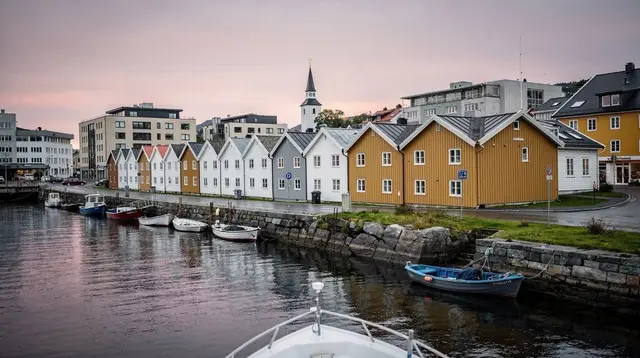
GetYourGuide does not provide a product photo for this activity — the image shows the meeting point, photographed by us.