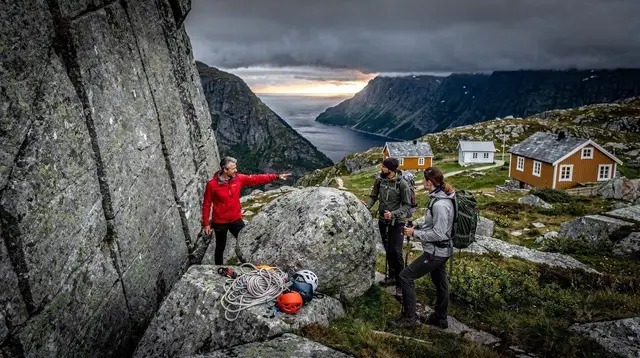
Flørli and Its 4,444 Empty Steps
I did the maths on the ferry back and it embarrassed me a little: I had just climbed roughly the same vertical distance as Preikestolen, on a staircase instead of a trail, and I had seen four other people doing it. Four. That same afternoon, a boat full of day-trippers was queuing to file up the switchbacks toward the plateau, and by all accounts the top was standing-room only. I know, because I’d been up there myself two days earlier, shuffling in a line to get a photograph without a stranger’s elbow in it.
Flørli sits on the Lysefjord, not far past Preikestolen as the boat travels, and its claim to fame is a genuinely strange one: 4,444 wooden steps built up the mountainside to service a hydroelectric power station that no longer runs the way it once did. The plant is largely a relic now. The staircase, somehow, is still exactly as steep as it was built to be, and nobody has softened it for tourism. There’s no fee, no visitor centre, no crowd management, because there’s no crowd.
Two mountains, one day, two entirely different queues
I want to be precise about what I’m comparing, because it’s not really Flørli versus Preikestolen as places — both are worth seeing, and I’m not arguing Preikestolen is overrated in any absolute sense. What I’m comparing is what it feels like to be there, and that’s almost entirely a function of how many other people made the same decision you did that morning.
At Preikestolen, you’re never alone with the view. The trail itself, at around 8 km round trip, is busy enough in July that you settle into a kind of shuffling rhythm behind other hikers, and the plateau at the top is a shared stage — hundreds of people a day, all reaching for the same angle on the same cliff edge. It’s still worth it. But it is not solitude, and it never claims to be.
Flørli, on the day I climbed it, was closer to silence than to crowd. I heard my own breathing more than I heard other voices. Somewhere around step 2,500 I sat down on a step — any step, they’re all identical — and had the fjord entirely to myself for what must have been fifteen minutes. That doesn’t happen at Preikestolen in August, or really at any time of year when the weather cooperates.
The climb itself doesn’t ask your permission
I’ll be straightforward about something a lot of write-ups skate past: 4,444 consecutive wooden steps is a serious physical undertaking, and treating it as a quirky photo-op destination undersells it in a way that could genuinely catch someone out. There is no flat stretch to recover your breathing on, no switchback that eases the gradient the way a hiking trail naturally does. It is step after step after step, the same motion repeated thousands of times, and by the upper third your legs know it even if your head is still distracted by the view opening up behind you.
I’d put it bluntly: this is not a casual outing you decide on the morning of, in whatever shoes you happened to pack. It rewards people who are honestly fit and mentally ready for monotony as much as exertion. If you’re weighing it against something gentler, Rogaland has easier options that don’t demand the same sustained leg strength, and it’s worth being honest with yourself about which category you’re in before you commit a full day to it.
What struck me most, coming down, was how the sparse traffic changed the character of the effort. On a crowded trail, there’s a kind of social momentum — you keep pace with the flow, other hikers’ presence is a distraction from your own fatigue. On the Flørli steps, there’s nothing external to lean on. It’s just you, the wood underfoot, and a number in your head slowly ticking toward 4,444, which somehow makes the physical difficulty feel more honest, if also more isolating.
What the emptiness actually tells you
Here’s the thesis I keep coming back to: how many people visit a place tells you almost nothing about how good that place is, and quite a lot about how well it’s been photographed and repeated. Preikestolen earned its reputation fairly — it’s a genuinely striking plateau — but that reputation has become self-reinforcing to the point where it now crowds out comparably dramatic places nearby that simply didn’t get the same postcard treatment early on.
Flørli has the numbers to make an equally strong case for itself: a fjord-facing staircase built for an industrial purpose, now standing as an odd, almost sculptural relic that happens to double as the longest climb of its kind anywhere. It should, by rights, draw a fraction of what Preikestolen draws — not close to zero. The gap between those two numbers is, as far as I can tell, mostly inertia. People go where they’ve already seen photos from, and not enough photos exist of an empty wooden staircase disappearing into a fjord.
I’m not going to turn this into a step-by-step planning guide — the logistics of getting to Flørli, timing the boat, and what to actually pack deserve their own dedicated page, and cramming that in here would do a disservice to both the practical details and the story. What I’ll say instead is that if your Rogaland itinerary has room for one hike beyond the obvious, and you’re prepared for the physical reality of it rather than the postcard version, Flørli is the one I’d point you toward.
The trail conditions after rain matter for Preikestolen, sure, but at Flørli the bigger variable is simply whether your legs can take four thousand steps without a flat section — and whether you’re willing to go somewhere the boats don’t especially advertise.
Getting there without turning this into a solo epic
You don’t need to plan this as an isolated mission. A cruise along the Lysefjord that also covers Preikestolen can be paired with a Flørli stop depending on the operator and schedule, and I’d genuinely recommend seeing both in the same trip if you can, if only to feel the contrast for yourself rather than take my word for it.
this Lysefjord cruise combined with the Preikestolen hike is the option I’d point most first-time visitors toward, since it puts the fjord, the plateau and the general shape of the landscape in front of you before you decide where to spend a harder day. If you’d rather approach from the water side specifically, a Forsand-departure boat trip toward Preikestolen gets you onto the fjord itself, which is where Flørli’s staircase is best appreciated from a distance before you commit to climbing it up close.
For the climb itself, I’d lean toward going with people who know the terrain rather than improvising, especially given how unforgiving the step count is on tired legs; a guided hike with a local operator in the wider Preikestolen area is a reasonable way to build fitness and local knowledge before attempting something as sustained as Flørli on your own.
If Flørli whets your appetite for the harder end of what this region offers, Kjeragbolten sits at a different level of commitment again, and the Lysebotn approach to it closes for winter in a way Flørli doesn’t — worth knowing before you build a season around either one. I’ve also written about why the cruise-ship version of this fjord tells only part of the story, which touches on the same crowding logic from the water rather than the steps.
And if a full day on the fjord under sail appeals more than a climb, sailing the Lysefjord is worth a look as a genuinely different way to take in the same scenery. Either way, decide whether a single hard day or an overnight in the fjord suits your trip better before you book anything — Flørli rewards people who give it more than a rushed afternoon squeezed between other plans, and not needing a car for most of this region means the boat schedule, not traffic, is what will actually shape your day.
Questions about hiking Flørli’s 4,444 steps
Is the Flørli staircase harder than Preikestolen, and is it crowded?
Yes on both counts, in opposite directions. Flørli’s 4,444 consecutive wooden steps are a steeper, more sustained physical effort than the Preikestolen trail, but on the same summer day that draws hundreds of people to the plateau, you can climb Flørli and pass only a handful of other hikers.
How many steps does the Flørli staircase actually have?
4,444, built to service a hydroelectric power station on the mountainside above the settlement. The station is no longer in active use for that purpose, but the staircase remains, and it is generally described as the longest wooden staircase in the world.
Is climbing 4,444 steps harder than it sounds?
It is exactly as hard as it sounds, and I’d argue people underestimate it because the word staircase sounds tame next to a mountain trail. It is a relentless, repetitive vertical effort with almost no flat sections to recover on.
Why is Flørli so much emptier than Preikestolen?
Reputation, mostly. Preikestolen has become the single image most visitors associate with Norway’s fjords, so it absorbs the bulk of everyone’s limited hiking time, while Flørli barely registers on most itineraries despite being comparably dramatic.
Do you need to be an experienced hiker to climb the Flørli steps?
You need to be honestly fit, not necessarily an experienced mountain hiker. The route-finding is trivial since you are on a staircase, but the sustained leg effort catches out people who assume steps are gentler than an unmarked trail.
Can you see the Lysefjord from partway up the staircase, or only at the top?
The fjord opens up progressively as you climb, with wide views available well before the final steps, which is part of what makes the ascent feel rewarding even if you don’t push all the way to the top structures.
Where can I find the practical details for planning a Flørli hike?
I’ve kept the logistics — getting there, timing, what to bring — on a separate, dedicated guide, since this piece is really about the experience and the comparison with Preikestolen rather than trip planning.
tours.Field notes
Verified deep-linked GetYourGuide tours. Book through these links and we earn a small commission at no cost to you.
GetYourGuide does not provide a product photo for this activity — the image shows the meeting point, photographed by us.