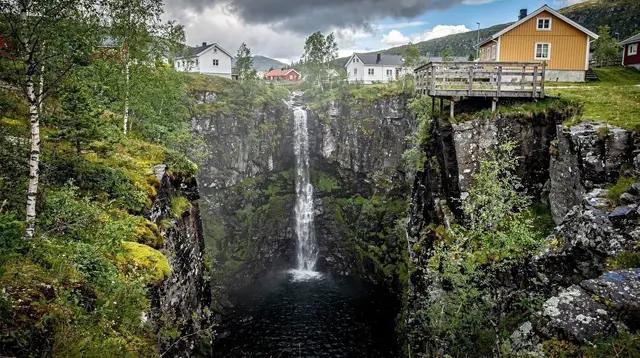
The Best Season to See Månafossen Waterfall
When is the best time to see Månafossen at its most powerful?
Månafossen is generally most dramatic in late spring, when snowmelt from the mountains above Frafjord feeds the falls, and again in autumn, when sustained rain builds up the flow. There is no single confirmed peak date, so watch recent weather rather than a fixed calendar month.
Why the Calendar Alone Won’t Tell You
Ask when Månafossen looks best and you will find plenty of confident answers online, several of them contradicting each other, and almost none of them backed by an actual measurement of how much water is moving over the ledge on a given day. That is because nobody publishes a reliable, continuously updated flow figure for this particular waterfall, and quoting an invented number would be worse than saying nothing at all.
What can be said with confidence is simpler and, in practice, more useful: Månafossen is fed by the catchment above Frafjord, and that catchment behaves the way mountain catchments in Ryfylke generally behave — full of snowmelt in spring, full of rain in autumn, and comparatively quiet in a dry midsummer stretch. If you plan around that seasonal logic rather than around a specific month printed in a guidebook, you will make a better decision than most visitors do.
This guide focuses squarely on timing. If you are looking for trail distance, elevation gain, or how technical the path itself is, that detail lives in the dedicated Månafossen hike guide rather than here.
Spring: When the Snowpack Lets Go
Through winter, snow accumulates across the higher ground that feeds the streams above Månafossen. When temperatures climb in spring, that snowpack releases its water gradually at first, then more quickly as longer days and milder air take hold. The practical result is that late spring — broadly, the back half of May into June, though the exact window shifts from year to year depending on how much snow fell and how fast it melts — is one of the two periods most likely to show Månafossen running fuller than average.
There is a genuine trade-off here. A heavier spring melt is also a wetter, muddier, and occasionally more slippery period on the ground around the falls and on approach paths in the wider area, and meltwater-swollen streams elsewhere in Ryfylke can behave unpredictably. None of that changes the guidance in the dedicated hike guide, but it is worth knowing before you commit to a specific date purely because “spring” sounded promising on paper. Checking recent conditions close to your travel date, rather than relying on the season name alone, remains the more reliable approach.
Autumn: When the Rain Takes Over
The second strong candidate for seeing Månafossen at its fuller end is autumn, roughly September into October, when Rogaland’s rainfall tends to pick up after the relatively drier stretch of high summer. Unlike the spring melt, which draws down a finite snowpack over a period of weeks, autumn flow depends almost entirely on how much rain has actually fallen in the days and weeks immediately beforehand. A wet September can produce a genuinely dramatic waterfall; a dry one will not, regardless of what the calendar says the season is supposed to deliver.
This is the single most important idea in this guide: autumn does not guarantee a fuller Månafossen by itself. What it offers is a higher baseline probability of sustained rain, and sustained rain is what actually swells the falls. If you are travelling in autumn and want the best possible chance of seeing Månafossen at its most active, look at how wet the preceding one to two weeks have been across the Frafjord and wider Ryfylke area rather than trusting the month on its own.
Summer: The Quiet Middle Ground
Midsummer in Rogaland brings the longest days and, on balance, the driest and most settled stretch of weather the region sees — though “settled” in this part of Norway is a relative term, and rain remains a real possibility on any given day even in July. Because there is neither an active snowmelt pulse nor the reliable autumn rain pattern feeding the catchment, Månafossen typically runs at its calmer end during a dry summer week.
It is still a genuine waterfall worth seeing, and long daylight hours make for easier logistics around a visit, but if a dramatic, high-volume waterfall is specifically what you are after, summer is statistically the least likely season to deliver it — unless a wet spell happens to move through while you are there, which does happen.
The upside of summer is predictability of a different kind: easier underfoot conditions, more daylight to work with if you are combining a visit with other stops in Ryfylke, and simpler logistics if you are travelling as a family or with people who prefer not to gamble on shoulder-season weather.
Winter: Frozen, Distant, and Often Inaccessible
Winter changes the equation again. Cold spells can freeze sections of the waterfall and the rock around it, producing a striking but very different sight from the roaring falls of spring or autumn — more ice sculpture than cascade in the coldest stretches. Daylight is short, the ground can be treacherous, and access in general becomes far less predictable across Rogaland as a whole.
For a first visit built specifically around seeing Månafossen at its most powerful, winter is the season to plan around least, not because there is nothing to see, but because the flow itself becomes the most unpredictable and the conditions around it the most demanding. If a winter trip to the region is what you are planning regardless, the broader guide to what you can still do in Stavanger in winter is a better starting point than this page.
Reading the Weather Instead of a Calendar
The honest takeaway from all of the above is that season is a proxy, not a promise. Spring and autumn both raise the odds of a fuller waterfall for genuinely different physical reasons — one because snow is melting, the other because rain is falling — while summer and winter each lower those odds in their own way, one through dryness and one through cold. None of the four seasons guarantees an outcome on any specific day.
If you want the best realistic chance of a memorable Månafossen, the single most useful habit is checking recent weather for the Frafjord and Ryfylke area in the one to two weeks before you travel, rather than fixating on a month. A late-May trip that follows a dry spring will likely underwhelm compared to an early-October trip that follows two weeks of steady rain, even though the calendar would suggest the opposite.
This is also why this guide deliberately avoids quoting a specific flow figure in cubic metres per second or any similar precise number — no verified, continuously updated measurement for this waterfall is available, and a confident-sounding figure pulled from an unreliable source would mislead more than it would help. Seasonal logic, checked against recent weather, is the more honest tool.
For a broader sense of how Rogaland’s weather shifts across the year beyond just this one waterfall, the month-by-month guide to visiting Stavanger is a useful companion, as is the more general piece on why the rain here isn’t bad luck so much as the climate.
What This Means for Planning Your Trip
If flexibility is on your side, treat spring and autumn as your two strongest candidates, and treat the specific week rather than the specific month as the thing to watch. If your travel dates are already fixed for reasons unrelated to the waterfall — a summer holiday, a winter city break — there is still a genuinely good visit to be had, just with different expectations set from the outset. A summer visit trades waterfall drama for easier walking and longer daylight; a winter visit trades flow for a quieter, starker, ice-touched landscape that has its own appeal if you go in with the right expectations rather than hoping for a spring-level cascade.
Whatever the season, pack for changeable Rogaland weather rather than for whatever the forecast says at home — the general packing guidance for hiking in this region covers the essentials, and it applies whether you are visiting in a wet October or a dry July.
Getting to Frafjord and Timing Your Visit
Månafossen sits above Frafjord, inland from Stavanger in the wider Ryfylke area, and most independent visitors reach it by car as part of a longer day out rather than a quick standalone errand. If you don’t have your own transport, or would simply rather not navigate rural Ryfylke roads yourself, a guided option removes that layer of planning entirely and can be built around whichever season you are travelling in.
a guided day trip to Månafossen that includes transport from Stavanger is the simplest way to see the waterfall without renting a car, and it pairs well with checking recent rainfall beforehand so you know roughly what to expect on arrival. For visitors who want to turn the day into something more active, a combined via ferrata and bouldering outing at Månafossen adds a physical challenge alongside the waterfall itself, which can be a good way to make the most of a calmer, drier-season visit when the falls are running quieter.
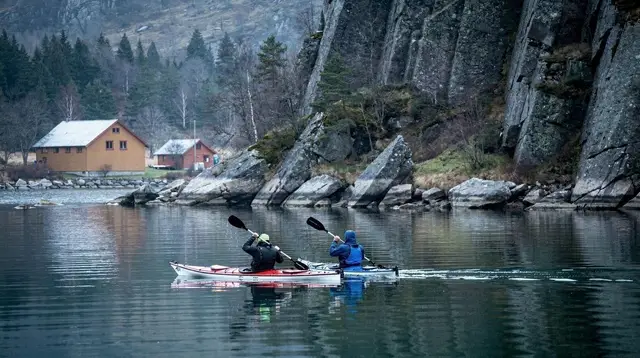
If you would rather experience the wider Frafjord valley from the water, a guided kayak or stand-up paddleboard tour around Frafjord offers a different vantage point on the same landscape, and works well in the calmer conditions of a settled summer stretch. Those who want to combine Månafossen with another well-known viewpoint in a single outing can look at a guided day combining Månafossen with the Dalsnuten viewpoint, which suits travellers with limited time who still want to see two distinct sides of the region.
Combining a Visit With the Rest of Ryfylke
Because Månafossen’s best moments are weather-dependent rather than date-dependent, it makes sense to build in flexibility if your itinerary allows it. A multi-day route through the region, such as the four-day car-based route through Ryfylke, gives you room to shift a Månafossen visit to whichever day looks wettest or most recently rain-fed, rather than locking it to a single fixed slot. If your trip is shorter, the Ryfylke and Månafossen day trip guide lays out how to fit the waterfall into a single day from Stavanger.
Travellers who are building their trip specifically around wet-weather resilience — a sensible approach in a region where rain is common rather than exceptional — may also find the rain-proof Stavanger itinerary useful for filling out the rest of the trip, since a rainy stretch that swells Månafossen is also, unsurprisingly, a rainy stretch elsewhere in the region.
A Quieter, Family-Friendly Option
For visitors who want the atmosphere of the falls without the more demanding elements of a via ferrata or a full guided hike, a Månafossen hike paired with a traditional local meal offers a gentler pace, and works reasonably well across most of the year since it is built around the outing as a whole experience rather than around catching the waterfall at a specific flow level. It is a sensible choice if your travel dates are fixed and fall outside the two shoulder seasons discussed above, since it sets expectations around the day rather than around the waterfall alone.
If waterfalls in general are the draw rather than Månafossen specifically, it is also worth browsing the wider list of easy hikes near Stavanger, several of which have their own seasonal patterns worth checking before you commit to a date.
Månafossen Season Questions Answered
What is the best month to see Månafossen at its most powerful?
There is no single confirmed peak month. Late May and June tend to carry meltwater from the highlands above Frafjord, while September and October often bring sustained autumn rain. Both periods regularly produce a fuller waterfall than a dry midsummer week.
Does Månafossen freeze in winter?
Parts of the waterfall and the rock around it can ice up in cold spells, and the surrounding trail becomes far harder to judge safely. Winter is the least predictable season to plan a visit around seeing the falls at their best.
Is Månafossen more impressive after rain?
A stretch of recent, sustained rainfall across Rogaland is one of the more reliable signals that Månafossen will be running fuller than usual, more so than any single calendar date.
Can you visit Månafossen year-round?
The area is accessible across the seasons, but conditions change a great deal. Spring and autumn tend to reward visitors with more water; summer is calmer and easier underfoot; winter brings ice, shorter daylight and less predictable footing.
Is spring or autumn the better season to visit?
Both can be excellent for different reasons. Spring depends on how much snow built up over winter and how quickly it melts; autumn depends on how wet the preceding weeks have been. Neither is guaranteed to beat the other in any given year.
Does the waterfall ever dry up in summer?
Månafossen rarely dries up outright, but a run of dry, settled summer weather typically leaves it visibly thinner than during the wetter shoulder seasons.
How do I know if recent weather has been wet before I go?
Checking a Norwegian weather service for the Frafjord and Ryfylke area over the preceding one to two weeks is more useful than checking the forecast for the day itself, since the waterfall responds to accumulated rain and melt, not a single day’s conditions.
Waterfalls on GetYourGuide
Verified deep-linked GetYourGuide tours. Book through these links and we earn a small commission at no cost to you.
GetYourGuide does not provide a product photo for this activity — the image shows the meeting point, photographed by us.