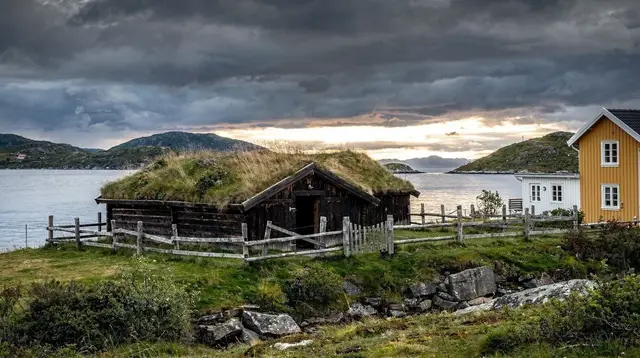
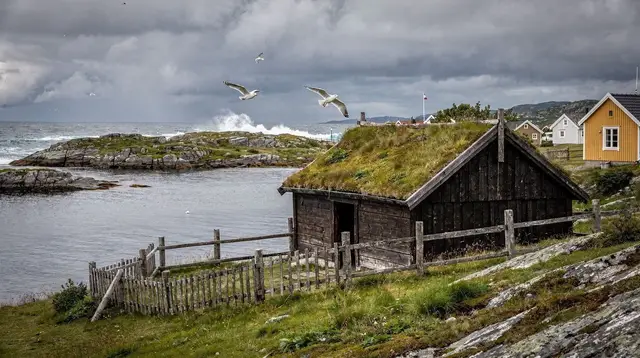
Avaldsnes: Norway's Ancient Viking Royal Seat
What is Avaldsnes and is it the same as Sverd i Fjell?
Avaldsnes is a Viking-age royal site on Karmøy island near Haugesund, with a reconstructed longhouse called Nordvegen Viking Farm and a medieval church. It is a separate site and story from Sverd i Fjell at Hafrsfjord near Stavanger, which is a modern sculpture commemorating a different ninth-century battle.
A Reconstructed Farm With a Real Claim on History
Avaldsnes sits on the island of Karmøy, a short way from Haugesund and roughly an hour and a half north of Stavanger by car. At its centre is Nordvegen Viking Farm, a reconstructed longhouse standing beside a genuinely old stone church, on ground that local tradition and a body of historical evidence connect to Norway’s early kings. It is a small site compared to Stavanger’s museums, but it carries an outsized weight in the story of how Norway came to be a single kingdom — a story that overlaps in period, but not in place, with Sverd i Fjell near Stavanger.
This guide covers what Avaldsnes actually is, why the location mattered enough to become a royal seat, what you see at Nordvegen Viking Farm today, and how the site fits into a wider visit to Karmøy and Haugesund. For the fuller logistics of getting between Stavanger, Haugesund and Karmøy in one outing, see the dedicated Haugesund and Karmøy day trip guide rather than expecting that ground repeated here.
Why a Narrow Strait Became a Royal Seat
The strait running past Avaldsnes, known historically as Karmsundet, was a sheltered shortcut on the long coastal sailing route that connected the Norwegian coast from south to north — a route some sources link to the older name behind the country’s own name, Norway. Whoever controlled this narrow passage controlled a chokepoint that ships preferred to the exposed open sea outside Karmøy. That, more than anything else, is the practical reason Avaldsnes grew into a place of power rather than a location chosen for a view or a harbour alone.
Historical and archaeological tradition places early Norwegian rulers at Avaldsnes across the period usually associated with the country’s unification, the ninth and tenth centuries. The site is often described as one of Norway’s oldest royal seats, predating Stavanger’s own emergence as a town, which is conventionally dated to the consecration of its cathedral around 1125. Avaldsnes, in other words, was already old business by the time Stavanger’s own recorded history begins.
Nordvegen Viking Farm: What You Actually Walk Into
Nordvegen Viking Farm is a reconstruction — a Viking-age longhouse rebuilt on or near its original site, furnished to suggest how such a building was used, along with outbuildings and grounds. It is not a large open-air museum on the scale of some Scandinavian sites; treat it as a focused, single-site visit rather than a full day out, and pair it with something else on Karmøy if you want to fill an afternoon.
Inside the longhouse, the interior is built around a central hearth and long benches, the kind of space where a Viking-age household, and its retainers or guests, would have eaten, worked and slept under one roof. Costumed interpretation and guided storytelling are common ways these sites bring the space to life, and a guided visit generally gets more out of the building than walking through it alone, since much of what matters here is context rather than visible artefacts.
a combined cruise that stops at the Viking farm and the Viking Planet exhibits is one way to see Avaldsnes without driving yourself, folding the transfer and some interpretation into a single outing from Haugesund.
The Church and the King’s Grave
Standing directly beside the reconstructed farm is Avaldsnes church, a stone building with roots in the medieval period, built on ground that had already carried religious and political significance for centuries before its own construction. The churchyard and surrounding fields hold burial mounds and standing stones, among them a large mound long associated in local tradition with a Viking-age king’s grave. As with much of the deepest Viking-age history, some of the specific attributions here rest on tradition and later written sagas rather than contemporary documentation, and it is worth treating them with that appropriate caution rather than presenting every claim as settled fact.
The pairing of an active-looking medieval church with reconstructed Viking-age buildings just outside its walls is part of what makes Avaldsnes worth the detour: it compresses several centuries of Norwegian religious and political history into one small, walkable site.
Avaldsnes and Sverd i Fjell: Same Period, Different Place
This is the point worth getting right before you plan anything: Avaldsnes and Sverd i Fjell are not the same site, do not tell the same story, and are not close to each other.
| Avaldsnes | Sverd i Fjell | |
|---|---|---|
| Location | Karmøy, near Haugesund | Hafrsfjord, near Stavanger |
| What it is | A reconstructed Viking farm and a medieval church on a real royal-seat site | Three modern bronze swords planted in rock, unveiled in 1983 |
| Historical anchor | Long tradition of early royal residence, ninth-tenth centuries | The Battle of Hafrsfjord, traditionally dated to 872 |
| Distance from Stavanger | About 1.5 hours by car | About 15-20 minutes by car |
| What you visit | Buildings, church, grounds, guided interpretation | An outdoor monument on the shoreline, free to view |
Both sites sit within the broad period of Norway’s unification under Harald Fairhair, and both get folded into the same national story in guidebooks and museum panels — which is exactly why they get confused. But one is a monument commemorating a battle near Stavanger; the other is an actual settlement site, with a church and reconstructed buildings, on a different island near a different city. If your itinerary only has room for one, decide based on geography first: Sverd i Fjell suits a short stop near Stavanger, Avaldsnes suits a trip that already includes Haugesund or Karmøy.
For a closer look at Sverd i Fjell on its own terms, including the battle it commemorates and the mythology attached to it, see the separate Sverd i Fjell guide and the related Sverd i Fjell blog piece.
Karmøy Beyond Avaldsnes
Avaldsnes is one stop on Karmøy, an island with more to it than this single site, though this guide keeps the focus narrow rather than duplicating a full island itinerary. Skudeneshavn, on the island’s southern tip, is a well-preserved wooden-house town with a very different, much later character than Avaldsnes — worth knowing about if you have extra time on Karmøy, even though it sits outside the scope of a Viking-history visit. Karmøy also connects north toward Haugesund, the town most visitors use as their base or starting point for reaching Avaldsnes.
If Viking-age history is the specific thread you are pulling on for this trip, it is also worth knowing that Stavanger itself has an indoor complement to Avaldsnes: a VR-based Viking experience housed in the city, useful on a day when weather or time rules out the trip north. See the Viking House Stavanger VR guide for what that indoor alternative actually involves, and how it differs from an outdoor site like Avaldsnes.
Getting There From Stavanger or Haugesund
Avaldsnes is reachable by car from both Stavanger and Haugesund, and the practical routing differs enough between the two that it is worth separating them plainly.
| Starting point | Approximate drive | Notes |
|---|---|---|
| Stavanger | About 1.5 hours | Longer drive; usually paired with a Haugesund stop rather than done alone |
| Haugesund | About 20-30 minutes | Short hop; easiest base for an Avaldsnes visit |
| Karmøy (other points) | Varies, generally short | Island roads connect most of Karmøy without a ferry |
Public buses run on Karmøy and toward Haugesund, but a self-driven visit or an organised tour with transfers included is considerably simpler for most visitors, since bus schedules to a specific rural site like Avaldsnes are not built around tourist timing. If you are weighing whether to rent a car at all for this part of Norway, the wider car-or-no-car guide covers the trade-offs in more depth than makes sense to repeat here.
Ways to Visit Without Renting a Car
For visitors staying in Haugesund or arriving there for the day, several tours bundle Avaldsnes into a wider look at the town and its surroundings, removing the need to arrange your own transport to a fairly rural site.
a guided VR Viking museum experience based in the Stavanger area is a useful alternative or complement if your schedule cannot stretch to the trip north to Karmøy, giving a Viking-age framing without leaving the city.
Other Haugesund-based options put Avaldsnes into the context of the wider region rather than treating it as an isolated stop:
a Haugesund tour that pairs the town with a visit to a local mountain farmer gives a different, more rural and contemporary side of the region alongside the historical material at Avaldsnes, useful if you want more than Viking history out of a single day around Haugesund.
For visitors who want to combine the region’s history with its landscape rather than choosing between them, a guided hike out of Haugesund is worth considering on a separate day from the Avaldsnes visit itself — see the Himakånå hike guide for what that involves.
When to Go and What to Expect
Like most outdoor and semi-outdoor sites in this part of Norway, Avaldsnes is more comfortable to visit in the milder months, roughly May through September, when longer daylight and drier ground make walking the grounds and standing outside the longhouse more pleasant. Winter visits are possible, since the church and much of the site are not dependent on a hiking trail the way Preikestolen or Kjeragbolten are, but check opening details before planning a winter trip, since staffing and interpretation at smaller heritage sites tend to be reduced outside the main season.
Bring the same practical mindset that applies across Rogaland: expect rain and wind to be possible in any season, and dress for weather rather than for a forecast. None of this is a Preikestolen-scale physical undertaking — Avaldsnes is a flat, walkable site — but standing outside a reconstructed longhouse in a coastal downpour is not an uncommon experience here.
Planning Avaldsnes Into a Wider Trip
Because Avaldsnes sits closer to Haugesund than to Stavanger, it fits most naturally into an itinerary that already treats Haugesund and Karmøy as a unit, rather than as a rushed add-on to a Stavanger-based day. If you are building a longer trip around Rogaland’s Viking-age sites specifically, it is worth planning Avaldsnes and Sverd i Fjell as two separate stops on two separate days or legs, given the distance between them, rather than trying to combine them into one exhausting loop.
A short, focused visit — the longhouse, the church, the grounds, perhaps one guided tour — is enough to get what Avaldsnes offers. It rewards visitors who arrive knowing roughly what they are looking at rather than expecting a large museum experience, and it rewards separating it clearly, in your own head and your itinerary, from the very different bronze swords standing on the shore near Stavanger.
a scenic minibus tour covering Haugesund’s highlights is one further option for visitors basing themselves in the town and wanting Avaldsnes folded into a broader look at the area without self-driving.
Avaldsnes and the Viking Farm: Practical Questions
Is Avaldsnes the same place as Sverd i Fjell?
No. Avaldsnes is on Karmøy near Haugesund and centres on a reconstructed Viking farm and an old church tied to early Norwegian kingship. Sverd i Fjell is a set of three large bronze swords planted in rock at Hafrsfjord, near Stavanger, marking a separate ninth-century battle. Both belong to the same broad period of Norwegian unification, but they are different sites with different stories, roughly an hour’s drive apart.
What can you actually see at Avaldsnes?
The core of a visit is the reconstructed Viking longhouse at Nordvegen Viking Farm, the medieval stone church next to it, and the surrounding grounds where several burial mounds and standing stones survive. It is a compact site that rewards an hour or two rather than a full day, unless you combine it with other stops on Karmøy.
Why is Avaldsnes considered historically important?
Avaldsnes sits on a narrow, sheltered stretch of the historic north-south sailing route along the Norwegian coast, which made it a natural point of control and, according to long-standing local and historical tradition, an early royal seat associated with the unification period of the ninth and tenth centuries.
Do you need a car to get to Avaldsnes?
A car is the easiest way to reach Avaldsnes, since it sits on Karmøy some way from central Haugesund and further still from Stavanger. Public transport connections exist but involve more changes, so most independent visitors either drive or join an organised tour that includes the transfer.
Can Avaldsnes be combined with a Haugesund trip?
Yes, and this is how most visitors approach it. Avaldsnes works well as one stop within a wider look at Haugesund and Karmøy rather than as a standalone day, since the town, the coastline and Avaldsnes itself sit within a similar radius of each other.
Is Nordvegen Viking Farm a full-day museum like the petroleum museum in Stavanger?
No. It is a small, focused site built around one reconstructed longhouse and its immediate surroundings, closer in scale to a single historic building than to a large museum. Set expectations accordingly and plan a shorter visit.
What does the name Avaldsnes have to do with the name Norway?
One widely repeated explanation ties the old name for this stretch of coast, sometimes rendered as Nordvegen, meaning roughly the way north, to the later name Norway itself. It is a compelling story rather than a settled etymological fact, and worth presenting as tradition rather than certainty.
tours.viking-history
Verified deep-linked GetYourGuide tours. Book through these links and we earn a small commission at no cost to you.
GetYourGuide does not provide a product photo for this activity — the image shows the meeting point, photographed by us.