A Day Trip to Haugesund and Karmøy: Norway's Viking Route
Can you do Haugesund and Karmøy as a day trip from Stavanger?
Yes, but treat it as a full day, not a quick outing. Haugesund and Karmøy lie well north of Stavanger, and getting there and back eats a much bigger share of your day than a Lysefjord-area trip does, before you have even stopped anywhere.
Why go north at all
Almost everyone who lands in Stavanger points their day trips south and east, toward Preikestolen and the Lysefjord. That instinct makes sense — the fjord is the headline attraction, and it is genuinely close. But it also means the north gets skipped by travelers who never had a reason to look that way, and that is a shame, because Haugesund and Karmøy offer something the fjord side simply does not: a concentrated stretch of Viking-age and early Norwegian royal history, anchored by Avaldsnes, one of the most significant historical sites in the country.
This guide is about how to structure that day sensibly. It will not walk you through every exhibit at Avaldsnes or every stop on Karmøy’s so-called Viking Route in detail — those sites each have their own dedicated pages under the site’s Viking history category, and duplicating that content here would only make this page longer without making it more useful. What this page does is help you decide whether the trip fits your schedule, get the logistics right, and avoid the single biggest mistake people make when planning it.
The mistake to avoid: treating this like a Lysefjord trip
Here is the pitfall, stated plainly. A boat out onto the Lysefjord, or a drive to the Preikestolen trailhead, can be arranged and executed within a morning or an afternoon because those destinations sit close to Stavanger. Haugesund and Karmøy do not. They lie a substantial distance to the north, and the road and ferry connections between Stavanger and that part of Rogaland mean the journey itself takes a real bite out of your day — often more time than you would spend actually getting to and from the fjord.
If you plan this the way you would plan a quick trip to Sandnes or a short excursion just outside the city, you will arrive later than expected, feel rushed at every stop, and either skip Avaldsnes entirely or see it at a sprint. The fix is simple: block out a full day, start early, and accept that a meaningful chunk of that day is transit. Do not schedule anything else — no Lysefjord cruise, no long city walk in Stavanger — either side of it.
How to get there
You have three realistic options, in roughly ascending order of convenience and descending order of flexibility.
Driving yourself. This gives you full control over the day and lets you decide on the spot whether to linger at Avaldsnes, detour to a Karmøy viewpoint, or cut the day short if the weather turns. The route north from Stavanger involves stretches of the E39 and, depending on which crossing you use, a car ferry or two — factor that into your timing, since ferries run on a schedule, not on demand. Build in buffer time rather than cutting it close.
A guided day tour. Several operators run half-day and full-day tours out of Haugesund itself, and at least one runs directly from Stavanger. This is the lower-effort option: someone else handles the driving, the ferry timing, and the route planning, and you can focus on the sites rather than the logistics. It is worth it if you would rather not drive Norwegian roads for the first time on unfamiliar terrain, or if you are traveling without a car at all.
Public transport. Kolumbus buses connect Stavanger and Haugesund, but this is the slowest option and the least flexible once you are on Karmøy, where sites are spread out and bus frequency drops. Unless you are committed to a car-free trip on principle, treat this as a fallback rather than the default — see the guide on whether you need a car in Stavanger if that question is on your mind more broadly.
| Option | Flexibility | Effort | Best for |
|---|---|---|---|
| Own car | Highest | You do the driving and ferry timing | Travelers comfortable with Norwegian roads and ferries |
| Guided tour | Moderate | Low | First-time visitors, no car, want the history explained |
| Public transport | Lowest | Moderate | Strict budget, no time pressure |
A realistic shape for the day
Start early — earlier than you would for a Lysefjord trip, given the extra distance. A workable outline looks like this:
- Early departure from Stavanger. Aim to be on the road, ferry, or bus before mid-morning at the latest, since arrival in Haugesund already accounts for a meaningful part of your day.
- Haugesund first. Use the town as your base and orientation point before heading out to Karmøy. A short walking tour or a scenic minibus loop covers the town’s harbor and center efficiently if you do not want to spend the whole morning here.
- Karmøy and Avaldsnes in the middle of the day. This is the core of the trip. Avaldsnes rewards an unhurried visit, so give it real time rather than treating it as a photo stop on the way to somewhere else.
- One additional Karmøy stop, if time allows. Depending on your pace, a second site along the Viking Route or a short coastal stretch can fit in before you need to start back.
- Return with margin. Build in slack for the return ferry or drive — Norwegian road and ferry schedules are not forgiving of a late start back, and you do not want to be racing a ferry departure at the end of a long day.
Trying to compress this further, or adding a stop back in Stavanger on the way home, is how the day falls apart. Keep it simple: north, Karmøy, back.
Haugesund itself
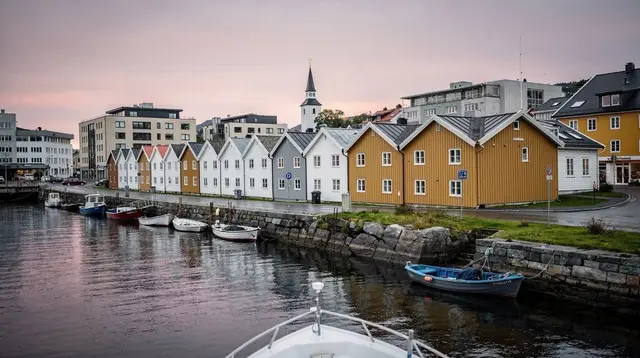
Haugesund is a working coastal town rather than a tourist set piece, and that is part of its appeal — it gives the day a different texture from the more curated experience of central Stavanger. It makes a sensible first stop and a natural base for the Karmøy leg of the trip, since Karmøy connects to the mainland right at Haugesund’s edge.
Rather than listing every attraction here, this guide points you to the town’s dedicated coverage: a scenic minibus tour, a hop-on hop-off bus, and city e-bike routes are all reasonable ways to get an efficient overview of Haugesund if your time there is limited, which — given the distance from Stavanger — it probably will be.
Karmøy and the Viking Route
Karmøy is where the day’s real substance is. The island carries an outsized share of early Norwegian history for its size, and Avaldsnes in particular is often described as one of the country’s oldest royal seats — a site with a documented connection to Norwegian kingship stretching back over a thousand years. Its position on the historic sailing route along the Norwegian coast is precisely why it mattered: ships heading north or south had reason to pass close by, and whoever controlled that stretch of water controlled a lot.
This guide will not attempt to summarize the site’s full history here — the dedicated Avaldsnes guide covers that properly, including what the reconstructed farm and church actually show visitors. What matters for planning purposes is simply this: give Avaldsnes real time, and think of the rest of Karmøy’s Viking Route sites as worthwhile additions if your schedule allows, not as a checklist you need to complete in one visit.
If you are interested in how this history connects to the more famous swords planted outside Stavanger, the Sverd i Fjell guide covers the Battle of Hafrsfjord and its traditional role in the unification of Norway — a story that overlaps thematically with what you will see at Avaldsnes, even though the sites themselves are on opposite sides of the region.
Weighing this trip against your other options
Stavanger visitors with limited time almost always face a choice between spending an extra day on Lysefjord-side activities and using that day for something like this instead. There is no universally right answer, but a few honest distinctions help:
- If your priority is dramatic landscape and hiking, another day around the Lysefjord or a hike near Himakåna will serve you better than Haugesund and Karmøy.
- If your priority is history — specifically Viking-age and early royal Norwegian history — this trip delivers something the fjord side does not have.
- If you are short on time overall, be honest about the travel distance before committing. A rushed version of this trip, arriving late and leaving early, does not do Avaldsnes justice.
- If you have already spent a day on Rogaland’s other day-trip option toward Ryfylke and Månafossen or the beaches of Jæren, this trip offers real variety rather than more of the same.
For a longer stay, several multi-day itineraries build Haugesund and Karmøy in properly rather than squeezing them into a single rushed day — worth a look if your schedule has any flexibility at all.
Booking the day
If you would rather not plan the route and ferry timing yourself, a guided option removes most of the friction. A half-day tour covering the region’s highlights around Haugesund is a solid option if your time is limited and you want an efficient overview without driving yourself. For the Karmøy side specifically, a shore excursion out to Karmøy and its Norwegian cultural history departing from Haugesund covers the Viking Route sites without you needing to navigate the island’s back roads on your own.
If hiking appeals to you more than history for at least part of the day, a guided hike up Himakåna with a local guide is worth considering as a way to add some elevation and views to what would otherwise be a day of driving and walking flat sites.
Practical notes
Pack for changeable coastal weather regardless of season — this part of Rogaland shares the same wet, mild-in-winter, cool-in-summer climate as Stavanger itself, and there is little shelter at outdoor sites like Avaldsnes. Wear shoes suited to uneven ground rather than city footwear, since several of Karmøy’s historic sites are outdoor grounds rather than paved courtyards.
If you are relying on ferries as part of your route, check the current schedule the morning you travel rather than the night before — Norwegian ferry timetables shift with season, and a missed sailing can cost you an hour or more you do not have to spare on a trip this long. And if you are flying in or out around this trip, note that Sola airport sits on the opposite side of Stavanger from the road north, so factor that into airport-day planning if this excursion falls close to your arrival or departure.
Haugesund and Karmøy: frequently asked questions
How far is Haugesund from Stavanger?
Haugesund sits well north of Stavanger, far enough that the round trip is a genuine commitment. It is not comparable to the short hop out to the Lysefjord side of Rogaland, and you should budget real hours of driving or transit time each way.
Do I need a car to visit Haugesund and Karmøy?
A car gives you the most flexibility, since Karmøy’s sites are spread out and public transport between them is limited. A guided tour from Haugesund is the practical alternative if you would rather not drive.
What is the Viking Route around Karmøy?
It is the loose name for a string of historically significant sites on Karmøy, anchored by Avaldsnes, that trace Norway’s early royal and Viking-age history. Each site has its own depth, and this guide is a planning overview rather than a substitute for visiting them.
Is Avaldsnes worth the detour?
For anyone interested in Viking-age and early Norwegian royal history, yes. It is the main reason most visitors extend a Haugesund trip out to Karmøy rather than stopping in the town itself.
Should I choose Haugesund and Karmøy over another Lysefjord trip?
They answer different questions. Choose Haugesund and Karmøy for history and a change of scenery from fjord walls; choose the Lysefjord side again if hiking and dramatic landscape are what you came for.
Can I combine Haugesund with Preikestolen in one day?
Not realistically. Both are substantial half-day-plus commitments in opposite directions from Stavanger, and combining them in a single day leaves too little time at either to be worthwhile.
Day trips on GetYourGuide
Verified deep-linked GetYourGuide tours. Book through these links and we earn a small commission at no cost to you.
GetYourGuide does not provide a product photo for this activity — the image shows the meeting point, photographed by us.